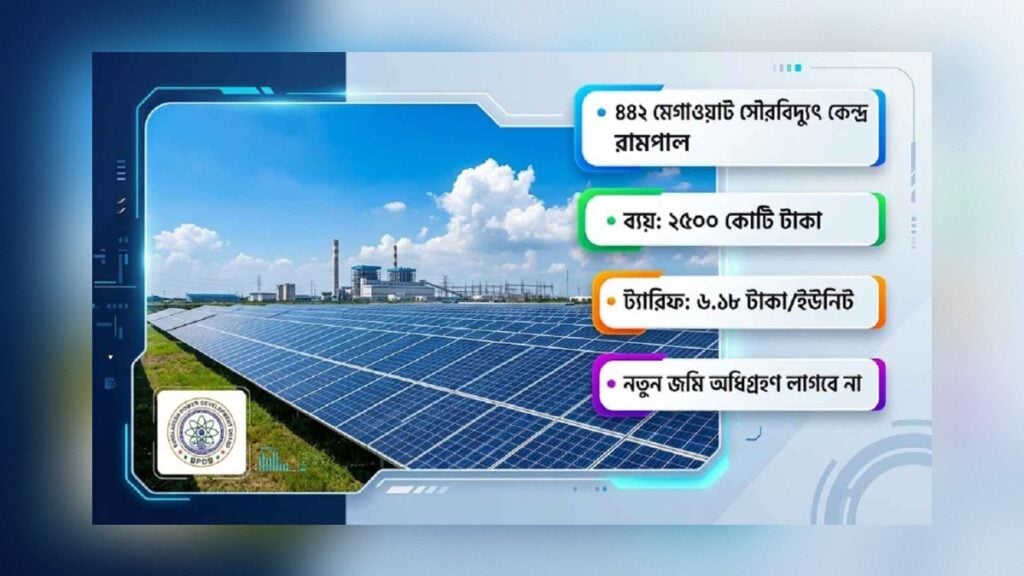
A 442-megawatt solar power project in Rampal, Bagerhat, has been approved by the Executive Committee of the National Economic Council (ECNEC), bringing renewed attention to a renewable energy initiative that, according to former State Minister for Power, Energy and Mineral Resources Nasrul Hamid Bipu, dates back to the previous Awami League government.
The approval has prompted a political debate over the origins of the project. While the current administration and media outlets aligned with it have presented the initiative as a new undertaking, Hamid has argued that the groundwork for the Rampal solar project was laid several years ago, including efforts to secure foreign investment from Saudi Arabia.
In a social media post, the former state minister said his government had initiated discussions with ACWA Power, a major Saudi company involved in renewable energy, to develop solar power generation capacity in Bangladesh.
According to Hamid, Saudi Ambassador to Bangladesh Essa bin Yousuf Alduhailan visited his office on 10 November 2022, when preliminary discussions were held over the signing of a memorandum of understanding with ACWA Power. He said, however, that negotiations between the relevant parties had begun before the ambassador’s visit.
The original plan was considerably larger than the project now approved. ACWA Power was expected to invest around US$1.5 billion to develop 1,000 megawatts of solar power in Bangladesh, while the Bangladesh Power Development Board (BPDB) was to facilitate the provision of the required land.
As part of that plan, ACWA Power and the BPDB signed a memorandum of understanding on 28 November 2022. The proposed investment was intended to support two major solar facilities: a 500MW plant at Rampal in Bagerhat and another 500MW facility at Matarbari.
Hamid said negotiations with Saudi Arabia had reached an advanced stage by July 2024. Had the process proceeded as planned, construction work was expected to begin by the end of that year, he claimed.
The former state minister also attributed the subsequent halt in the initiative to the political transition after 5 August. He alleged that the negotiations with Saudi Arabia were discontinued after the change in government, bringing the earlier investment process to a standstill.
The financial structure of the newly approved project also marks a significant difference from the earlier proposal, according to Hamid. He said the previous government had sought to attract about US$1.5 billion in foreign investment for the broader solar initiative, whereas a part of the project is now being pursued with domestic funding at an estimated cost of around Tk 2,500 crore.
The availability and previous preparation of land at Rampal is another element Hamid cited in support of his claim that the project has a longer history.
He said the BPDB acquired 1,834 acres of land in Rampal in 2012 for the development of a coal-fired power plant. Part of that land was subsequently used for the Maitree Super Thermal Power Plant. The remaining Block B area, he said, had already undergone land development and boundary-wall construction during the Awami League government’s tenure.
The history of the site therefore forms an important part of the discussion surrounding the newly approved solar project. While the present 442MW scheme is not identical in scale to the earlier 500MW Rampal proposal, Hamid’s account suggests that its location, land preparation and the broader concept of large-scale solar generation were considered under the previous administration.
The latest ECNEC approval now moves the 442MW project into a new phase. Its implementation will depend on the project’s detailed financing arrangements, technical planning, land use and subsequent construction work.
The debate over its origins is likely to continue, particularly because the current project differs from the earlier proposal in both capacity and financing structure. What remains clear from the former state minister’s account is that discussions over large-scale solar generation at Rampal, including efforts to attract Saudi investment, were already under way well before the latest approval.
The project also comes amid Bangladesh’s broader efforts to expand renewable energy generation. Solar power has emerged as a key option for increasing electricity production from non-fossil sources, although the success of large-scale projects ultimately depends on financing, land availability, grid connectivity and timely implementation.
For Rampal, the newly approved 442MW facility represents the latest stage in a process whose planning and preparatory work, according to Hamid, began during the previous government and evolved through several years of negotiations and site development.