Staff Reporter,
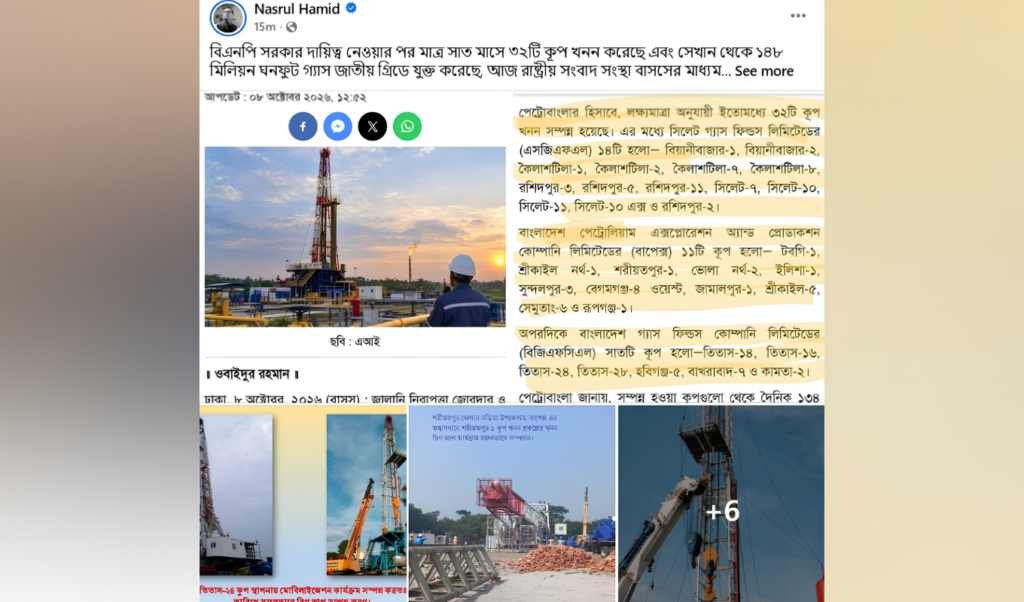
Former State Minister for Power and Energy Nasrul Hamid has questioned the claim that the BNP government drilled 32 wells within seven months of taking office and added 148 million cubic feet of gas per day to the national grid.
He alleged that the planning and drilling of several wells included in the list had already begun during the Awami League government. He argued that before presenting all 32 wells as achievements of the current government’s first seven months, the history and timeline of each project should be made public.
Nasrul Hamid raised the questions in a Facebook post on Thursday, 8 October. Referring to a report published by the state news agency on the drilling of 32 wells, he said it was important to clarify when work on each well had started and which government had overseen the various stages of implementation.
According to Nasrul Hamid, drilling a new well is not a process that can normally be completed within a few days. It involves several stages, including site selection, geological and seismic surveys, feasibility assessments, project approval, financing, drilling, testing and eventual production. He therefore argued that the claim that the entire process for 32 new wells had been completed within seven months should be examined against the projects’ earlier preparations and timelines.
Wells whose work began under the Awami League government
In his Facebook post, the former state minister named several wells, including Tobgi-1, Ilisha-1, Bhola North-2, Srikail North-1, Shariatpur-1, Kailashtila-8, Sylhet-10 and Titas-24. He claimed that work on several of these wells had already started and progressed during the Awami League government.
Citing Ilisha-1 as an example, he said the discovery of a gas-bearing layer there had been confirmed as early as April 2023. Meanwhile, drilling at Kailashtila-8 began on 11 January 2024. A report published on 24 May that year stated that drilling had been completed and that preparations were under way to supply around 21 million cubic feet of gas per day from the well to the national grid.
Work on the Begumganj-4 (West) well also began on 29 April 2024. Nasrul Hamid therefore pointed out that the work on at least several of the wells had started before the political changeover on 5 August 2024.
Nasrul Hamid highlights the 50-well programme
The former state minister said that, after the Covid-19 period, his government had undertaken a special programme in response to the country’s growing gas demand and the realities of domestic production.
Under the programme, the target was to drill and carry out workovers on 50 wells by 2025, with the aim of adding around 648 million cubic feet of gas per day to domestic supply.
He also said a further programme had been planned to drill and carry out workovers on 100 wells between 2025 and 2028. The programme was expected to have the potential to add around 985 million cubic feet of gas per day, according to his post.
Nasrul Hamid claimed that a sector-based report published in October 2024 had stated that drilling on 15 wells under the 50-well programme had been completed. The wells listed, according to him, were Bhola North-2, Tobgi-1, Ilisha-1, Srikail North-1, Shariatpur-1, Titas-24, Beanibazar-1, Kailashtila-2, Sylhet-10, Rashidpur-2, Sundarpur-3, Titas-14, Rashidpur-5, Kailashtila-8 and Begumganj-4 (West).
Drilling a well is not the same as supplying gas
Nasrul Hamid also stressed that discovering gas in a well does not automatically mean that the gas can immediately be supplied to the national grid.
Before supply can begin, the necessary well-related work must be completed, the gas must be tested, and collection and processing facilities must be established. Pipeline connections are also required to transport the gas into the national distribution system.
In this context, he cited the example of a new processing plant with a capacity of 45 million cubic feet per day that was installed to handle additional gas from the Haripur gas field.
He said a project that begins under one government but is completed by a subsequent government can legitimately form part of the latter’s achievements. However, he argued that claiming sole credit for an entire project without presenting its history and relevant records would not provide a complete picture.
Call for a detailed well-by-well list
Nasrul Hamid questioned whether the government would publish details showing which of the 32 wells were newly drilled during the past seven months, which had begun earlier, and when gas from each well was actually connected to the national grid.
He called for a comprehensive list containing the date work began on each well, project approval details, funding allocations, rig deployment, completion of drilling and the date on which gas was added to the national grid.
According to him, making project documents, financial allocations, reports from Petrobangla and field-level information publicly available would provide a clearer picture of the government’s actual achievements during its first seven months and the continuity of projects initiated under the previous government.
The report on the 32 wells stated that work on all 32 had been completed within seven months and that they were supplying around 147.9 million cubic feet of gas per day to the national grid.
However, detailed clarification from the relevant authorities regarding when work on each well began and how the different stages of the projects were implemented would help establish a clearer account of the contribution made by the current government and the work inherited from earlier administrations.