India’s Rajasthan State Consumer Disputes Redressal Commission has upheld an order requiring The New India Assurance Company Limited to pay 75 per cent of the insured value of a tourist bus set ablaze by an angry mob following a fatal road accident in June 2019.
The commission, based in Jodhpur, dismissed appeals filed by both the bus owner, Jairam, and the insurance company. The decision leaves intact an earlier order issued by District Consumer Commission-II in Jodhpur, which awarded compensation equivalent to 75 per cent of the vehicle’s insured value of Rs 38 lakh.
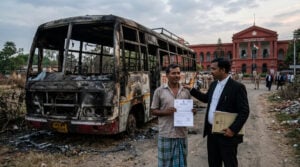
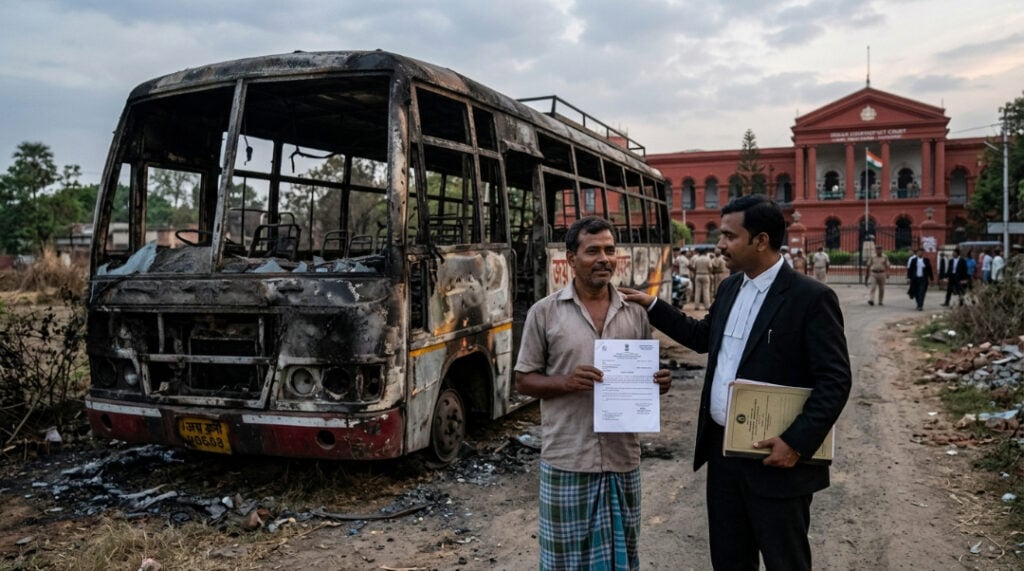
The case arose when the tourist bus was travelling from Barmer to Haridwar and collided with a motorcycle near Phalsund in Rajasthan. The motorcyclist died in the accident, triggering anger among people at the scene. An agitated crowd subsequently set fire to the bus, causing extensive damage.
Following the incident, Jairam informed the insurer and submitted a claim for the loss. An appointed surveyor inspected the damaged vehicle and classified it as a total loss. Such an assessment indicates that the damage is sufficiently extensive for the vehicle to be treated as a complete loss for insurance purposes.
Despite the surveyor’s findings, the insurance company rejected the claim, alleging that the bus had been operated in breach of the conditions of its policy. The insurer argued that the vehicle had been used as a stage carriage rather than as a contract carriage, which was the basis on which it should have operated under the relevant arrangements.
The distinction between the two categories was central to the dispute. A stage carriage generally carries passengers along a specified route, allowing them to board and alight at different points. A contract carriage, by contrast, is engaged under an arrangement to transport a particular person or group from one place to another. The insurer maintained that the bus’s alleged use as a stage carriage violated the policy terms and undermined the owner’s entitlement to compensation.
Jairam challenged the rejection before the district consumer commission. After considering the complaint, the commission directed the insurer to pay 75 per cent of the insured amount. The owner subsequently appealed, seeking the full value of the policy, while the insurance company challenged the compensation order in an attempt to avoid the payment.
During the proceedings, the state commission took account of the fact that Jairam held an All India Tourist Permit. The permit authorised him to transport a party or its members from one location to another. This was relevant to the dispute over whether the vehicle’s use was consistent with its authorised purpose and the conditions of the insurance policy.
The district commission had also considered the driver’s decision to pick up passengers from the roadside. It treated this conduct as contributory negligence and limited the compensation accordingly. Rather than awarding the entire insured value, the commission decided that the owner should receive 75 per cent of the amount.
The Rajasthan State Consumer Disputes Redressal Commission, comprising president Devendra Kachhawaha and member Liaquat Ali, upheld the district commission’s decision and dismissed both appeals.
With the original order remaining in force, the compensation amounts to Rs 28.5 lakh, representing 75 per cent of the bus’s insured value of Rs 38 lakh. The owner’s request for full compensation was unsuccessful, while the insurer also failed to overturn the payment order.
The dispute illustrates how disagreements over policy conditions can complicate insurance claims, even when a vehicle has been assessed as a total loss. A surveyor’s assessment of physical damage does not, by itself, settle every question surrounding a claim; the insurer may also examine whether the vehicle was being used in accordance with the policy and applicable permit conditions.
Consumer dispute commissions provide a forum for examining such disagreements and assessing the arguments advanced by both policyholders and insurers. In this case, the state commission left the partial compensation award unchanged after rejecting both parties’ challenges.
The ruling therefore preserves a compromise between the competing positions: the bus owner retains the right to partial compensation, but his demand for the full insured amount has not been accepted. The insurer, meanwhile, remains subject to the district commission’s direction to pay the awarded sum.