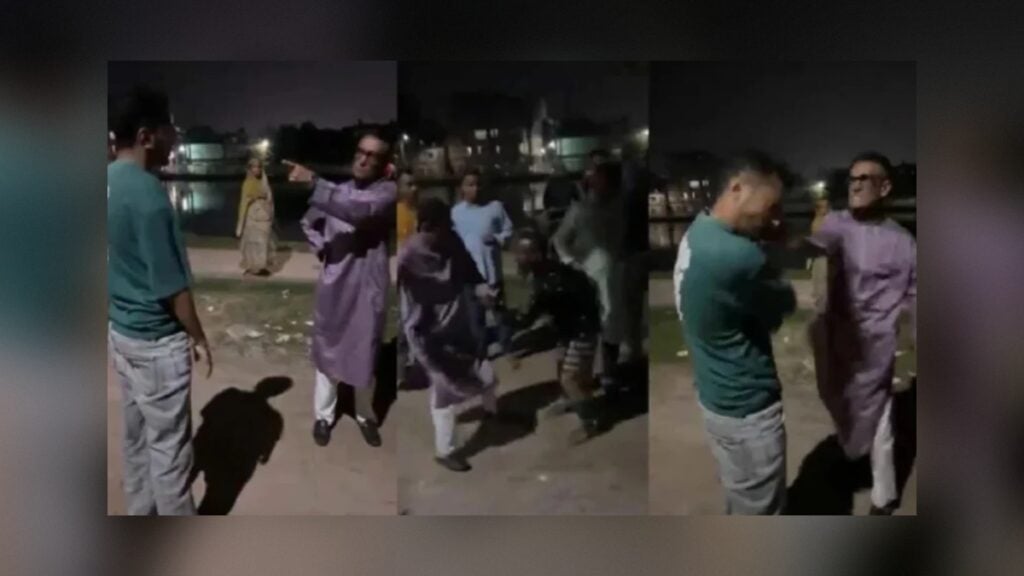
A controversial anti-drug operation led by Barishal Metropolitan BNP Convener Moniruzzaman Faruk has sparked criticism after footage showing several individuals being physically assaulted during the operation circulated on social media.
The incident has raised questions about the legal authority of political leaders to conduct anti-drug raids, particularly as no police officers or other law enforcement personnel were present during the operation.
The incident occurred at approximately 9 pm on Tuesday, 20 October, near the Chest Disease Hospital in Ward No. 4 of Barishal city.
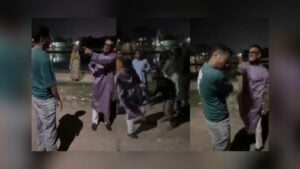
A video lasting three minutes and 39 seconds, widely circulated on social media, shows Faruk and several party activists detaining and searching a group of individuals. Some of those detained were subsequently brought before the BNP leader for questioning.
During the questioning, two young men were seen being slapped, while several others appeared to be beaten with plastic pipes. The footage has prompted debate over the methods employed by the political activists and the legitimacy of their actions.
Navid Rahman Tushar, member secretary of the Barishal Metropolitan unit of Jatiyatabadi Chhatra Dal, said the operation was carried out following complaints from local residents about suspected drug-related activities in the neighbourhood.
According to Tushar, four individuals were detained while allegedly consuming drugs. They were later released following requests from local elders and their guardians.
He acknowledged, however, that the police had not been informed before the operation.
Defending the initiative, Moniruzzaman Faruk said the incident had taken place in his own neighbourhood, where four or five individuals were detained during the operation.
When asked about the physical assaults, Faruk expressed dissatisfaction with the handling of suspected drug offenders by law enforcement agencies.
“What is the point of involving law enforcement agencies? They simply release them. So we gave them a beating and released them ourselves,” he said.
His remarks have intensified the controversy, with questions emerging over whether political activists can detain, interrogate or physically punish individuals accused of drug-related offences.
Meanwhile, police officials have confirmed that they had no involvement in the operation.
Sub-Inspector Rezaul Islam Reza, officer-in-charge of the Amanatganj Police Outpost, said BNP leaders had neither informed the police about the operation nor sought their assistance.
He confirmed that no members of any law enforcement agency were present at the scene.
Officials from the Department of Narcotics Control have also questioned the legal basis of the operation.
Md Tanvir Hossain Khan, deputy director of the department in Barishal, said individuals were not authorised to conduct such operations without the involvement of law enforcement authorities.
He expressed concern that the operation had taken place near his office, yet he had only learnt about the incident afterwards.
The controversy has also drawn reactions from senior BNP figures.
Akon Kuddusur Rahman, the party’s central assistant organising secretary for Barishal division, said he supported initiatives aimed at combating drug abuse but emphasised that enforcement operations were the responsibility of the administration.
He maintained that political leaders and activists could assist police in efforts to address drug-related offences, rather than independently conducting operations.
The legal implications of the incident have also attracted attention.
Supreme Court lawyer Abu Al Raihan said that only the Department of Narcotics Control and authorised law enforcement agencies had the legal authority to conduct such anti-drug operations.
He described Faruk’s actions as unlawful, arguing that political figures or members of the public could not independently assume the powers of law enforcement authorities.
According to the lawyer, if local residents apprehend individuals suspected of involvement in drug-related offences, they should hand them over to the appropriate law enforcement agencies rather than impose punishment themselves.
The incident has highlighted the distinction between community participation in preventing drug abuse and the exercise of powers reserved for authorised authorities.
While cooperation from residents can help identify suspected drug-related activities, allegations of criminal conduct do not justify physical punishment outside the legal process.
The Barishal operation has consequently prompted questions about the responsibilities of political activists, the treatment of suspected offenders and the importance of maintaining legal safeguards during efforts to combat drug abuse.
With the video circulating on social media and officials questioning the legitimacy of the operation, the incident has brought renewed attention to accountability and the boundaries of political involvement in law enforcement activities.