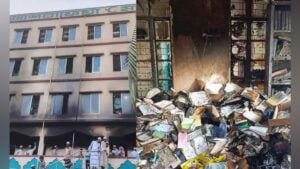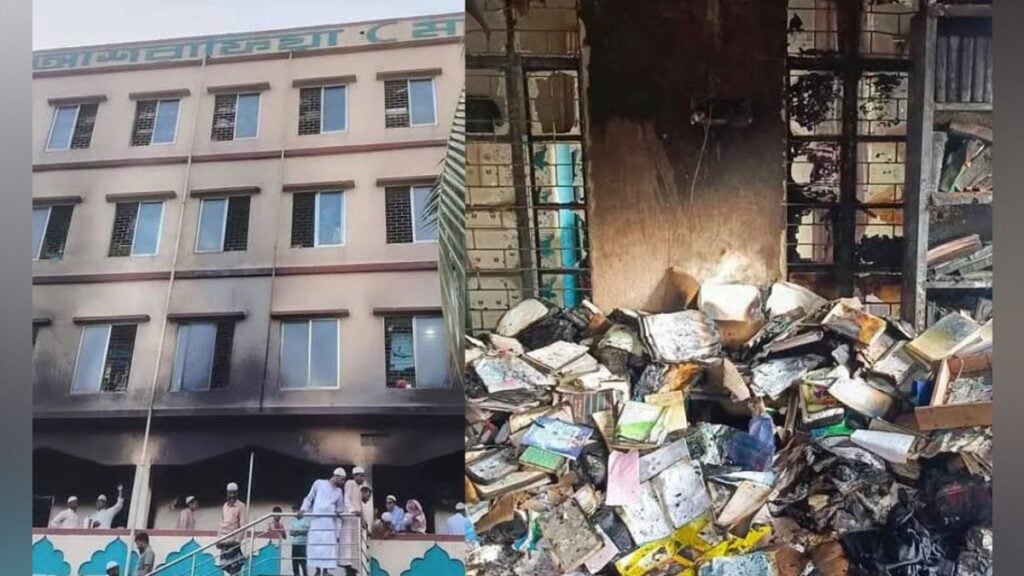
The fire broke out at around 1.55am on Tuesday in the library on the second floor of the five-storey building of Jamia Ashrafia Madrasa. Thick smoke quickly spread through different parts of the building, causing panic among students who were inside at the time.
Sultan Mahmud Sikder, a resident physician at the National Institute of Burn and Plastic Surgery, confirmed that 63 students had been brought to the hospital following the incident. He said three of them required intensive care because of the severity of their condition.
The critically ill students have been identified as Yusuf, 18, Khairul, 22, and Jobayer, 18. One of the three is being supported by a ventilator, indicating the seriousness of his respiratory condition.
According to the physician, information provided by the affected students suggests that an electrical short circuit may have triggered the fire. Smoke spread rapidly through the madrasa building, leaving several students struggling to breathe.
The incident caused considerable panic among those staying in the residential institution. As smoke filled the building, students rushed to get out, while some experienced breathing difficulties after inhaling the fumes. Several reportedly suffered injuries to their respiratory tracts as a result of prolonged exposure to the smoke.
Shahjahan, duty officer at the Kachpur Fire Service, said firefighters received information about the blaze at 1.55am. Four fire service units were subsequently dispatched to the scene to tackle the fire and prevent it from spreading further.
Firefighters worked for nearly two hours before bringing the blaze under control at 3.44am. Their operation focused on extinguishing the flames inside the second-floor library, where the fire had originated.
Partha Haldar, a firefighter at Kachpur Fire Station, said the blaze broke out in the madrasa’s second-floor library and generated a substantial amount of smoke. Several students were asleep when the incident occurred and became ill after inhaling the fumes. They were subsequently taken to hospital for medical treatment.
The library was reportedly gutted in the fire, according to students admitted to hospital. However, the full extent of the damage to the institution has yet to be established.
Regarding the possible cause, Haldar said it would only be possible to determine what had triggered the fire after a proper investigation. Initial suspicions point to either a mosquito coil or an electrical short circuit, although neither possibility has been confirmed.
The incident has once again drawn attention to fire safety arrangements in residential educational institutions, where large numbers of students often sleep in shared accommodation. Fires in such buildings can become particularly dangerous when smoke spreads through corridors and sleeping areas before occupants have time to respond.
Electrical installations, fire extinguishers, emergency exits and evacuation arrangements are essential safeguards in institutions of this kind. Thick smoke can pose a serious threat even when flames remain confined to a relatively small area, particularly for people who are asleep or unfamiliar with emergency escape procedures.
For now, the immediate concern remains the condition of the three critically ill students and the recovery of those receiving treatment. The precise cause of the fire and the extent of the damage will become clearer once the relevant authorities complete their investigation.