Mishkatul Mashiat, a student at Dhaka University, has heard successive explosions over the past few days while travelling from her home in Dhanmondi to the campus. What worries her most is that attackers appear able to detonate crude bombs near police officers in public places and escape without being apprehended.
She has also expressed frustration with the government and the university administration, accusing them of failing to take visible steps to protect students.
“Although there have been several cocktail explosions on and around the campus over the past few days, the university administration has taken no visible action. It feels as though the administration is asleep,” she said.
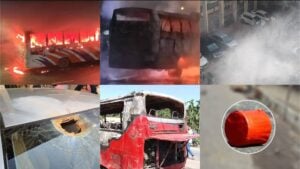
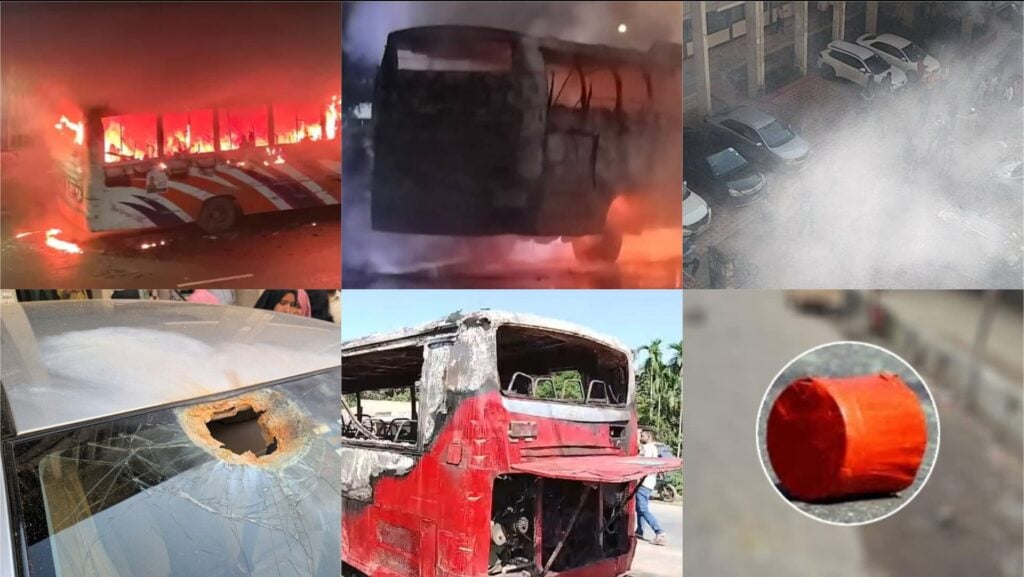
The recent surge in violence has coincided with heightened political tensions following former prime minister Sheikh Hasina’s announcement that she plans to return to Bangladesh by December. Against this backdrop, hand bombs have exploded in several locations, buses have been set alight and a sleeping bus driver has died in one of the fires.
Concern has also spread beyond the capital after two grenade-like objects were discovered near the main entrance to Shah Makhdum Airport in Rajshahi.
Although police have sought to reassure the public that there is no security crisis, Mishkat remains unconvinced. Her concerns extend to animals on the university campus, where she is involved in animal welfare activities.
She fears that indiscriminate bomb attacks could injure stray dogs and other animals as well as people.
“The way hand bombs are being thrown indiscriminately means dogs could also be injured at any moment,” she said.
Violence threatens business and public confidence
The deteriorating security situation is also causing concern among business leaders, who warn that continued unrest could undermine commercial activities and damage Bangladesh’s international reputation.
Md Fazlul Hoque, administrator of the Federation of Bangladesh Chambers of Commerce and Industry (FBCCI), the country’s apex trade organisation, said the violence was affecting both social life and economic activity.
“The ongoing violence is affecting not only social life but also business and commerce. Conducting business has become risky in an environment of insecurity. At the same time, the country’s image is being damaged internationally,” he told TIMES.
An uncertain security environment can affect business operations in several ways, including the movement of goods, transport arrangements and employees’ ability to reach workplaces safely. Persistent unrest may also weaken confidence among investors and business partners.
Mohammad Aynul Islam, a professor of political science at Dhaka University, believes the repeated explosions and arson attacks should not be treated merely as isolated criminal incidents. In his assessment, the pattern of violence is generating widespread fear and uncertainty.
He was at the university’s Faculty of Business Studies when an explosion occurred and witnessed students running in panic. He said he had not expected to see such an atmosphere on campus in the aftermath of the July uprising.
“People look to the government to ensure the security of their lives and property. If the government cannot restore security, people’s fear will not go away,” Aynul said.
Offering a political explanation, he argued that a lack of mutual trust between the government and opposition parties could create opportunities for a third party to exploit the situation. Political organisations, he said, need to establish at least a minimum level of understanding and confidence to prevent further instability.
He also pointed out that banning a political party does not necessarily bring all its organisational activities to an end. Similar incidents had occurred in the past as groups sought to demonstrate their continued presence, he added.
Commuters increasingly afraid of travelling
The fear generated by the recent incidents is no longer limited to university students or residents of particular neighbourhoods. Repeated explosions and arson attacks on roads, around educational institutions, on public transport and near important installations have made ordinary journeys increasingly stressful.
Many people now worry about being caught in a bomb attack while walking along a street or finding themselves trapped inside a burning bus.
Afsana Mimi, a student at Bangladesh University of Professionals, experienced this fear first-hand after a bus was set on fire in the busy Farmgate area of Dhaka last Monday evening.
When an automatic fire alarm sounded, passengers and pedestrians waiting inside the station area began rushing about in panic. The smoke and sudden movement of the crowd created further confusion.
While trying to escape, Mimi injured her foot. Unable to decide where to go, she eventually took shelter inside a shop at Farmview Super Market.
“Now I feel afraid whenever I leave home, wondering who might throw a bomb and from which direction. I am afraid to get on a bus too, thinking someone might set it on fire at any moment,” she told TIMES.
Reports of buses being torched in Dhaka have emerged since last week, with further incidents involving explosives and arson reported in several parts of the country.
The attacks have raised particular concerns about the safety of passengers, drivers and transport workers, many of whom have little opportunity to escape when a vehicle catches fire.
Explosions reported around Dhaka University
Dhaka University and several other educational institutions have become among the most concerning locations in the recent wave of incidents.
On Tuesday, two hand bombs exploded at the university’s Faculty of Business Studies and in the Shadow area. One person was seriously injured. Students were also left frightened after a hand bomb was thrown at a vehicle belonging to a university teacher.
Police recovered two unexploded hand bombs and a handwritten note from an area in front of Dhanmondi 32. The note contained the phrases “Bangladesh Muktir Dak 71” and “Joy Bangla, Joy Mujibbad”.
In a separate incident, a box wrapped in a white bag and marked with red tape was discovered beneath an ashwattha tree on the grounds of Haji Muhammad Mohsin Hall at Dhaka University.
Flowers and a letter were found inside the box. The letter contained an obscure message referring to participants in the 2024 July movement as “miscreants”. The circumstances surrounding the placement of the box and the purpose of the message remained unclear.
Several other explosions were reported in different parts of the capital the previous night.
Students detained a person after a cocktail exploded in front of the second gate of Titumir College. Explosions were also reported outside the Bangladesh Road Transport Authority (BRTA) office in Mirpur 13 and at Technical Intersection.
A bag containing unexploded hand bombs was recovered from beneath the TSC Metro Station, prompting further concern over the security of public spaces.
Other reported incidents took place at Chowdhurypara in Malibagh, outside the second gate of Jagannath University, near the entrance to Bangla College, outside Southeast University in Tejgaon and in front of World University and Shanto-Mariam University in Uttara.
The concentration of incidents around educational institutions has raised questions about the safety of students, teachers and staff, particularly during busy hours when campuses and surrounding roads are crowded.
Meanwhile, a Basumati Paribahan bus was set on fire in Mirpur 11.
The Special Response Battalion (SRB) said it had arrested two Chhatra League members in Adabar. Six petrol bombs and 950 grams of gunpowder were reportedly recovered from them.
Suspicious objects found at Rajshahi airport
The security concerns have extended to important installations outside Dhaka.
On Tuesday morning, two grenade-like objects were discovered beside the main entrance to Shah Makhdum Airport in Rajshahi. A passer-by spotted the objects at around 11am and alerted the police.
Security was subsequently tightened around the airport as authorities responded to the discovery. A bomb disposal unit later destroyed the objects.
Power, Energy and Mineral Resources Minister Iqbal Hassan Mahmood was inside the airport’s VIP lounge when the incident occurred. For security reasons, he was escorted out through the rear gate rather than the main entrance.
The discovery raised concerns about the potential vulnerability of sensitive public installations, particularly as the country was already witnessing a series of explosions and arson attacks.
Arson and clashes spread to other districts
The violence has also been reported in Khulna, Shariatpur, Gopalganj, Cox’s Bazar, Khagrachhari and several other districts.
In Khulna, a railway carriage parked at a train-washing plant caught fire. On the same night, the BNP office in Batiaghata upazila was also set alight.
Police detained six suspects in connection with an arson attack on the BNP office in Guimara, Khagrachhari.
In Jazira, Shariatpur, leaders and activists of the Awami League, Jubo League and Chhatra League blockaded the south toll plaza of the Padma Bridge.
Hand bombs exploded during the blockade, while several vehicles were vandalised. Toll collection remained suspended for around an hour, leaving vehicles stranded on both sides of the bridge and disrupting traffic.
Clashes also broke out between police and leaders and activists of the Awami League and its affiliated organisations in Gopalganj. A police vehicle was set on fire during the confrontation.
To bring the situation under control, six platoons of Border Guard Bangladesh (BGB) personnel were deployed in the district.
Cox’s Bazar also witnessed a series of explosions on Monday night. Seven crude bomb and petrol bomb explosions were reported at different locations.
The incidents occurred in the Kalatali and New Market areas of the town, as well as outside Cox’s Bazar Medical College, at Link Road, near Ramu Government College and in front of a school in Eidgaon.
The incidents added to growing concerns about the spread of violence beyond the capital, particularly in areas where public movement and commercial activities depend heavily on stable security conditions.
Bus driver killed in Faridpur fire
One of the most tragic incidents occurred at the new bus terminal in Faridpur town, where a parked bus was set on fire while its driver was sleeping inside.
The driver, identified as Md Kalachan Sheikh, died after inhaling smoke. He was unable to escape the burning vehicle.
His death has highlighted the human cost of arson attacks, which place not only passengers but also drivers, transport workers and others in immediate danger.
Buses have also been set on fire in several other locations, including Dhaka, Gazipur, Manikganj and Naogaon.
The incidents have intensified concerns across the transport sector, where drivers and workers are increasingly exposed to risks while vehicles remain parked at terminals or operate on busy roads.
Police investigating possible organised sabotage
The growing number of explosions and arson attacks has prompted questions about the effectiveness of law enforcement operations and the ability of authorities to prevent further incidents.
Particular concern has centred on how attackers manage to escape after detonating explosives near crowded roads, university campuses and important installations.
Mohammad Akhtar Hossain, deputy commissioner of the Media and Public Relations Division of Dhaka Metropolitan Police (DMP), said the incidents might have different underlying causes. However, investigators were examining whether a particular group was carrying out or attempting sabotage to create public panic.
“Different incidents may have different causes. However, the police are considering the possibility that a group is carrying out or attempting sabotage to create panic among the public,” he told TIMES.
He said investigators were also looking into the possibility that individuals might be using other people to carry out attacks without appearing physically at the scenes themselves.
Police officers working in the field are coordinating with intelligence officials to establish the circumstances surrounding the incidents, identify those responsible and determine whether the attacks are connected.
The investigation is expected to examine the nature of the explosives, the methods used in the attacks and the possible involvement of organised groups.
Growing demand for visible security measures
The successive incidents have created a climate of uncertainty across the country. For students, commuters and business owners, concerns about security are increasingly becoming part of everyday life.
The attacks have also exposed the wider consequences of instability. Educational activities can be disrupted, transport services may become unreliable, businesses face operational risks and public confidence in law enforcement can weaken.
The death of the Faridpur bus driver has further demonstrated how attacks on public transport can have fatal consequences, even for people who are not directly involved in political or other disputes.
Political tensions may provide a backdrop to the current unrest, but establishing responsibility for individual incidents requires proper investigation and evidence. Authorities will need to distinguish between isolated criminal acts and any coordinated attempts to destabilise the country.
Restoring public confidence will depend not only on arresting suspects after attacks but also on preventing incidents before they occur. Effective intelligence gathering, visible security around vulnerable locations, prompt investigations and accountability will be essential.
For many ordinary citizens, the immediate expectation is straightforward: they want to travel to work, attend classes and use public transport without fearing sudden explosions or fires.
Until that confidence is restored, the continuing wave of violence is likely to remain a major source of anxiety for people across Bangladesh.