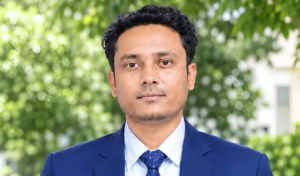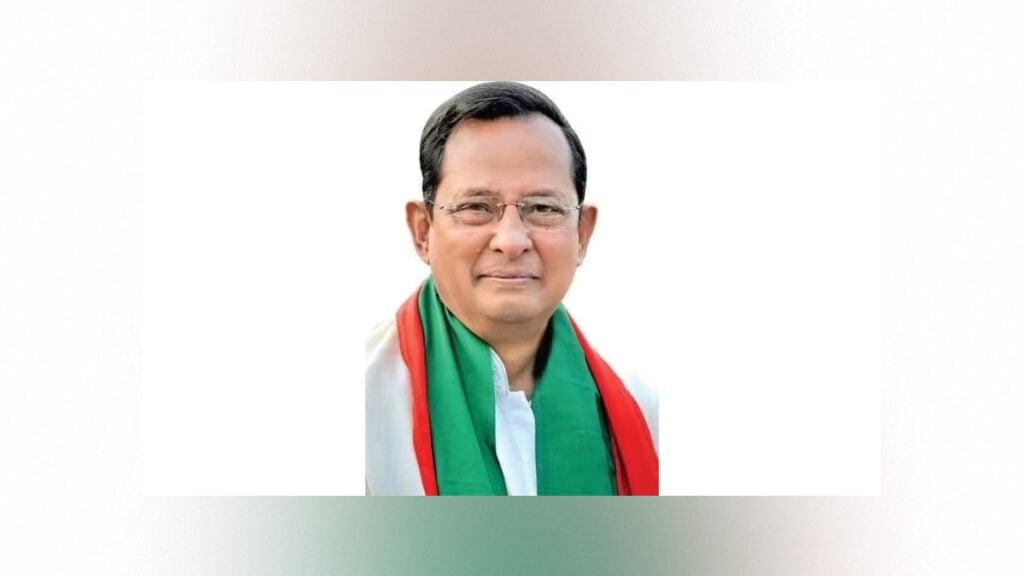
Hasanul Haq Inu, president of the Jatiya Samajtantrik Dal (Jasod), former Information Minister and one of the organisers of Bangladesh’s Liberation War, turns 80 on 12 November. Born on 12 November 1946, Inu has spent more than five decades in the country’s political arena, with a career spanning the struggle for independence, post-independence socialist politics, movements against military rule and parliamentary democracy.
His milestone birthday, however, is being marked in prison. For his family, political colleagues, supporters and well-wishers, his detention on the occasion carries particular significance given his long involvement in the country’s independence movement and subsequent democratic struggles.
Early life, education and entry into politics
Inu was born to AHM Kamrul Haq and Begum Hasna Hena. He was the eldest of their six children, comprising five sons and a daughter. Raised in an educated and culturally minded family, he developed an early interest in academic pursuits, discipline, leadership and sport.
He completed his secondary education at Karnaphuli Paper Mill High School in Chandraghona, in the Chattogram Hill Tracts region, before attending the renowned Notre Dame College in Dhaka. He subsequently enrolled in the Chemical Engineering Department of the then East Pakistan University of Engineering and Technology, now Bangladesh University of Engineering and Technology (BUET).
Alongside his studies, Inu established himself as an athlete and footballer. He was recognised as an athlete in East Pakistan and played first-division football in Dhaka. His involvement in sport was an important part of his student life, but the political upheaval of the 1960s would eventually shape the course of his career.
In 1968, he joined the Bangladesh Chhatra League and became actively involved in the movement for greater autonomy for East Pakistan. He took part in the campaign surrounding the Six-Point Movement, announced by Bangabandhu Sheikh Mujibur Rahman, which became a central platform for the Bengali people’s demand for political and economic rights.
During the mass uprising of 1969, Inu emerged as an active student leader and became general secretary of the BUET unit of Chhatra League. His growing involvement in politics gradually took precedence over the conventional professional path that might have followed his engineering studies.
Preparing for independence and organising the Liberation War
Inu’s political activities before the Liberation War included involvement in organised demonstrations and military-style parades that reflected the growing demand for independence.
On 15 February 1969, he led a military parade organised by Chhatra League under the initiative of the Swadhin Bangla Nucleus. The event was held in protest against, and in remembrance of, the killing of Sergeant Zahurul Haq, one of the accused in the Agartala Conspiracy Case, inside Dhaka Cantonment. The force involved later became known as the Joy Bangla Bahini.
On 7 June 1970, during the observance of the historic Six-Point Day and Self-Rule Day at Paltan Maidan in Dhaka, Inu led another parade by the Joy Bangla Bahini and formally saluted Sheikh Mujibur Rahman. Such activities formed part of the wider effort to prepare the Bengali population for a more organised resistance to Pakistani rule.
In January 1971, he was reportedly involved in leading an operation at the Science Laboratory in Dhaka as part of preparations for an armed struggle. On 23 March that year, observed by the independence movement as Resistance Day rather than Pakistan’s Republic Day, he formally hoisted the flag of Bangladesh in accordance with the programme announced by the Swadhin Bangla Chhatra Sangram Parishad. He also saluted the student leaders present at the event.
After the Liberation War began, Inu became involved in the military training activities of the Bangladesh Liberation Front (BLF), widely known as the Mujib Bahini, in India. He served as camp-in-charge at the Tanduwa training centre, where he was involved in organising and training guerrilla fighters. His activities during this period remain among the defining chapters of his political life.
The formation of Jasod and revolutionary politics
Following Bangladesh’s independence in 1971, Inu was appointed general secretary of the newly established Jatiya Krishak League in 1972. The organisation sought to mobilise farmers and promote a programme of socialist transformation in agriculture. Inu became involved in building agricultural organisations in different parts of the country and maintaining political contacts with former members of the Mujib Bahini.
On 31 October 1972, the Jatiya Samajtantrik Dal, commonly known as Jasod, was founded. Inu joined the new party and was elected to its central executive committee in 1973. Jasod emerged as a distinct socialist political force in the turbulent political landscape of post-independence Bangladesh. Inu became one of its prominent organisers and political thinkers.
As the party faced restrictions and repression, he took on a role as deputy chief of its Biplobi Gonobahini, or Revolutionary People’s Army. The organisation was headed by Colonel Abu Taher, a decorated Liberation War officer.
The political situation changed dramatically after the assassination of Sheikh Mujibur Rahman on 15 August 1975. Inu became involved in efforts to build political unity against the government of Khondaker Mostaq Ahmad. He also played an organisational role alongside Colonel Taher in the Sipahi-Janata Biplob, or Soldiers and People’s Uprising, of 7 November 1975.
The upheaval was followed by a period of political uncertainty and military intervention. Inu was arrested on 23 November 1975. In 1976, a special military court sentenced Colonel Taher to death and handed prison terms to Inu and other leaders. Inu remained behind bars until his release on 13 June 1980.
After his release, he worked to re-establish contact with Jasod leaders and activists across the country and became involved in organising opposition to military rule.
Opposition to military rule and the democratic movement
In March 1982, General Hussain Muhammad Ershad seized power and imposed military rule, prompting a broad movement against his government. Inu became involved in efforts to organise political opposition, including the formation of student platforms and the coordination of different political parties.
He played a role in the process that brought together the Awami League and other political forces in the 15-Party Alliance. The alliance sought to build a common platform against authoritarian rule and restore democratic government.
In 1986, Inu was elected general secretary of Jasod. As the political landscape and alliance arrangements evolved, he also took part in efforts to establish a five-party alliance after the 15-party grouping broke up.
The movement against Ershad reached its climax in the mass uprising of 1990, which eventually brought down the military-backed government. Inu was involved in efforts to maintain coordination among opposition parties and formulate political strategies and programmes during the campaign.
After Ershad’s fall, Inu continued to work towards unity among left-wing and democratic political forces. He also helped bring Jasod into the movement led by Shaheed Janani Jahanara Imam, which demanded the prosecution of those accused of committing crimes during the 1971 Liberation War.
In 1997, Inu was elected general secretary of a united Jasod. Five years later, in 2002, he became the party’s president, taking responsibility for its overall leadership.
The 14-party alliance and parliamentary career
Between 2001 and 2004, Inu was involved in discussions and political coordination aimed at bringing progressive and pro-Liberation War parties under a broader political platform. These efforts contributed to the formation of the 14-party alliance on 15 July 2005, with the Awami League and several other political parties.
During the political crisis surrounding the 2007-08 period, commonly referred to as the One-Eleven episode, Inu supported holding an early election and transferring power to a government elected by the people. He sought to build public support for a return to an elected administration.
In the ninth parliamentary election in 2008, Inu was elected as a member of parliament from Kushtia-2. He retained the seat in the 2014 and 2018 parliamentary elections.
On 13 September 2012, he was appointed Information Minister. He held the position until January 2019. During his tenure, he addressed issues relating to the expansion of information technology, wider access to the internet, the development of the media sector and the facilitation of information flows.
As a minister and parliamentarian, Inu also spoke on issues including good governance, the rule of law, accountability, corruption prevention and the rights of working people. He repeatedly identified communalism, religious extremism, militancy and political forces opposed to the ideals of the Liberation War as challenges to Bangladesh’s democratic and secular state principles.
Political thinker, organiser and writer
Inu’s public life has extended beyond party organisation and parliamentary politics. He is also known as a political thinker, essayist and author. His writings have addressed socialist philosophy, the nature of the state, democracy, constitutional governance, political alliances, the legacy of the Liberation War and the changing course of Bangladesh’s political development.
He has remained involved in political negotiations, the formulation of protest programmes and the development of strategies for alliances. His career has therefore encompassed three major arenas of political activity: street movements, party organisation and parliamentary debate.
His long political journey has also been marked by controversy and differing assessments of his role in important events. As a participant in several defining periods of Bangladesh’s history, his record remains a subject of political discussion and historical evaluation.
An 80th birthday in prison
The circumstances surrounding Inu’s 80th birthday stand in sharp contrast to his decades in public life. He was arrested in Uttara, Dhaka, on 26 August 2024 and has remained in custody since then.
Several cases have been filed against him. On 30 June 2026, International Crimes Tribunal-2 delivered a verdict in a case concerning crimes against humanity linked to the events of July and August 2024. The tribunal found him guilty on three of the eight charges and sentenced him to 10 years’ imprisonment on each count. As the sentences were ordered to run concurrently, the total prison term was set at 10 years. He was acquitted of the remaining five charges.
Inu subsequently appealed against the verdict, seeking acquittal. The prosecution also appealed, seeking an increase in his sentence to the death penalty. The legal proceedings are therefore continuing, and the appeals remain an important part of the case.
Jasod and Inu’s lawyers have said that he has faced harassment and legal complications through multiple cases since his arrest. His family and party have described the cases against him as politically motivated. These are their stated positions; the allegations and the tribunal’s findings remain matters to be addressed through the judicial process.
His detention at the age of 80 has prompted concern among family members, political colleagues and supporters. It has also brought renewed attention to questions of due process, judicial transparency, political differences and the protection of human dignity. Ensuring a fair and impartial legal process remains essential, irrespective of an individual’s political identity or past public role.
Eight decades shaped by political struggle
Inu’s political life has intersected with several major chapters in Bangladesh’s history: the student movements of the 1960s, the mass uprising of 1969, the struggle for independence and the Liberation War, the emergence of socialist politics after 1971, resistance to military rule, the mass uprising of 1990, the formation of the 14-party alliance and the practice of parliamentary democracy.
His role in these events has attracted both recognition and criticism, and his political record remains open to debate. Yet his long participation in the country’s political movements makes him a significant figure in the history of Bangladesh’s post-independence politics.
On his 80th birthday, Jasod has expressed its wishes for his good health, longevity, dignity and justice. The party has also called for the establishment of the rule of law, arguing that justice should take precedence over political vengeance and that democratic coexistence should be strengthened despite differences of opinion.
For Inu’s family, colleagues and supporters, the occasion is both a moment to reflect on his long political career and a reminder of his present circumstances.
Happy 80th birthday, Comrade Hasanul Haq Inu.