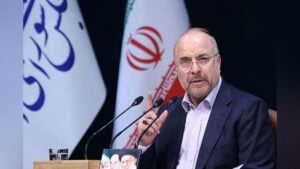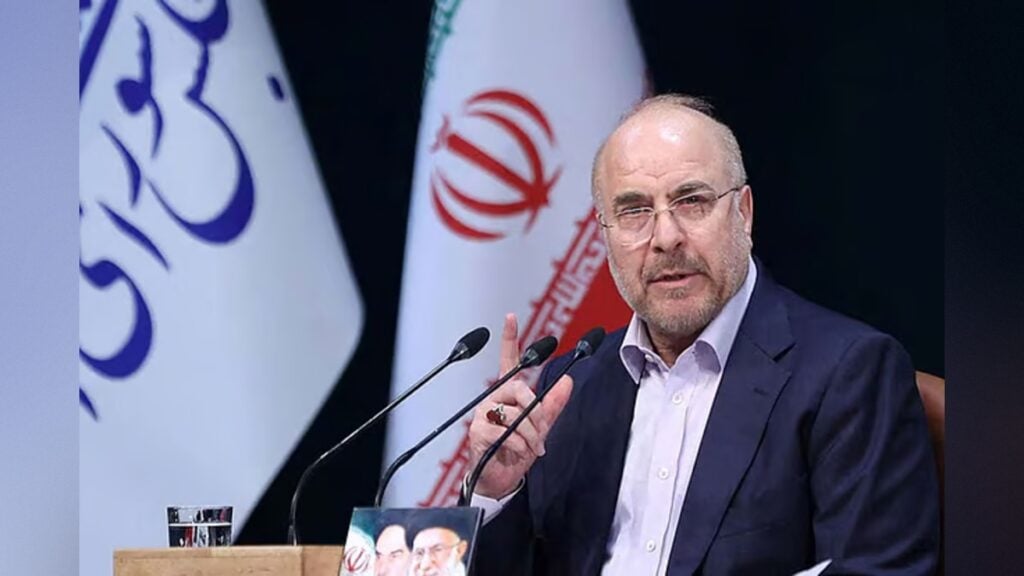
In an exclusive interview with Al Jazeera, published on Wednesday, Ghalibaf said Iran and Oman had reached an understanding over the management and oversight of the important maritime passage. He described the arrangement as part of a broader seven-point proposal put forward by Tehran to bring an end to the conflict, which he said had continued for nearly eight months.
Ghalibaf is leading Iran’s negotiations aimed at securing an end to the war. His comments indicate that the future status of the Strait of Hormuz is likely to be a central issue in any eventual agreement with Washington.
Explaining Iran’s position on the waterway, the parliamentary speaker argued that there was no open water or international waters within the Strait of Hormuz. He maintained that the provisions of the 1982 United Nations Convention on the Law of the Sea (UNCLOS) did not apply to the passage.
According to Ghalibaf, the rules governing the strait are determined by the domestic laws of the two coastal states, Iran and Oman.
His remarks reflect Tehran’s intention to assert a greater role in determining the future arrangements for the waterway. However, the legal status of international navigation through the strait remains a significant issue, given its importance to global shipping and energy supplies.
The Strait of Hormuz connects the Persian Gulf with the Gulf of Oman and the Arabian Sea. It is one of the world’s most strategically important energy transit routes, carrying substantial volumes of crude oil and liquefied natural gas from Gulf producers to international markets. Any restrictions or changes to its operating arrangements could therefore have far-reaching consequences for global trade and energy prices.
Seven conditions put forward for peace
During the interview, Ghalibaf said Tehran had delivered a clear message to Washington through Qatari mediators, outlining seven conditions for achieving peace.
Iran is now waiting for an official response from the United States, he said, adding that the next move was Washington’s responsibility.
“The ball is in America’s court,” Ghalibaf said.
Among the conditions outlined by Iran are the lifting of the naval blockade and economic sanctions imposed by the United States, the release of Iranian funds frozen abroad, an end to hostilities across all fronts and a formal declaration bringing the war to a close.
The speaker said these demands formed part of an understanding reached during negotiations in Islamabad, Pakistan, in June. Tehran considers their implementation essential before entering formal negotiations with the United States.
Ghalibaf indicated that Iran remained open to reaching an agreement, provided Washington did not introduce additional demands or take actions that could undermine confidence between the two sides.
He said an agreement would be possible if the United States respected the existing understanding and refrained from behaviour that could create further mistrust.
The conditions suggest that Iran is seeking more than an immediate halt to military operations. Tehran also wants economic relief, the release of frozen assets and assurances that the conflict will not resume.
Lack of trust remains the biggest obstacle
Ghalibaf identified the absence of trust between Tehran and Washington as the principal obstacle to finalising an agreement.
“The main obstacle to finalising an agreement is our lack of trust in the United States,” he said.
The statement highlights the longstanding tensions between the two countries, whose diplomatic relations have remained deeply strained over sanctions, security concerns and regional conflicts.
Iran wants Washington to demonstrate that it is prepared to honour its commitments before Tehran agrees to move forward with a formal settlement. For the Iranian leadership, assurances alone may not be sufficient; concrete steps on sanctions, financial restrictions and military operations are likely to be essential.
Ghalibaf also referred to Russia’s possible involvement in diplomatic efforts. He claimed that, during a visit to Moscow, US officials had asked Russian President Vladimir Putin to help mediate direct negotiations with Tehran.
Although he did not provide further details about the alleged request, his remarks pointed to the potential role of Moscow in facilitating communication between the two sides.
Russia maintains diplomatic relations with both Iran and the United States, although their interests and positions on the conflict differ. Any mediation effort could provide another channel for dialogue if direct negotiations encounter difficulties.
Ghalibaf warns Trump against further military action
The Iranian parliamentary speaker also issued a warning over the possibility of fresh US military action against Iran.
Ghalibaf said US President Donald Trump could face another defeat if Washington launched a new attack. He also predicted that Trump would come under political pressure from the new Congress, which is due to take office next January.
His remarks appear intended to discourage Washington from considering another military confrontation while negotiations remain possible.
The comments come against the backdrop of continuing tensions over the future of the conflict and the strategic importance of the Strait of Hormuz. For Iran, the waterway is not simply a shipping route but also a major element of its regional security and geopolitical influence.
For the United States and other countries dependent on energy supplies from the Gulf, maintaining freedom of navigation through the strait remains a significant concern.
Any new restrictions, changes to maritime oversight or disagreements over jurisdiction could affect international shipping and increase uncertainty in energy markets.
The immediate focus is now on Washington’s response to Tehran’s seven-point proposal. Whether the two sides can overcome their deep mistrust and agree on a framework for ending the conflict remains uncertain.
Ghalibaf’s latest remarks, however, make one point clear: Iran is seeking a post-war arrangement in which the Strait of Hormuz operates under conditions substantially different from those that existed before the conflict.