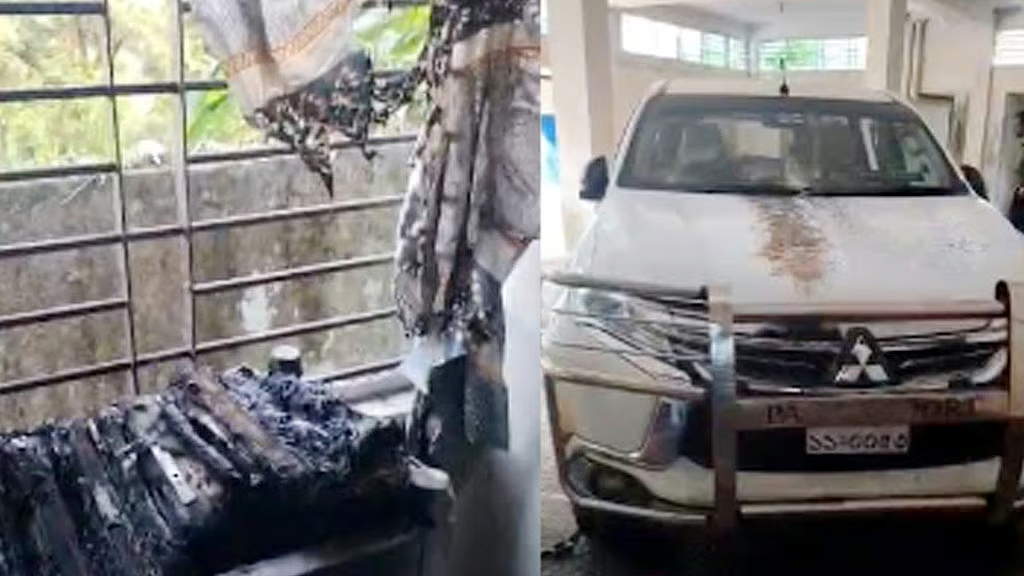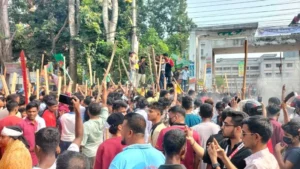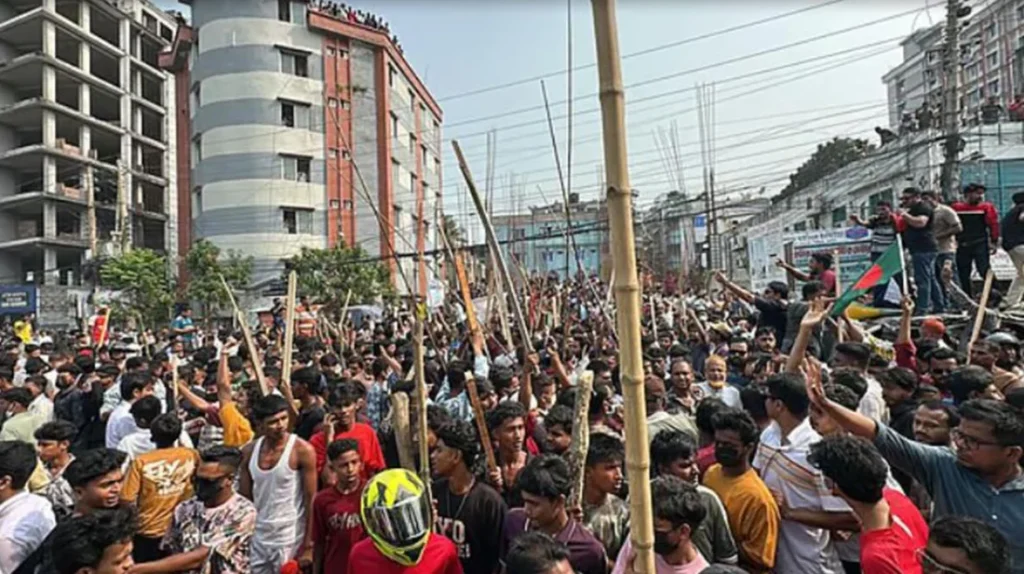
Leaders and activists of the Awami League, whose political activities are currently restricted, staged an armed demonstration and rally in Gopalganj town on Sunday, 15 November, ahead of their announced 19 November lockdown programme. According to local reports and eyewitness accounts, protesters breached police barricades, vandalised a police armoured personnel carrier (APC) and a police box, unlocked the shuttered district party office, and damaged prominent local monuments.
Gopalganj, long regarded as a traditional stronghold of the Awami League and the ancestral home of its top leadership, experienced significant disruption between 11:00 am and 1:45 pm as thousands of party members and affiliates took to the streets.
From early morning, activists and supporters from surrounding unions and rural areas converged on the district headquarters using motorcycles, vans, buses, and trucks. By midday, large crowds had gathered near Shishu Park and the BSCIC industrial area before marching through Launchghat, Mahila College, and the Shilpakala Academy road to enter the town’s main thoroughfares. Demonstrators broke through police cordons during their advance.
Eyewitnesses reported that many participants carried local weapons, including traditional wooden oars, sticks, machetes, Chinese axes, spears, and lances, with several wearing helmets. A considerable number of female activists also joined the procession. Chanting slogans such as “Joy Bangla, Joy Bangabandhu” and “Sheikh Hasina will return, Bangladesh will smile,” the marchers engaged in widespread vandalism and arson across several neighbourhoods.
Protesters shattered the glass facade of a local superstore named FNF and vandalised the July Memorial monument near Sheikh Kamal Stadium before setting it on fire. Another July Memorial structure in the Launchghat area was also damaged. Outside the municipal office, demonstrators tore down banners and festoons belonging to the Bangladesh Nationalist Party (BNP) and burned them in the middle of the road. Bonfires of tyres, bamboo, and wood were lit to blockade key roads near the old Launchghat, Gopalganj Government College, and the local Press Club. During the demonstrations at Launchghat, Chhatra League leaders Raju Khan and Samsul Haque addressed the crowd.
As the march progressed, protesters climbed onto a police armoured personnel carrier to chant slogans, smashing its rear-view mirror and scrawling “Joy Bangla” across its exterior in red paint. A nearby police box also had its glass windows shattered.
In a symbolic assertion of their former political dominance, activists defaced the main gate nameplate of Gopalganj Government College and hung a banner reading “Government Bangabandhu College”. They later unlocked the closed district Awami League office. At Gopalganj Science and Technology University, marchers smashed the nameplate of “Hadi Chattar” and restored its previous name, “Joy Bangla Chattar”.
Ahead of the scheduled programme, authorities had implemented stringent security measures across the district town. Personnel from the police, Border Guard Bangladesh (BGB), and Armed Police Battalion (APBn) were deployed at sensitive locations, including Launchghat, central markets, and outside the Deputy Commissioner’s office, alongside heightened intelligence surveillance.
The unrest forced businesses across Gopalganj to close in panic, bringing rickshaw and van transport to a halt for several hours. Demonstrators began dispersing around 1:30 pm, and by 2:00 pm, their presence had largely subsided, allowing some shops to cautiously reopen and normal traffic to resume.