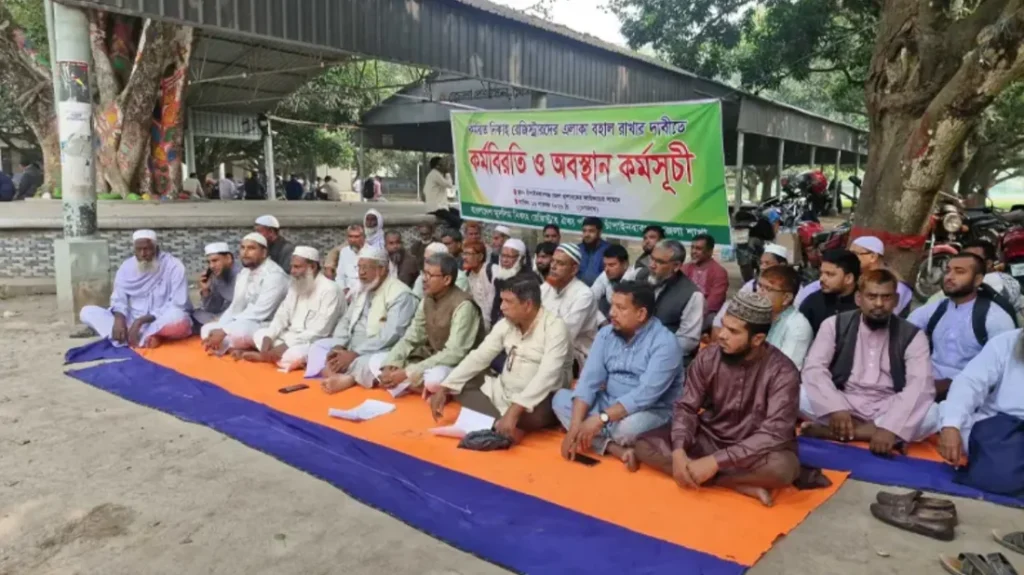
Marriage and divorce registrations ground to a complete halt across Chapainawabganj and Jhenaidah on Monday as licensed Muslim marriage registrars staged coordinated work stoppages and sit-in demonstrations. The protests were mounted against a preliminary government decision to appoint multiple new registrars within existing jurisdictions, a move current officeholders warn will undermine their livelihoods and disrupt established administrative boundaries.
In Chapainawabganj, the demonstration began in the morning outside the Deputy Commissioner’s office under the banner of the Bangladesh Muslim Nikah Registrar Oikya Parishad’s district unit. Every registrar representing the district’s 45 union parishads and four municipalities participated in the boycott, bringing all official marital documentation to a standstill for the day. Simultaneously, members of the District Nikah Registrar Association in Jhenaidah staged a parallel pen-down strike and sit-in outside their respective Deputy Commissioner’s office, voicing identical grievances.
Under existing regulations governing the Muslim Marriages and Divorces (Registration) Act in Bangladesh, a single licensed registrar, traditionally known as a Kazi, is authorised to oversee a designated union or municipal area. Because Kazis do not receive a fixed monthly salary from the state, their income depends entirely on statutory registration fees collected from marriages and divorces.
Addressing the gathering in Chapainawabganj, speakers stated that the Ministry of Law has taken a preliminary decision to subdivide existing licensed territories. The proposed policy seeks to appoint three registrars per union, one per municipal ward, and three per ward within city corporations. Protest leaders condemned the proposal as “illogical and reckless,” arguing that the current volume of annual marriages and cash dower (denmohor) settlements within rural unions is already too low to sustain existing registrars. Many are enduring severe financial hardship, making the recruitment of additional personnel entirely unjustifiable.
Prominent figures at the Chapainawabganj demonstration included the district unit’s president Kazi Setaur Rahman, general secretary Kazi Abdul Bari, executive president Kazi Mozammel Haque, and municipal registrar Kazi Durul Alam, alongside peers from across the region. They warned that unless the ministry rescinds the subdivision plan and preserves their current territorial jurisdictions, they will escalate their movement into a broader, more stringent programme of action.
Echoing these concerns in Jhenaidah, protesting registrars noted that expanding the roster from one to three registrars per union would trigger unhealthy competition within small communities. Speakers cautioned that dividing an already limited pool of registrations would plunge both veteran and newly appointed registrars into acute financial crisis, ultimately compromising the integrity and stability of local record-keeping.