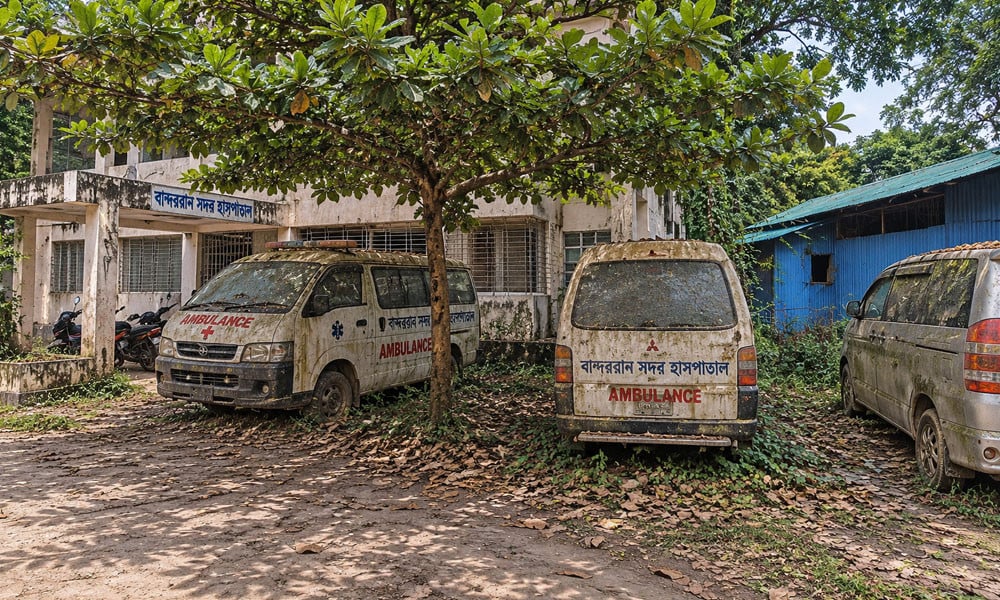
Nine out of 15 state-operated ambulances in Bandarban have remained out of commission since 2024, leaving a population of over 650,000 dependent on just six operational vehicles for emergency medical transport. The crisis is compounded by a total absence of private ambulance services across the district town’s four private healthcare facilities, alongside broken-down vehicles at both the municipality and the Mother and Child Welfare Centre.
For residents living across the rugged hill tracts, government ambulances represent the sole lifeline for transferring critically ill patients from remote settlements to the district headquarters or onward to Chattogram for advanced medical care. Without reliable emergency transport, patients suffering from cardiac arrests, road accidents, or obstetric emergencies face severe delays that frequently prove fatal.
Administrative records show that Bandarban comprises seven upazilas, seven police stations, two municipalities, 33 unions, 96 mouzas, and 1,482 villages. While the 2022 Population and Housing Census recorded 481,106 indigenous and Bengali residents across 106,155 households in the district’s 300th parliamentary constituency, local government and non-governmental estimates indicate the current population exceeds 650,000.
Serving this vast terrain are 15 official ambulances distributed across Bandarban Sadar Hospital, the Mother and Child Welfare Centre, the municipality, and the seven upazila health complexes, including Ruma. Nine of these vehicles have been grounded since 2024. Patients from remote upazilas such as Lama, Ruma, Thanchi, Rowangchhari, and Alikadam must routinely be transported to the district headquarters—and often further to Chattogram when local facilities lack specialist care.
Transport infrastructure in the hills already poses formidable obstacles, characterised by narrow winding roads, steep inclines, and stretches accessible only by engine-driven boats or on foot. The acute shortage of ambulances has turned medical emergencies into perilous ordeals.
Aungchaching Marma, a resident of Thanchi upazila, noted that transporting a critical patient from remote hill areas to the district hospital takes four to five hours. When an ambulance is unavailable, families are forced to move patients in open-air jeeps—locally known as chander gari—or public buses, worsening the patient’s physical trauma and jeopardising timely treatment.
The human cost of this shortfall was starkly illustrated in Rowangchhari upazila, according to local resident Bhoshan Joy Tanchangya. Following a road accident at Merai Para in Taracha union that left six people, including children, seriously injured, poor road links and the lack of an ambulance prevented rapid evacuation. Due to the delay in receiving medical attention, Hlaingnu Marma, wife of Headmanpara resident Chathowaimong Marma, died before reaching care.
Even within the district town, families face agonising waits. Bandarban municipality resident Abu Toyab recounted that when his father suffered a heart attack last week, he contacted multiple local offices without securing an ambulance. He was eventually forced to summon a vehicle from Keranihat in neighbouring Chattogram to transfer his father to Chattogram Medical College Hospital.
Vehicles intended to serve as emergency backups have also been left idle for years. Bandarban Municipal Administrator SM Manzurul Haque confirmed that the municipality’s ambulance has been out of order for a prolonged period, adding that while repair work is underway, it will take further time before the vehicle is roadworthy.
At the Bandarban Mother and Child Welfare Centre, physician Kamrul Monir Ribon stated that their ambulance has been non-functional since 2024. Despite repeated appeals to the District Council and senior health officials, a lack of dedicated funding has stalled necessary repairs, leaving mothers and infants without vital emergency transport.