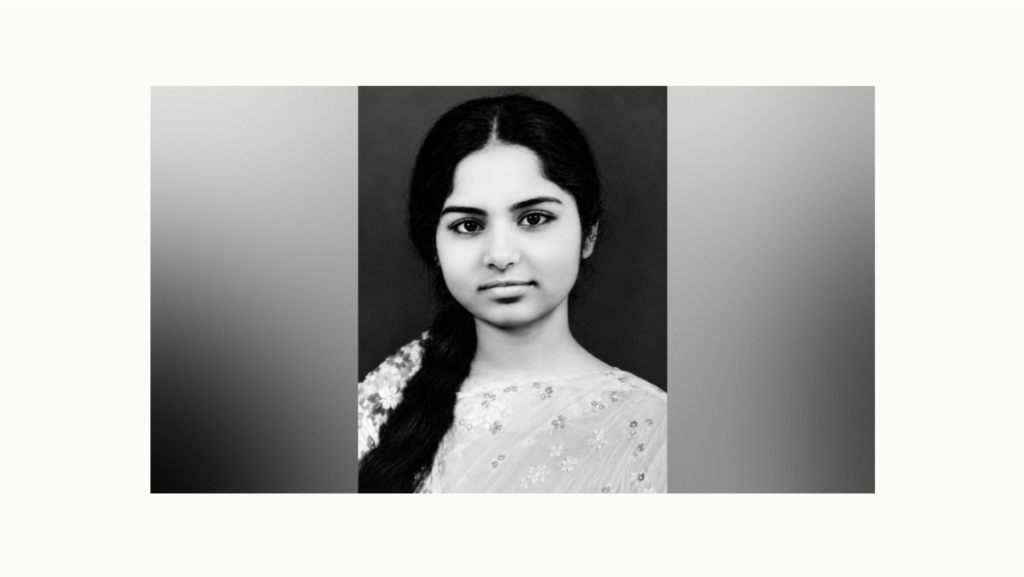
The story of Nipa Lahiri is one of extraordinary courage, sacrifice and unwavering devotion to her country. A medical student who dreamed of becoming a doctor, she took up arms during the 1971 Liberation War and fought against the Pakistani occupation forces. At just 18, she gave her life for Bangladesh’s independence. Yet, despite her remarkable contribution, her name remains largely absent from the nation’s mainstream historical narrative.
The following account captures one of the most harrowing moments of her final battle:
“The entire village was burning. Flames had spread to the roof of the house. Risking her life, Nipa went back inside to retrieve the weapons. She tried to escape with bags containing grenades and firearms. By then, however, the flames had spread from the roof to the bamboo walls surrounding the doorway. The thunder of artillery shook the area. Smoke had engulfed everything, punctuated by occasional bursts of fire. At one point, the roof collapsed.
Nipa managed to emerge with the weapons. But she had not realised that sparks from the fire had already caught her clothes.”
This was neither a scene from a film nor an imaginary tale. It was part of the real-life struggle of a young woman who chose to fight for the freedom of her country.
From a medical student to a freedom fighter
Nipa Lahiri was born on 17 May 1953. Her family’s ancestral home was in Pabna, and she was affectionately known as ‘Bubla’. Her father, Principal Shibaprasanna Lahiri, was an eminent educationist and compiler of a Bengali-language dictionary. Her mother, Professor Rama Lahiri, was a researcher of Bengali literature and linguistics. Her younger sister, Neera Lahiri, would later become recognised as Bangladesh’s first female radiologist.
Growing up in an intellectually accomplished, culturally engaged and progressive family, Nipa developed an early awareness of social and political issues. She was courageous, compassionate and deeply concerned about the rights of ordinary people.
During her student years, she became involved in left-wing progressive politics. While studying at Carmichael College in Rangpur, she was associated with the Palli Chhatra Union. She later continued her education at Rajshahi College before enrolling at Dhaka Medical College, where she was a second-year MBBS student in 1971.
The mass uprising of 1969, the sacrifice of Professor Dr Shamsuzzoha and the broader struggle for the rights of the people of East Pakistan had a profound influence on her political outlook. These experiences helped shape her determination to stand against injustice.
Her commitment to humanity was evident even before the Liberation War. Following the devastating cyclone and tidal surge of 1970, she took part in relief efforts for affected communities, collecting money and clothing to support those who had lost their homes and livelihoods. Her desire to serve people had initially inspired her to pursue medicine. However, the events of 1971 transformed the course of her life.
Choosing the battlefield over the classroom
The Pakistani military’s crackdown on 25 March 1971, which marked the beginning of a brutal campaign of genocide and repression, left Nipa unwilling to remain a passive observer. She decided to join the struggle for independence.
Her medical education became an important foundation for her wartime contribution. Alongside her studies and practical medical preparation, she learnt how to bandage wounds, administer saline and injections, perform stitches and provide emergency treatment to injured freedom fighters.
She received medical guidance and assistance from doctors including Dr Ruhul Haque, Dr Kashem and Dr Alim Chowdhury. These skills would prove invaluable during the fighting, when access to proper medical facilities was severely limited and wounded combatants often depended on makeshift treatment centres.
Nipa subsequently travelled to India, where she underwent military training. Her preparation extended well beyond medical assistance. She learnt guerrilla warfare techniques, including running, crawling, launching surprise attacks, throwing grenades, laying mines and operating light machine guns (LMGs).
Following her training, she was assigned to participate in operations in the Pubail and Kaliganj areas.
Returning to Bangladesh, she joined fellow freedom fighters in Luduria, Kaliganj. With the support of local residents who were committed to independence, she took part in guerrilla operations against the Pakistani occupation forces.
A fighter, medic and organiser
At the Luduria mission, Nipa helped establish a temporary medical centre where wounded freedom fighters and civilians received treatment. The location also served an important logistical purpose. Weapons and ammunition belonging to the resistance fighters were concealed beneath the altar of a church to protect them from discovery by the Pakistani forces.
Her responsibilities were not confined to treating the wounded. She was simultaneously a medical volunteer, military trainee, organiser and combatant. Her courage and leadership inspired local young people to join the resistance and contribute to the independence movement.
Her ability to combine medical responsibilities with direct participation in armed operations made her an exceptional figure among the young women who took part in the Liberation War.
The circumstances in which she served were extremely dangerous. Freedom fighters had to operate with limited resources while facing a better-equipped military force. Medical assistance, the protection of weapons and the coordination of local resistance were all essential to sustaining their operations.
Nipa accepted these responsibilities without hesitation.
The final battle of 22 November 1971
One of the most defining episodes of Nipa’s life took place on 22 November 1971, when fierce fighting broke out between freedom fighters and Pakistani troops around the Tumilia and Boali Bridge areas of Kaliganj.
The battle was marked by intense resistance. Pakistani forces launched attacks from the air and subjected the area to artillery bombardment. Surrounded by enemy troops and facing overwhelming military pressure, the freedom fighters continued their fight.
Nipa joined her fellow combatants in the resistance.
During the fighting, she entered a burning house to retrieve grenades and other weapons. Despite the flames spreading rapidly through the building, she managed to recover the weapons and bring them outside.
Her actions were not simply an attempt to save military equipment. The weapons were vital to the survival of the resistance fighters and their ability to continue confronting the enemy.
After emerging from the burning building, Nipa continued fighting. She reportedly removed the safety clips from six grenades and hurled them towards the Pakistani troops.
By then, sparks from the fire had caught her clothing. Her garments were burning, but she attempted to move towards safety while continuing to face the danger surrounding her.
Then an enemy bullet struck her in the chest.
Nipa Lahiri was only 18 years old.
The young medical student who had once dreamed of treating the sick and saving lives had sacrificed her own life for the freedom of her homeland.
A body lost, a sacrifice remembered
The circumstances following Nipa’s death were as tragic as the battle itself. Her fellow freedom fighters were unable to arrange a proper funeral because of the extremely dangerous conditions. They were compelled to consign her body to the waters of the Shitalakkhya River.
Her remains were never recovered.
For her family, the loss was devastating. Her parents lost their beloved daughter, while her younger sister, Neera, lost the elder sister who had been an important part of her life.
Yet Nipa’s ideals and aspirations continued to influence her family. Neera Lahiri chose to pursue medicine, carrying forward her elder sister’s dream of serving humanity. She subsequently became recognised as Bangladesh’s first female radiologist.
Neera also devoted herself to preserving her sister’s memory and bringing her contribution to the Liberation War to wider public attention. She authored books titled Nipa and Muktijoddha Nipa, documenting the life, struggle and sacrifice of the young freedom fighter.
Through these efforts, the story of Nipa Lahiri has survived despite the limited attention it has received in the wider national narrative.
A forgotten heroine deserving national recognition
One of the most painful aspects of Nipa Lahiri’s story is that her extraordinary contribution has not received the level of official recognition and public acknowledgement it deserves.
Despite serving as a medical student, receiving military training in India and participating directly in armed resistance, her name remains relatively unfamiliar to many people. Her contribution has yet to find the prominent place it deserves in the broader public understanding of the Liberation War.
The absence of adequate memorials and recognition raises important questions about how the country preserves the contributions of its freedom fighters, particularly women who took part in combat operations.
The history of Bangladesh’s independence cannot be understood solely through accounts of military victories and political developments. It is also a history of countless individuals who risked everything, often without expecting recognition or reward.
Women played significant roles in the Liberation War in different capacities. Some provided medical assistance, organised supplies, gathered intelligence and supported resistance networks. Others received military training and fought directly against the occupation forces. Their experiences and sacrifices deserve equal attention in the national historical record.
Nipa Lahiri represents this extraordinary generation. At an age when most young people are beginning to shape their ambitions and plan their futures, she abandoned the security of student life and embraced the dangers of armed resistance.
She had the opportunity to continue her medical education and pursue a career as a doctor. Instead, when her country faced an existential crisis, she chose to fight for its independence.
As Bangladesh approaches the 55th anniversary of its independence, the need to preserve the stories of lesser-known freedom fighters remains particularly important. Their contributions should not be confined to family memories or scattered historical accounts.
There is a strong case for including Nipa Lahiri’s life and sacrifice more comprehensively in the country’s official history, ensuring appropriate state recognition and establishing meaningful ways to preserve her memory for future generations.
Her story should be introduced to students and young people so that they can understand the courage, determination and sense of responsibility that inspired her to take up arms.
Nipa Lahiri was more than a brave young woman who died in battle. She was a medical student, a compassionate humanitarian, a trained guerrilla fighter and a symbol of the determination that drove countless people to fight for an independent Bangladesh.
She belonged to a family that valued education, culture and humanity. Yet, when the freedom of her country was at stake, she placed the future of the nation above her own dreams.
Her sacrifice should never be allowed to fade from collective memory.
On the 55th anniversary of her martyrdom, the nation remembers Shaheed Nipa Lahiri with profound respect and gratitude. She was not merely the pride of her family; she was a daughter of Bangladesh who gave everything for its freedom.
May her sacrifice continue to inspire generations, and may her name finally receive the recognition it deserves in the history of Bangladesh.
Shaheed Nipa Lahiri, your courage will never be forgotten.