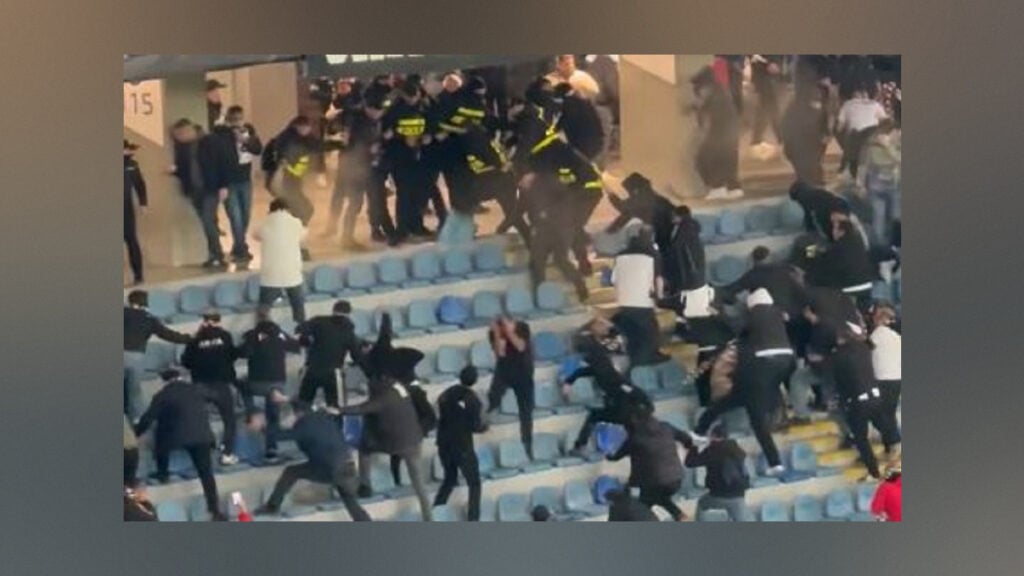
Political tensions surrounding Israel and Turkey spilled into European football as Besiktas defeated Israeli side Hapoel Be’er Sheva 2-1 in a Europa League fixture in Georgia. The match was overshadowed by pro-Palestinian demonstrations, clashes between supporters and police, and a 30-minute suspension after disturbances broke out in the stands.
Besiktas players declined to shake hands with their Israeli opponents before kick-off, while supporters displayed Palestinian flags and banners calling for Palestinian freedom. Chants opposing Israel were also heard around the stadium. The confrontation between Besiktas fans and Georgian police eventually forced the referee to suspend play.
The league-phase match, part of the fifth round of the Europa League, was held in Batumi, Georgia, on Thursday night (26 November).
The fixture had originally been scheduled to take place in Istanbul, Turkey, but was moved to Georgia because of security concerns. Despite the change of venue, the political sensitivities surrounding the encounter remained evident, with tensions extending beyond the pitch and into the stands.
Besiktas Players Refuse Pre-match Handshakes
Signs of a politically charged encounter emerged before the opening whistle. Besiktas players avoided the customary pre-match handshake with their opponents from Hapoel Be’er Sheva.
Besiktas captain Orkun Kökçü also completed the coin-toss formalities with the opposing captain before walking away without the usual exchange.
The atmosphere in the stadium became increasingly charged as supporters raised Palestinian flags and displayed banners expressing solidarity with Palestine and its independence. Chants including ‘Death to Israel, freedom for Palestine’ could be heard from the stands.
The demonstrations reflected the wider political tensions surrounding the Israel-Palestine conflict, which have increasingly found expression at sporting events. Football, with its international audience and passionate supporters, has frequently become a platform for political messages and public demonstrations.
Police Clashes Force 30-minute Suspension
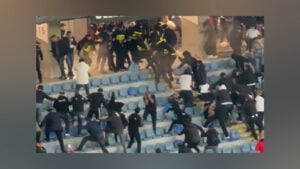
The situation escalated in the 26th minute, when the score remained 0-0. A confrontation broke out between sections of Besiktas supporters and Georgian police officers in the stands.
According to reports by international news agencies AP and AFP, police used pepper spray against supporters during the confrontation. Several fans were reportedly injured as the situation deteriorated.
With tensions rising, Danish referee Morten Krogh instructed players from both teams to leave the pitch and return to their dressing rooms. The match was suspended for approximately 30 minutes before play resumed after the situation had calmed down.
However, accounts of how the confrontation started differed between UEFA and Georgian authorities.
UEFA said the initial disturbance involved clashes among Besiktas supporters themselves. Police subsequently intervened to control the situation, but their involvement led to further escalation, forcing the temporary suspension of the match.
Georgia’s Interior Ministry presented a different account. It said the supporters’ violent behaviour and confrontation with police had begun before Palestinian flags or banners were displayed.
According to the ministry, some supporters threw stadium seats towards police officers, leaving three officers injured. Authorities also reported that 16 people had been detained in connection with the incident.
The ministry rejected allegations that police had used force because supporters were displaying Palestinian flags or expressing support for Palestine. The conflicting accounts left questions about the circumstances surrounding the confrontation.
Besiktas strongly criticised the police response, accusing officers of using excessive force against its supporters. The Turkish club subsequently lodged a formal complaint with UEFA, seeking action over the treatment of its fans.
Turkish Football Community Expresses Solidarity
The incident quickly developed into a wider issue involving Turkish football authorities and diplomatic representatives.
The Turkish Football Federation condemned the conduct of Georgian police, describing their actions as unacceptable. It also alleged that Besiktas supporters had been subjected to discriminatory treatment and called for an investigation into the events in Batumi.
The matter also reached diplomatic channels. Turkish Foreign Minister Hakan Fidan held a telephone conversation with his Georgian counterpart, Maka Bochorishvili, to discuss the situation.
Turkish diplomats were also involved in efforts to ensure the safety of supporters who had travelled to Batumi for the fixture.
Besiktas’s Istanbul rivals, Galatasaray and Fenerbahce, also expressed solidarity with the club’s supporters following the confrontation. Their response was notable given the intense sporting rivalry between the three clubs.
The incident highlighted the challenges of maintaining security at international sporting events when political tensions become intertwined with football. Although the fixture had been relocated to a neutral venue because of security concerns, the disturbances demonstrated that a change of location alone could not prevent the controversy from reaching the stadium.
Kökçü Makes Amends as Besiktas Secure Victory
Despite the disruption, Besiktas eventually emerged victorious in a closely contested match.
The Turkish side had an opportunity to take the lead in the first half after being awarded a penalty. However, captain Orkun Kökçü failed to convert from the spot, with Hapoel Be’er Sheva’s Argentine goalkeeper Marco Wolff saving his effort.
Besiktas continued to push forward after the interval and eventually broke the deadlock in the 75th minute. Junior Olaitan found the net to put the Turkish side ahead.
Kökçü then made amends for his earlier penalty miss by scoring Besiktas’s second goal in the 90th minute, giving his team a two-goal advantage.
Hapoel Be’er Sheva managed to reduce the deficit in the third minute of stoppage time through Javon East. However, the Israeli side could not find another goal before the final whistle.
Besiktas therefore secured a 2-1 victory in a match that was as notable for events in the stands as for the action on the pitch.
The encounter in Batumi brought together sporting competition, political expression and questions over crowd safety. While Besiktas left Georgia with three points, the confrontation involving its supporters and local police is likely to remain a significant part of the match’s aftermath.