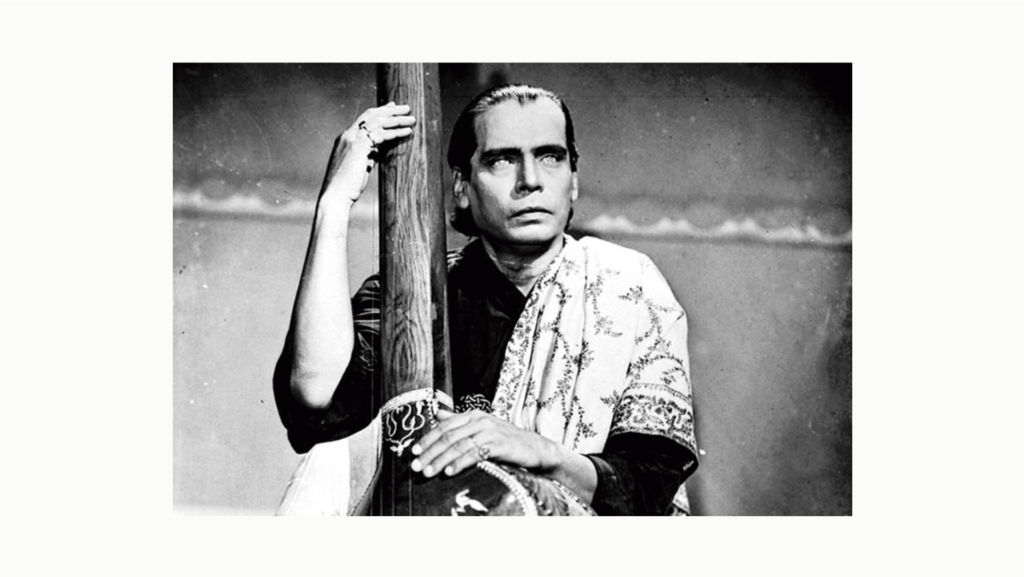
Known widely as K. C. Dey, Krishnachandra Dey was a multifaceted artist whose contribution extended well beyond singing. He was a classical vocalist, composer, music director, stage performer, film actor and mentor to generations of musicians. His work helped establish a distinctive musical tradition at a time when Bengali music and Indian cinema were undergoing significant transformation.
Born on 24 August 1893 in Kolkata into a music-loving family, Dey was the son of Shibchandra Dey and Ratnamala Devi. He developed a deep interest in music during his childhood. However, tragedy struck when he lost his eyesight permanently at the age of 13 or 14 following an illness.
The loss of vision could have severely limited his opportunities, but Dey refused to allow it to define his life. Instead, he devoted himself wholeheartedly to music, developing his skills through rigorous practice and determination. His journey became a remarkable testament to the power of perseverance, talent and an unwavering commitment to one’s passion.
Dey received classical music training from several accomplished musicians, including Shashibhushan Chattopadhyay, Harinath Shil and Keramatullah Khan. He later received specialised training in kirtan from Radha Raman Das. His mastery extended across several musical traditions, including dhrupad, dhamar, thumri, kirtan and folk music.
He became particularly renowned for devotional music and kirtan. His powerful, resonant voice carried an emotional depth that captivated audiences. Combining the discipline of classical music with the expressive qualities of devotional and folk traditions, he developed a distinctive singing style that set him apart from his contemporaries.
His performances were widely appreciated at musical gatherings in Kolkata, including those held at the prestigious Shobhabazar Rajbari and other prominent cultural venues. He was equally accomplished on stage, beginning a notable association with the theatre world through Shishir Bhaduri’s theatrical group in 1924.
As Indian cinema moved from silent films to talkies, Dey emerged as an important figure in the transition. His association with the renowned New Theatres studio in Kolkata brought him considerable success as a singer, actor and music director. He subsequently worked in the Mumbai film industry as well, contributing to the development of music in both Bengali and Hindi cinema.
His performances in films such as Devdas, Puran Bhagat, Dhoop Chhaon and Vidyapati, directed by Pramathesh Barua, remain particularly memorable. His portrayal of a blind singer, coupled with his emotionally expressive voice, brought exceptional depth to several cinematic scenes.
As a music director, Dey was among the pioneering figures who helped shape the musical language of early Indian films. He possessed a keen understanding of narrative, character and emotion, which enabled him to compose music that complemented the dramatic atmosphere of a film. His contributions during the 1930s and 1940s were particularly significant in the evolution of Bengali and Hindi film music.
His musical repertoire was remarkably diverse. He recorded songs in Bengali, Hindi, Urdu and Gujarati, earning admiration across linguistic and cultural boundaries. Among his best-known Bengali songs are:
-
Ogo Jamini Tumi Dighal Hoyo
-
Muktir Mandir Sopantale
-
Swapna Jodi Madhur Emon
-
Shatek Baras Pare
-
Bhober Kheya Ebar Bawa Hoilo Amar Shesh
-
Sakhi Loke Bole Kalo
His devotional songs and kirtan performances continue to hold a special place among music enthusiasts, reflecting the timeless appeal of his voice and musical interpretation.
Dey’s contribution was not limited to his own artistic achievements. He also played a vital role in nurturing emerging talent. Among his most distinguished students was Sachin Dev Burman, who would go on to become one of the most influential composers and singers in Indian music. Dey served as an early mentor and guide, helping shape Burman’s musical foundations.
His family also produced another celebrated figure in Indian music. His nephew, Manna Dey, became one of the subcontinent’s most versatile and accomplished playback singers. K. C. Dey played an important role in his nephew’s musical development and helped him secure his first playback singing opportunity in the 1942 film * Tamanna*. His influence as a teacher and guardian of musical talent extended well into the next generation.
In 1942, Dey moved to Mumbai to pursue work in film music and acting. After spending several years there, he returned to Kolkata in 1946. Even during the final years of his life, his connection with music remained unwavering.
Krishnachandra Dey died in Kolkata on 28 November 1962, aged 69. His death marked the end of an extraordinary life dedicated to music, artistic expression and mentorship.
More than six decades after his passing, his legacy continues to resonate. His life demonstrated that physical limitations need not diminish one’s creative potential. Although he lost his eyesight, he found extraordinary ways to experience, interpret and communicate the beauty of music.
His voice carried devotion, human emotion, classical richness and a distinctive melodic charm. His contributions to Bengali music, early Indian cinema and the development of future generations of musicians remain an integral part of the subcontinent’s cultural heritage.
Some people see the world through their eyes; others illuminate it through their creations. Krishnachandra Dey was one of those rare artists whose music opened new horizons for generations of listeners.
On the anniversary of his death, he is remembered with profound respect and admiration for a life that transformed adversity into artistic brilliance.