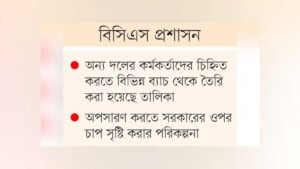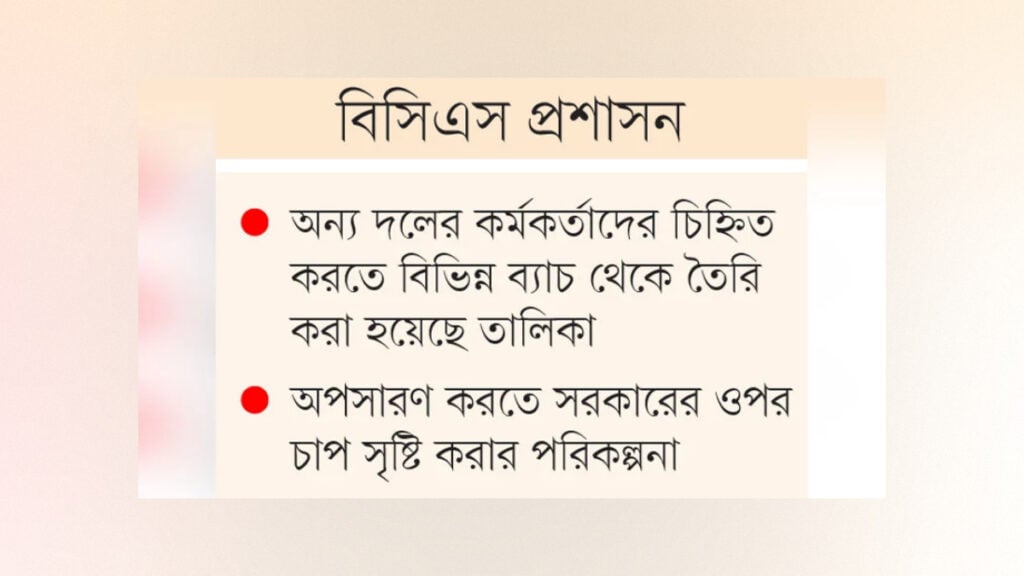
An initiative has emerged among leaders of several Bangladesh Civil Service (BCS) administration batches to remove officials considered close to the Awami League from important government positions. The officials concerned are accused of maintaining political affiliations, staying in contact with senior Awami League leaders and allegedly conspiring against the current government.
According to sources familiar with the matter, leaders of several BCS administration batches have begun compiling separate lists of officials they believe should no longer hold key administrative responsibilities. The lists are expected to form the basis of demands to the government for their removal or placement as Officers on Special Duty (OSD), a designation under which government officials are relieved of their regular responsibilities.
The initiative was discussed at a meeting of senior representatives from different BCS batches organised by the Bangladesh Administration Service Association on Thursday night. Participants reviewed the positions currently held by officials who served as secretaries, deputy commissioners (DCs) and heads of various government agencies during the Awami League administration. Several attendees called for these officials to be removed from their present posts.
During the meeting, the president of one BCS batch alleged that some of his batchmates were maintaining regular contact with senior Awami League leaders and were involved in conspiracies against the present government. He proposed that the officials concerned should immediately be placed on OSD status.
Some participants also referred to the recent detention of former Chattogram Deputy Commissioner Mohammad Ilias Hossain. They said he had been detained by activists of the Jatiyatabadi Chhatra Dal on Wednesday night and subsequently handed over to the police. A number of attendees suggested that anyone suspected of involvement in conspiracies against the government should, if necessary, be handed over to law enforcement agencies.
The meeting was held at the association’s headquarters in the Bangladesh Institute of Administration and Management (BIAM) building in New Eskaton, Dhaka. It was chaired by Kaniz Moula, president of the association and secretary of the Ministry of Chittagong Hill Tracts Affairs.
Sources present at the meeting said the association planned to formally communicate the demands raised by representatives of different batches to the Cabinet Secretary, the Principal Secretary to the Prime Minister and the Senior Secretary of the Ministry of Public Administration.
The discussions also covered the implementation of government development programmes, maintenance of law and order, social safety-net initiatives and the distribution of fertiliser. Participants stressed the importance of ensuring that administrative activities were carried out in accordance with the government’s policies and priorities.
They also discussed improving coordination with relevant ministries to deliver public services without corruption or political interference. Preparations for the forthcoming Upazila Nirbahi Officer (UNO) and Deputy Commissioners’ conferences were another subject of discussion, particularly how to raise ongoing challenges facing field administration.
Allegations of breaches of civil service conduct rules
Bangladesh’s government service regulations impose restrictions on the political activities of public servants. Under the Government Servants (Conduct) Rules, government employees are prohibited from becoming members of political parties or their affiliated organisations, as well as participating in political activities in other ways. Violations can lead to departmental proceedings and disciplinary action.
There have been allegations that several administration cadre officials maintained direct political affiliations during the Awami League government’s tenure. Their alleged involvement included attending party programmes and holding positions in various political committees.
Similar allegations have also been raised against some officials serving under the current BNP government. Critics claim that certain individuals who previously held positions within the party continue to occupy important administrative posts.
However, allegations of political affiliation do not automatically establish misconduct. Any decision to remove an official from a government position would need to be based on evidence and handled through the appropriate administrative and legal procedures.
Former secretary AKM Abdul Awal Majumder, speaking to Samakal, acknowledged that some officials had exceeded their authority and violated conduct rules during the Awami League government’s tenure.
He said the government should independently determine who had engaged in misconduct in the past and which officials could be trusted with important responsibilities. Such matters should not simply be overlooked, he argued.
At the same time, he warned that attempts by groups of civil servants to target colleagues could deepen resentment and divisions within the civil service. Such developments, he said, would ultimately benefit neither the administration nor the country.
He also questioned the propriety of government officials holding meetings of this nature, arguing that such activities could themselves be inconsistent with civil service conduct rules. Allowing public servants to become involved in such initiatives, he added, would be inappropriate.
Association distances itself from political allegations
Mohammad Babul Mia, secretary-general of the Bangladesh Administration Service Association and chairman of the Bangladesh Chemical Industries Corporation, offered a more cautious assessment of the initiative.
He said individuals might express different opinions, but determining whether government officials had political connections or were involved in conspiracies was not the responsibility of the association. Such matters fell within the remit of the state and intelligence agencies.
Mia also clarified that he had not attended the entire meeting and therefore had not heard all the views expressed by participants.
He described the gathering as the first of its kind and said the association intended to organise similar meetings regularly. According to him, such gatherings could provide opportunities to coordinate activities for the country’s benefit.
He added that almost every BCS batch had its own committee, making it easier to communicate government messages to officials through these organisational structures.
The association is also seeking to strengthen its links with batch-based organisations. The objective is to improve coordination among administrative officers and ensure greater cooperation in implementing government decisions at the field level.
Representatives attending the meeting included presidents or conveners, general secretaries or member secretaries, and treasurers of different batch committees. Senior officials were present alongside representatives from the 41st BCS batch.
Administrative reshuffles and pressure campaigns under previous governments
Pressure from groups of government employees over appointments, promotions and postings is not unprecedented in Bangladesh.
During the tenure of the interim government, the Anti-Discrimination Employees’ Unity Forum organised several programmes demanding the cancellation of promotions and postings granted to officials appointed as secretaries, deputy commissioners and heads of different government agencies.
The organisation’s leaders used protests and other forms of pressure to advance their demands. Following these campaigns, several officials reportedly had their promotions or postings cancelled. Some were placed on OSD status, while others lost their jobs.
The latest initiative reflects the continuation of tensions surrounding political affiliations and administrative appointments. As under the previous interim administration, a section of government employees is now demanding action against officials accused of having political connections.
Police officers face arrests and disciplinary action
Alongside the developments within the administration cadre, several police officers have recently faced arrest or administrative action over allegations of maintaining links with the Awami League and involvement in sabotage activities.
The developments have come amid concerns surrounding possible political unrest in December, particularly in connection with Sheikh Hasina’s anticipated return to Bangladesh.
On 14 November, Jahangir Alam, Superintendent of Police at the Chattogram Range Reserve Force (RRF), was arrested in connection with a treason case.
On 24 November, Additional Superintendent of Police Abul Hasan, company commander of SRB-14, was arrested by the Detective Branch (DB) over allegations of sabotage in Gopalganj.
The following day, PBI Superintendent Abul Kalam Azad and Additional Superintendent of Police Rakibul Hasan of the Noakhali In-Service Training Centre were detained and subsequently shown arrested.
On 26 November, Inspector Selim Mia, who was serving in Mymensingh, was withdrawn from his post over allegations of involvement in violence and terrorist activities in Gopalganj.
Earlier, on 24 September, a treason case was filed against Rakibul Hasan, former officer-in-charge of the Cantonment Police Station under the Dhaka Metropolitan Police (DMP). He was subsequently shown arrested in connection with the case.
These developments have prompted discussions about political influence within law enforcement agencies and the extent to which security personnel should be monitored during periods of political uncertainty.
Home Affairs Minister Salahuddin Ahmed has said that members of the security forces are being monitored over concerns that some could be involved in conspiracies. He also stressed that government employees must perform their duties without political involvement.
According to the minister, action would be taken in accordance with the law whenever specific allegations or credible information emerged. He confirmed that several officials had already faced arrest or departmental action.
Questions over political neutrality and administrative stability
The latest developments have brought renewed attention to the relationship between political loyalty and professional responsibility within Bangladesh’s civil service.
The administration plays a central role in implementing government policies, maintaining public order, managing development projects and delivering essential services. Its effectiveness depends heavily on institutional continuity, professional competence and political neutrality.
Allegations that officials used their positions to advance partisan interests warrant proper investigation. Equally, removing or sidelining public servants solely on the basis of political accusations could create further divisions within the administration.
The initiative by BCS batch leaders therefore raises broader questions about the limits of collective action by civil servants, the independence of administrative decision-making and the safeguards required to prevent political interference in public institutions.
The government now faces the challenge of addressing credible allegations of misconduct while ensuring that administrative decisions remain transparent, evidence-based and consistent with established service regulations. Maintaining public confidence in the civil service will depend not only on holding officials accountable but also on protecting them from arbitrary or politically motivated action.