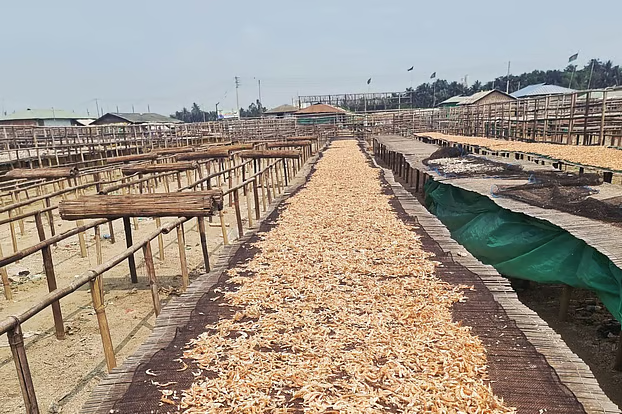
While the current sweltering heat across Cox’s Bazar provides the ideal conditions for salt and dried fish production, the latter industry has ground to a near-complete standstill. Despite the meteorological advantages of the summer season, more than 600 processing yards (locally known as mahal) in the district have ceased operations due to a critical shortage of raw fish.
The primary catalyst for this industrial paralysis is a 58-day governmental ban on sea fishing, which commenced on 15 April. In previous years, processors typically stockpiled sufficient inventory to navigate the restricted period; however, a lack of catch in the months leading up to the ban left reserves depleted. Consequently, the vast majority of the region’s drying kilns have fallen silent, leaving thousands of labourers facing economic hardship.
Industrial Impact and Labour Crisis
In the Nazirartek area of Cox’s Bazar Municipality’s Ward No. 1—the largest dried fish processing hub in the region—approximately 650 out of 700 processing yards have closed. Only 50 to 60 units remain operational, relying exclusively on expensive imported fish from India and Oman, or limited stocks from cold storage.
According to Akter Kamal, a former local councillor, the industry is currently operating at a mere 10% capacity. This downturn directly threatens the livelihoods of over 20,000 workers, roughly one-third of whom are women. A significant portion of this workforce—approximately 95%—consists of climate refugees who settled in Nazirartek following the devastating cyclone of 29 April 1991.
Human Cost and Economic Strain
For labourers like Maisha Begum, a widow and mother of four, the shutdown is catastrophic. Despite working 12-hour shifts (from 06:00 to 18:00) for a daily wage of 500 BDT, she struggles to support her seven-member household. Similarly, Samsunnahar, another labourer, reported that her daily earnings are insufficient to cover the medical expenses of her ill husband and the educational costs of her children.
Production Statistics and Market Trends
Data from the District Fisheries Department reveals a noticeable decline in production volumes. During the first eight months of the current fiscal year (July–February), production reached 31,000 metric tonnes, averaging 3,875 tonnes per month. This is a decrease compared to the previous fiscal year’s monthly average of 4,024 tonnes.
| Metric | FY 2022-23 (Full Year) | FY 2023-24 (Jul-Feb) |
| Total Production | 48,285 Metric Tonnes | 31,000+ Metric Tonnes |
| Monthly Average | ~4,024 Metric Tonnes | ~3,875 Metric Tonnes |
| Active Yards (Nazirartek) | ~700 | ~50-60 |
Market Deception and Price Inflation
The scarcity has also impacted retail markets along Sugandha Road. With local production stalled, many vendors are selling imported dried fish from Pakistan, India, and Myanmar. Industry insiders suggest that some traders misrepresent these imports—which may have been stored for up to two years—as fresh local produce to unsuspecting tourists.
Due to the supply deficit, retail prices have surged by 200 to 500 BDT per kilogram. Current market rates include:
-
Ribbon Fish (Churi): 900 – 2,500 BDT/kg
-
Bombay Duck (Loitta): 900 – 1,900 BDT/kg
-
Indian Salmon (Lakhyua): 2,000 – 3,800 BDT/kg
Md. Nazmul Huda, the District Fisheries Officer, confirmed that an investigation is underway to determine the underlying causes of the dwindling fish supply, citing climate change as a probable factor. Stakeholders, including Md. Joynal Abedin, President of the Cox’s Bazar Dried Fish Processing Fishermen’s Cooperative Society, have suggested that the government should reconsider the timing of the fishing ban to better align with biological cycles and industrial needs.