Sunday, 5th April 2026

Khabor Wala Desk
Published: 20th November 2025, 2:50 AM
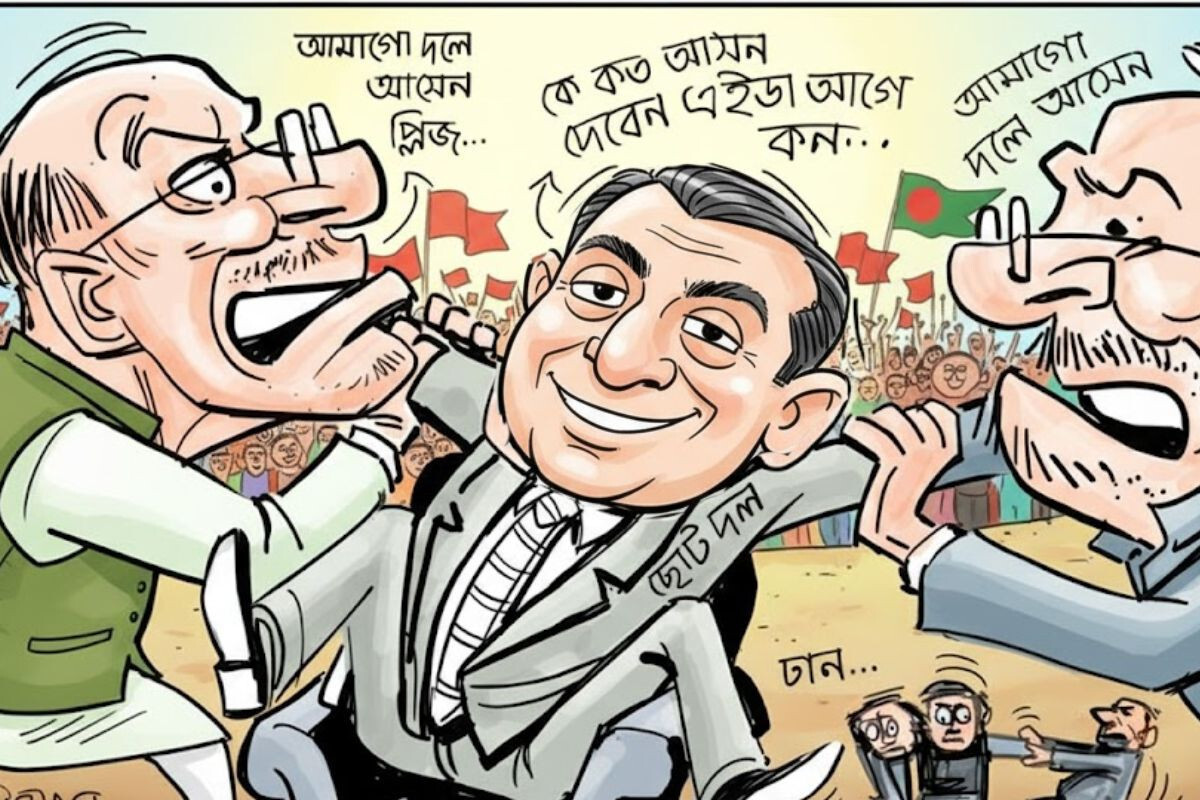
The interim government has announced that the next national parliamentary election will be held in the first half of February next year. Accordingly, the Election Commission is preparing to declare the election schedule in the first half of December. Although the announcement of the schedule is imminent, political parties have yet to resolve the deadlock over forming electoral alliances. Final negotiations over seat-sharing are still underway.
Strategic divisions and calculations regarding contesting under party symbols have prevented major parties from finalising their alliance structures. Discussions with leaders of various parties reveal attempts to form at least four alliances for the upcoming election. It appears unlikely that any major party will contest the election alone. The major political party BNP may form a large alliance with its like-minded partners. Seat-sharing with several other parties also remains a possibility.
Meanwhile, Jamaat-e-Islami, Islami Andolon and similar Islamic parties are working towards forming a separate alliance. The NCP may also form a coalition with several parties, or it may join another alliance. The NCP continues discussions with both the BNP and Jamaat.
At the same time, efforts are underway under the leadership of the Communist Party of Bangladesh (CPB) to form a left-leaning coalition with like-minded groups.
BNP Secretary General Mirza Fakhrul Islam Alamgir told the media, “Discussions continue with the parties who were part of the simultaneous movement. Negotiations are ongoing. This will also require internal discussions within our party. There is still time before the schedule is announced. Once finalised, we will inform everyone.”
On 3 November, the BNP announced its potential candidates for 237 constituencies, although the nomination for Madaripur-1 was later suspended. After the announcement, BNP candidates began campaigning, creating a clear election atmosphere. However, in constituencies where candidates have not been declared, both aspirants and potential alliance nominees are campaigning, leaving voters uncertain about who the final candidate will be.
Sources within the party say that the responsibility for seat negotiations with alliance partners has been assigned to Mirza Fakhrul Islam Alamgir and Standing Committee member Amir Khosru Mahmud Chowdhury. Meanwhile, Standing Committee member Nazrul Islam Khan has been coordinating discussions with parties involved in the simultaneous movement.
Reliable sources claim that while the BNP may leave 64 seats vacant, 20–22 seats may be offered to parties involved in the simultaneous movement. If an agreement is reached with the NCP and Bangladesh Khelafat Majlis, the BNP could leave around 40 seats. Some leaders from allied parties have already been informally assured of nominations, though their names have not been officially announced. If the BNP forms the government, top leaders from allied parties may be appointed to key government posts if they do not receive parliamentary seats.
Jamaat-e-Islami, on the other hand, has already announced potential candidates for all 300 constituencies and has been actively campaigning. However, many may be excluded from the final list. Jamaat has stated that it will negotiate seat-sharing with the eight Islamic parties it has been jointly campaigning with, along with several other parties.
Advocate Ehsanul Mahbub Zubair, Assistant Secretary General and head of the party’s media division, told the media, “Seat-sharing will be arranged with the eight parties who have been jointly active with us. We are also in discussions with several other like-minded groups. A final decision may come in early December or close to the schedule announcement.”
Discussions with senior BNP policymakers indicate that a coalition could involve Ganatantra Mancha, Jamiat Ulamaye Islam, the 12-party alliance, Bangladesh Jatiya Party (BJP), Gana Adhikar Parishad, Ganasanghati Andolon, LDP, Nationalist Likeminded Coalition, NDM, Bangladesh Labour Party, Gano Forum and several others.
Dr Fariduzzaman Farhad, coordinator of the Nationalist Likeminded Coalition and chairman of NPP, told the media, “Discussions regarding the alliance are ongoing. On Monday, we met BNP Secretary General Mirza Fakhrul Islam Alamgir and Nazrul Islam Khan. We stressed the need to finalise seat-sharing quickly. They informed us that the BNP’s Acting Chairman Tarique Rahman will review the matter and a decision will be announced soon.”
Discussions with Jamaat leaders reveal that Islami Andolon Bangladesh, Khelafat Majlis, Bangladesh Nezame Islam Party, Khelafat Andolon, JAGPA and Bangladesh Development Party are campaigning with them and will be part of seat-sharing. Talks are also underway with several other parties.
Another source reports that if the NCP does not join the BNP or Jamaat, it may form its own alliance with AB Party, Ganasanghati Andolon, Gana Adhikar Parishad, Rashtra Sanskar Andolon and others.
In a recent press briefing, NCP’s chief coordinator Nasiruddin Patwary said, “The country is going through a crisis. If the BNP or Jamaat pledge to implement structural reforms, we may form an alliance with either. If not, we will not join them.” In another event he added, “A reformist alliance outside BNP and Jamaat may emerge before the national election. Discussions are ongoing.”
Meanwhile, the CPB is working to form a coalition of all left-leaning groups before the election. The coalition will include the six parties of the Left Democratic Alliance—BASAD, BASAD (Marxist), Democratic Revolutionary Party, Socialist Party and Revolutionary Communist League. Efforts are underway to include indigenous, Dalit and civic groups as well.
CPB President Sajjad Zahir Chandan told the media, “We are working to form a broad political front comprising those who uphold the spirit of the Liberation War. Discussions are ongoing with various leftist, indigenous, Dalit and civic organisations. We will announce our candidate list on 25 November.”
Leaders from several parties say that the requirement to contest elections under each party’s own symbol has become a major concern for alliance partners. Many leaders may be known locally, but their party symbols are unfamiliar to voters. Even if a seat is given by the alliance, the unfamiliar symbol significantly reduces their chances of winning.
Mostafizur Rahman Iran, Chairman of Bangladesh Labour Party, told the media, “The symbol is a problem for unregistered parties. Our symbol is pineapple, which is well-known, yet we have still applied to the Election Commission. We hope to receive a positive outcome after the Commission’s dialogue with political parties.”
Khaborwala/TSN


Comments