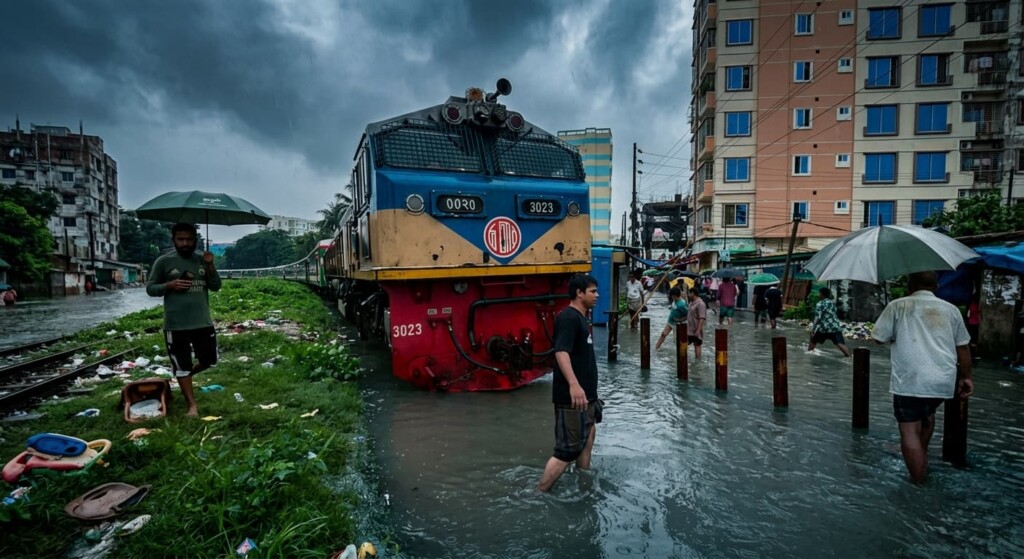
Train services connecting Dhaka and Chittagong with the coastal tourist hub of Cox’s Bazar remain entirely suspended after a critical stretch of the railway line became submerged under floodwaters. The waterlogging, centred in the Shomserpara area of Chittagong city, has persisted for six consecutive days. This marks the longest disruption to train operations on this vital route in recent memory, leaving thousands of commuters stranded and disrupting regional travel.
The crisis began following torrential monsoon rains that battered the port city. Parts of the track between the Shounnia Madrasa and Shomserpara areas were swallowed by one and a half to two feet of water. According to railway safety regulations, trains cannot operate unless the water level falls below six inches. Although the water receded near the Shounnia Madrasa, a 200-metre section in Shomserpara still held nine inches of water days later, keeping the tracks unusable.
This disruption hits a high-volume corridor where two pairs of trains from Chittagong and two pairs from Dhaka operate daily, catering to between 8,000 and 9,000 passengers, including tourists, professionals, and regular commuters. Local residents have expressed shock at the severity of the situation. A resident of Nazirpara noted that floodwaters reached waist-height inside nearby homes, stating he had never witnessed the railway line remaining underwater for such an extended period.
Interviews with officials from Bangladesh Railway, the Chittagong City Corporation, and the Chittagong Development Authority (CDA) reveal that the crisis is the result of long-term structural failures rather than just heavy rainfall. The natural drainage capacity of the low-lying area has been systematically destroyed over the years. Nearby wetlands and water bodies have been filled in for urban development, whilst drainage channels remain choked with weeds and debris. Furthermore, retaining walls built along local canals have trapped the water on the tracks instead of letting it drain away.
A major point of contention is a flawed 110-crore taka track rehabilitation project executed between 2011 and 2018. Originally built during the British era in 1931, the Sholashahar-Dohazari route desperately needed modernising. However, the multi-million-taka project failed to elevate the low-lying tracks. A subsequent evaluation report by the Implementation Monitoring and Evaluation Division (IMED) criticised the work severely, noting insufficient stone ballast, warped tracks, damaged sleepers, and subpar timber usage on bridges.
Compounding the problem is the three-decade-old Chittagong Drainage Master Plan. Drafted in 1995, the plan explicitly recommended digging a new canal parallel to the railway line and creating a 20-hectare water retention reservoir to prevent flash floods in Shomserpara. These recommendations were never implemented.
To resolve the immediate crisis, railway engineers are planning a temporary fix to raise the submerged section by 6 to 12 inches. For a permanent solution, the government is looking toward a massive 10,797-crore taka project aimed at upgrading the Chittagong-Dohazari section into a dual-gauge line. The State Minister for Railways confirmed that the tendering process has commenced, and the new project intends to raise the tracks by five feet to ensure that future monsoons do not paralyse the network.