Sunday, 5th April 2026

Khabor Wala Desk
Published: 23rd July 2025, 2:44 PM
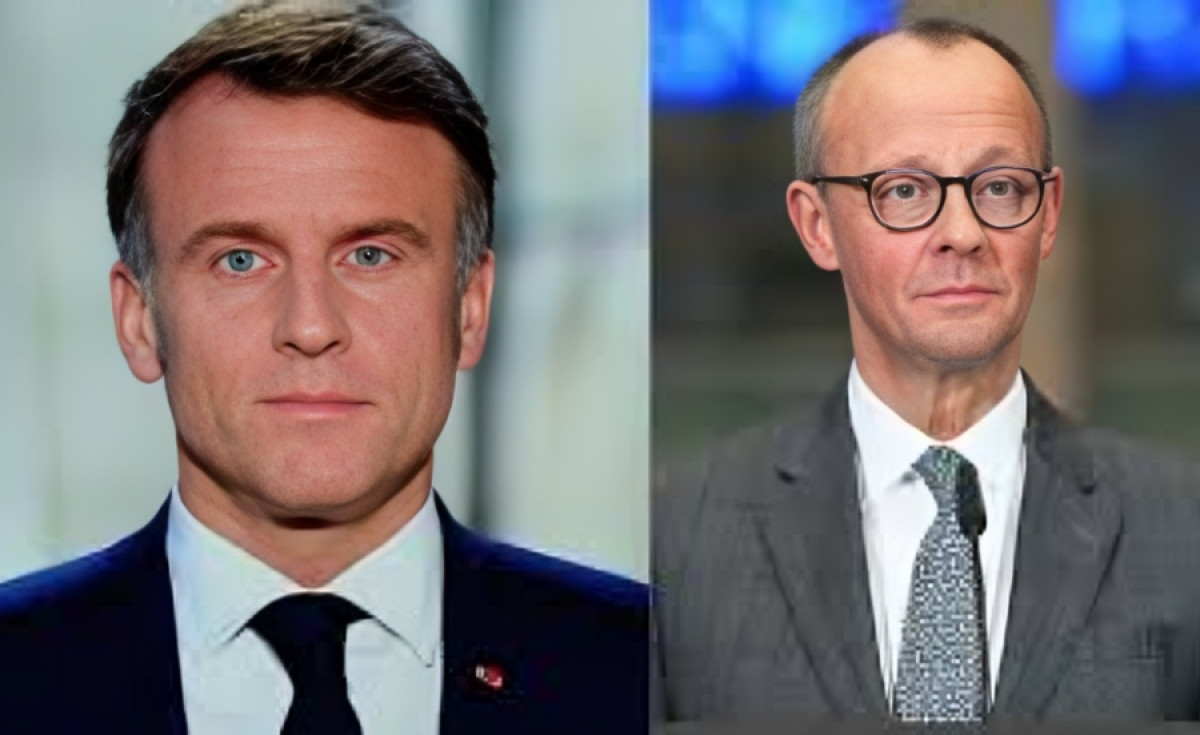
French President Emmanuel Macron is scheduled to meet German Chancellor Friedrich Merz in Berlin on Wednesday to address a wide range of pressing issues, including NATO security, a brewing EU–US trade dispute, and matters of bilateral and European cooperation.
Since assuming office in May, Merz has worked closely with Macron to revitalise the Franco-German alliance, a cornerstone of the European Union, amid growing tensions in transatlantic relations fuelled by US President Donald Trump’s aggressive trade posture.
“The most important message is: the Franco-German couple is back at work,” stated the Élysée Palace ahead of Macron’s planned visit and working dinner with Merz.
| Topic Area | Key Issues Discussed |
| NATO and European Defence | Joint support for Ukraine; differences on peacekeeping troop deployments |
| US–EU Trade Tensions | Avoiding Trump’s proposed 30% tariffs; seeking a low-tariff transatlantic agreement |
| Joint Defence Projects | Disagreements on leadership roles in combat jet programme |
| Energy Policy | France’s push for nuclear recognition; Germany’s shift to renewables |
| EU–Mercosur Trade Deal | France’s farming concerns; Germany’s strong support; search for compromise |
Both France and Germany, along with the UK and Poland, have been instrumental in rallying European support for Ukraine in the face of Russian aggression. While both countries agree on the need to bolster NATO’s European defences, a divergence remains on peacekeeping involvement.
France has expressed openness to deploying peacekeeping forces should a Ukraine ceasefire materialise. Germany, however, has yet to endorse any such move, reflecting a more cautious stance
President Trump has issued a stark warning to the EU, threatening to impose 30% tariffs on European goods if a new trade deal is not reached by 1 August.
Chancellor Merz emphasised the urgency of resolving the conflict, stating on Tuesday:
“In the tariff dispute with the USA, we are now approaching the decisive phase. We need a fair and reliable agreement with low tariff rates that strengthens the transatlantic market.”
The leaders are expected to explore solutions aimed at averting a full-blown trade war, which would have major consequences for European industry and diplomatic ties with Washington.
A major sticking point between Paris and Berlin lies in their trilateral joint combat aircraft project with Spain. The programme, viewed as a cornerstone of future European defence capabilities, has been hampered by disagreements over governance and leadership roles.
Chancellor Merz has voiced opposition to France taking a dominant role, though he remains optimistic that an agreement can still be achieved.
Eric Trappier, head of French aerospace giant Dassault Aviation, cast doubt on the project’s long-term feasibility:
“We have to question the effectiveness of a project which is run by three countries… where there isn’t one real leader but three.”
France continues to champion nuclear energy as a cornerstone of its climate strategy, while Germany is pressing ahead with a shift towards solar and wind power after deciding to phase out nuclear.
Paris has urged Berlin to adopt a stance of “technology neutrality” and support nuclear as a climate-friendly energy source at the EU level.
Though Germany’s previous left-leaning government resisted such moves, Merz’s centre-right CDU/CSU-led coalition appears more open. In a joint article published in May, Macron and Merz pledged:
“A restart in energy policy” and “equal treatment at the EU level for all low-emission energies.”
Another major topic of contention is the EU’s long-stalled trade agreement with South America’s Mercosur bloc. Germany has consistently supported the deal, viewing it as a gateway to expanding global trade partnerships.
France, however, has raised alarms about the potential negative impact on its agricultural sector. French sources say that a compromise may be within reach through the inclusion of a protocol offering a “robust safeguard clause for agriculture.”
President Macron will be officially welcomed by Chancellor Merz at 6:30 p.m. (1630 GMT) at Villa Borsig, a historic estate on the outskirts of Berlin and the former residence of the French post-war military commander in Germany.
The evening programme includes:
The meeting is designed not only to address urgent transatlantic and European matters, but also to reinforce the strategic partnership between Paris and Berlin as they navigate a shifting geopolitical landscape.


Comments