Sunday, 5th April 2026

Khabor Wala Desk
Published: 21st February 2026, 9:54 AM
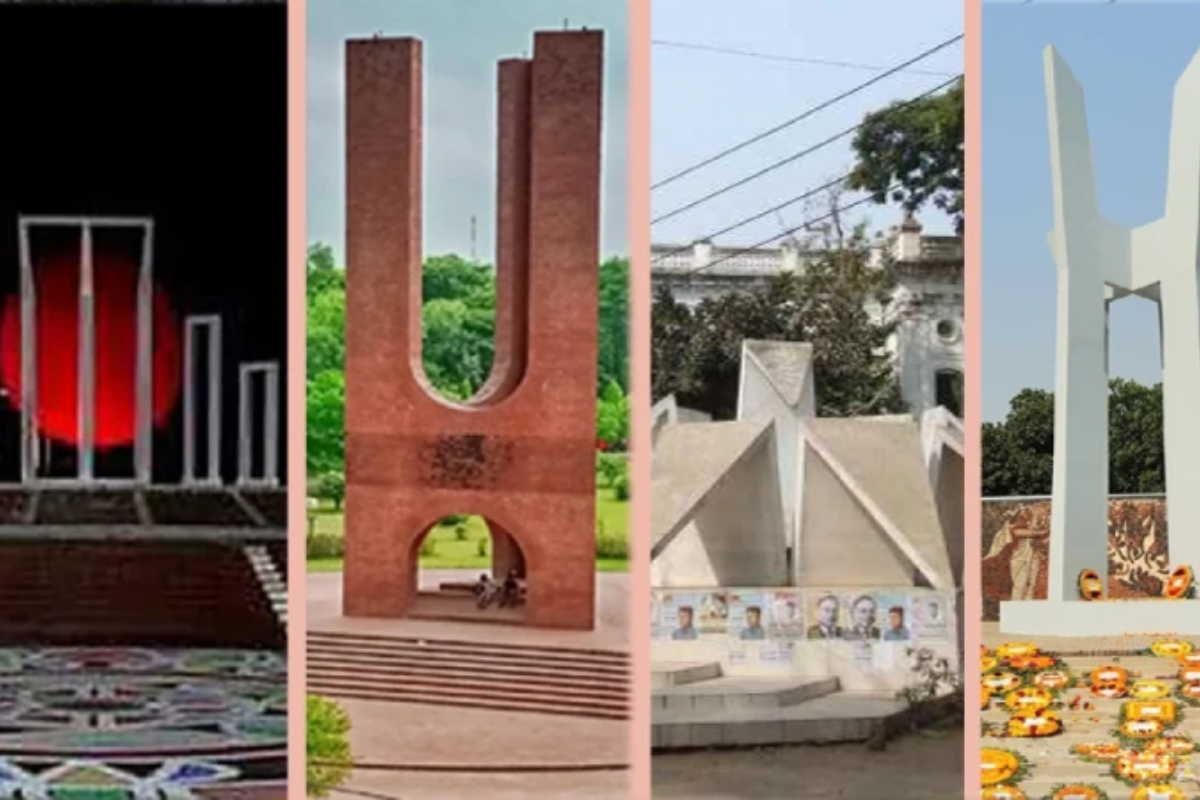
The Shaheed Minar stands as the most enduring architectural symbol of the Language Movement of 1952, when students and ordinary citizens laid down their lives to secure recognition of Bangla as a state language. Across Bangladesh, nearly every public university campus now hosts its own Shaheed Minar—each distinct in design yet united in purpose: to honour the martyrs and to preserve the spirit of linguistic and cultural self-determination.
Every year on 21 February, the Central Shaheed Minar in Dhaka is transformed into a sea of flowers as thousands gather barefoot at midnight to pay homage. Yet the present structure is the result of a turbulent history marked by demolition and reconstruction.
The first temporary monument was erected on 23 February 1952 in the compound of Dhaka Medical College Hostel. Designed by Badrul Alam and supervised by Engineer Sharafuddin, the ten-foot structure was built overnight by students. It was demolished by police and military forces on 26 February. A second monument followed in 1954. In 1956, under the United Front government, the foundation stone for a permanent structure was laid at its current site—reportedly by Basiran, daughter of language martyr Awal, in response to public demand.
Construction began in 1957 under sculptor Hamidur Rahman, with the involvement of Novera Ahmed. Martial law in 1958 halted progress, but a revised design was eventually completed and inaugurated on 21 February 1963 by Hasina Begum, mother of martyr Barkat. The monument was destroyed again during the Liberation War in 1971 and rebuilt after independence.
The five vertical columns are widely interpreted either as a mother flanked by her children or as the five fingers of an outstretched hand symbolising blessing and unity. Today, it is maintained by the University of Dhaka, though concerns about preservation periodically arise.
Located amid natural greenery on the outskirts of Dhaka, Jahangirnagar University boasts one of the country’s tallest Shaheed Minars. Designed by architect Robiul Hossain, its circular base measures 52 feet in diameter—commemorating the year 1952—while its three columns rise 71 feet, symbolising the Liberation War of 1971.
Eight steps on the base platform represent pivotal years in the nation’s political struggle: 1952, 1954, 1962, 1966, 1969, 1970 and 1971. The three columns respectively embody language and culture; land and people; and independence, sovereignty and democratic aspiration. The foundation stone was laid on 6 November 2004, and the monument was inaugurated on 6 February 2008.
In Old Dhaka, Jagannath University presents a strikingly unconventional Shaheed Minar. Designed by architects Kaiser Ahmed and Rajib Zahir, the monument features five gently curved pillars leaning inward, symbolising unity and collective resolve. A red circular disc behind the columns evokes the rising sun—a metaphor for the dawn of linguistic freedom.
The abstract geometry departs from traditional linear designs, introducing an expressionist aesthetic rarely seen in commemorative structures.
Following independence, students and faculty established a temporary monument in 1972. The renovated central Shaheed Minar, completed in 2018, stands 52 feet tall in a triangular form. Its three differently coloured façades symbolise the nation’s major rivers—Padma, Meghna and Jamuna—underscoring the organic link between land, language and livelihood.
Planned in 1972 by artist Murtaza Bashir, the Shaheed Minar at Rajshahi University combines geometric clarity with symbolic strength. Standing on a five-foot plinth, its three columns represent collective sacrifice. The monument serves not merely as a memorial but as a hub for cultural gatherings, protests and civic engagement throughout the year.
| Institution / Location | Year Completed | Height / Dimensions | Symbolic Features |
|---|---|---|---|
| Central Shaheed Minar, Dhaka | 1963 (rebuilt post-1971) | Multi-column structure | Five pillars symbolising unity and sacrifice |
| Jahangirnagar University | 2008 | 71 ft height; 52 ft base | Liberation and Language Movement symbolism |
| Jagannath University | Post-2005 | Five curved columns | Abstract unity; rising sun motif |
| Bangladesh Agricultural University | 2018 (renovated) | 52 ft | Triangular form; three rivers |
| University of Rajshahi | 1972 | Three columns on 5 ft plinth | Cultural and political centre |
Since 1999, when UNESCO recognised 21 February as International Mother Language Day, these monuments have acquired global resonance. More than architectural forms, the Shaheed Minars are living spaces of remembrance, reflection and resistance. They remind successive generations that linguistic rights are inseparable from dignity and democracy—values secured through sacrifice and safeguarded through vigilance.



Comments