Sunday, 5th April 2026
Khabor Wala Desk
Published: 16th December 2025, 8:30 PM
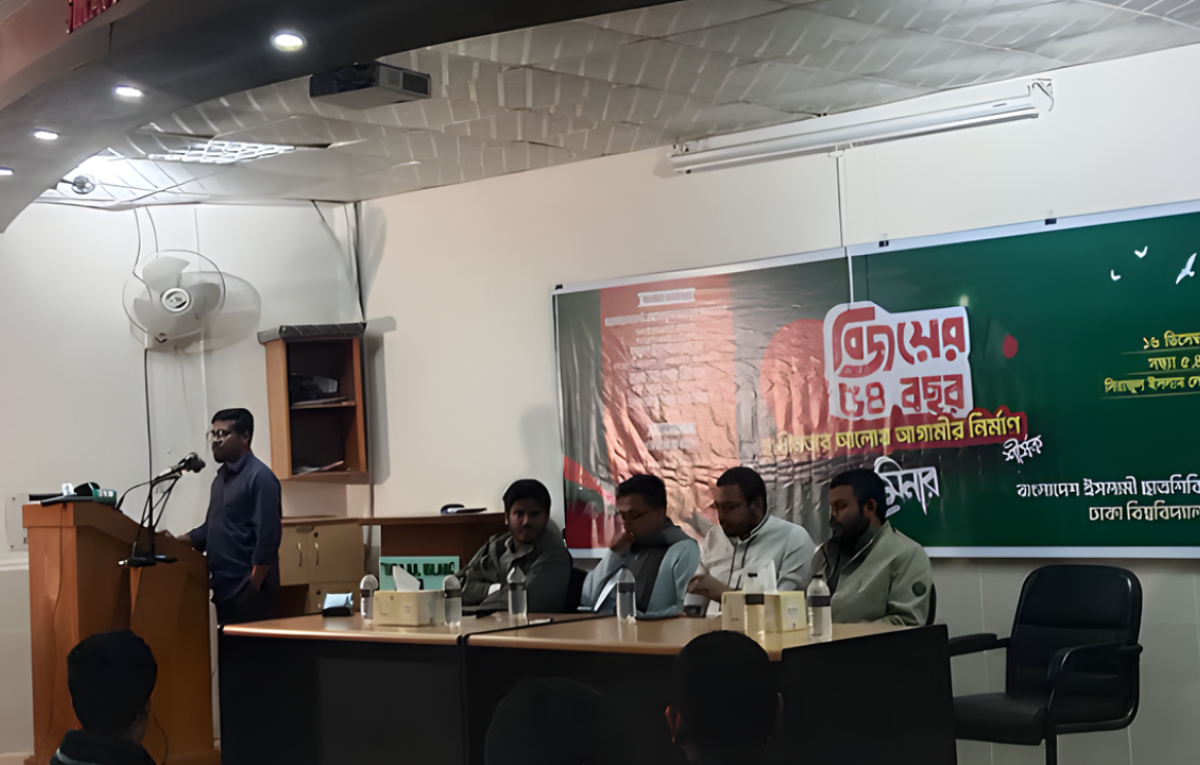
A significant portion of the history written about Bangladesh’s Liberation War in the post-independence period has been framed through what he described as “false narratives”, according to Nurul Islam Saddam, Central Secretary General of Islami Chhatra Shibir. He made the remarks on Tuesday evening while addressing a seminar at Sirajul Islam Lecture Hall of the University of Dhaka.
The seminar, organised by the Dhaka University unit of Islami Chhatra Shibir to mark Victory Day, was titled “Fifty-Four Years of Victory: Building the Future in the Light of Independence.” The discussion brought together student leaders and political activists to reflect on the Liberation War, its legacy, and contemporary interpretations of history.
In his address, Nurul Islam questioned why successive governments, particularly those that assumed power immediately after independence, failed to compile an authoritative list of martyrs of the Liberation War at the time. He argued that instead, new lists of freedom fighters were produced under different regimes, giving rise to prolonged secrecy and political manipulation. According to him, this process fostered division within the nation and enabled what he termed a subtle form of political strategy, through which economic benefits were allegedly channelled to specific groups.
He further claimed that such practices distorted the collective memory of the Liberation War and undermined national unity. Emphasising his organisation’s position, Nurul Islam stated that Islami Chhatra Shibir had upheld the spirit of independence since its inception and had consistently worked to protect national sovereignty. Recalling past experiences, he alleged that during what he described as periods of “fascist rule” under the Awami League, members of the organisation frequently faced arrests during Victory Day rallies, often counting the number detained at the end of each programme.
Drawing a parallel between historical and contemporary struggles, Nurul Islam remarked that divine intervention had liberated Bangladesh from Pakistani exploitation in 1971, while he viewed the events of 2024 as a popular uprising that freed the country from modern-day domination.
Another speaker, Rafe Salman Rifat, Chief Coordinator of United Peoples Bangladesh (UP Bangladesh), reflected on the long and turbulent journey from 1947 to 1971. He noted that the birth of Bangladesh came through immense sacrifice and a prolonged, blood-soaked struggle. He unequivocally condemned the Pakistani military and ruling elite for committing indiscriminate genocide, while also acknowledging the early violence, including the Bihari massacres, as part of the complex historical reality.
On the subject of Bangabandhu Sheikh Mujibur Rahman, Rafe Salman Rifat observed that debates surrounding his legacy contain conflicting perspectives. He argued that intellectual honesty demands recognising both positive and negative aspects without distortion.
Presiding over the seminar, SM Farhad, President of the Dhaka University unit of Islami Chhatra Shibir, stated that the organisation had commemorated independence every year, despite facing repeated arrests of its leaders and activists during Victory Day observances under prolonged authoritarian conditions.
| Aspect | Details |
|---|---|
| Event Title | Fifty-Four Years of Victory: Building the Future in the Light of Independence |
| Occasion | Victory Day |
| Venue | Sirajul Islam Lecture Hall, University of Dhaka |
| Organiser | Islami Chhatra Shibir, Dhaka University Unit |
| Key Speaker | Nurul Islam Saddam |
| Other Speaker | Rafe Salman Rifat |
| Presiding Chair | SM Farhad |
The seminar underscored the enduring contest over historical interpretation in Bangladesh and highlighted the continuing political significance of the Liberation War narrative in shaping national discourse.
Comments