Sunday, 5th April 2026

Khabor Wala Desk
Published: 31st August 2025, 12:09 PM
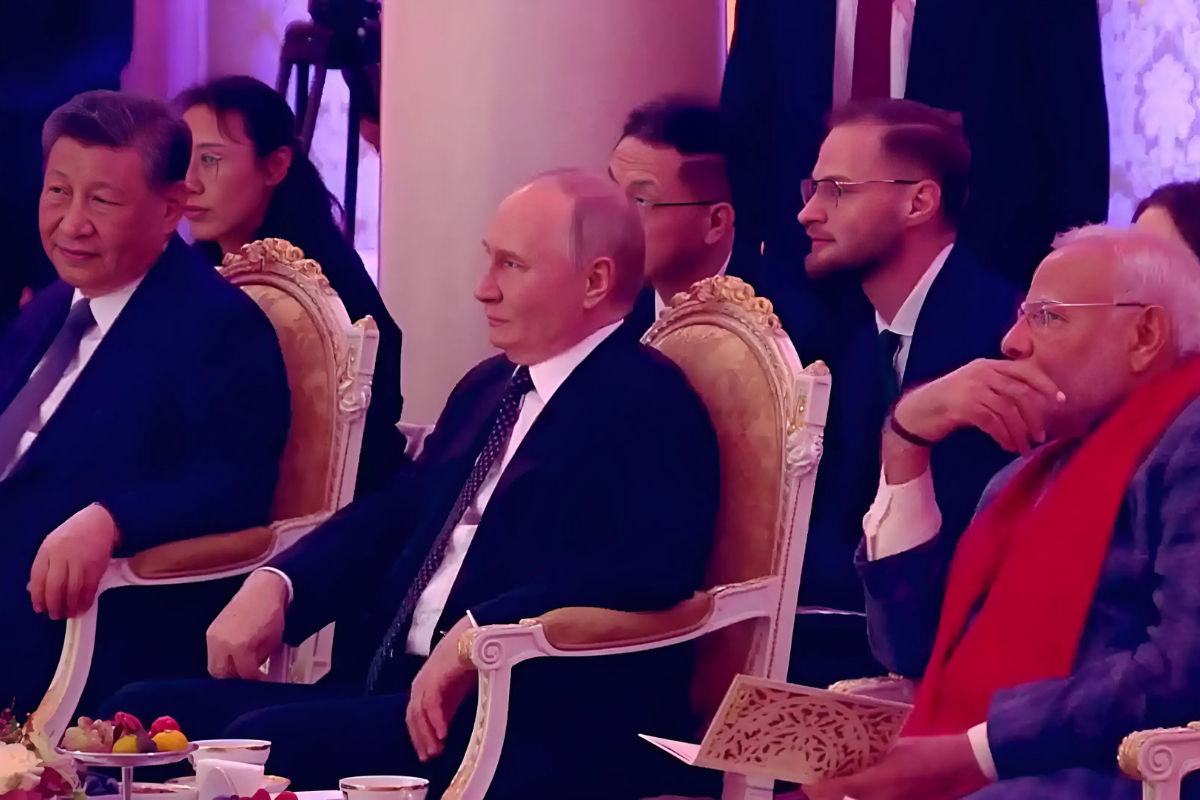
President Xi Jinping convened leaders from Russia, India, and dignitaries from around 20 Eurasian countries on Sunday for a high-profile summit aimed at positioning China at the centre of regional relations.
The summit is being held in the northern port city of Tianjin, with security measures tightened ahead of a massive military parade in Beijing later this month to mark 80 years since the end of World War II.
The meeting forms part of the Shanghai Cooperation Organisation (SCO), which includes China, India, Russia, Pakistan, Iran, Kazakhstan, Kyrgyzstan, Tajikistan, Uzbekistan, and Belarus. A further 16 countries are affiliated as observers or “dialogue partners”.
Russian President Vladimir Putin arrived in Tianjin on Sunday accompanied by senior politicians and business delegates. Meanwhile, Xi held a series of bilateral meetings with leaders from the Maldives, Azerbaijan, Kyrgyzstan, and Belarusian President Alexander Lukashenko, one of Putin’s staunch allies.
Xi also met Indian Prime Minister Narendra Modi, Xinhua news agency reported, marking Modi’s first visit to China since 2018.
| Key Leaders Present | Purpose of Attendance | Notes |
| Vladimir Putin | Strengthen SCO, bilateral talks | Focus on Ukraine and global positioning |
| Narendra Modi | Bilateral discussions, regional diplomacy | First China visit since 2018 |
| Xi Jinping | Host summit, foster SCO influence | Held multiple bilateral meetings |
| Other Leaders | Attend SCO summit | Includes Iran’s Masoud Pezeshkian, Turkey’s Recep Tayyip Erdogan |
China and Russia have occasionally promoted the SCO as an alternative to the NATO military alliance. This year’s summit is the first since US President Donald Trump returned to the White House.
In an interview with Xinhua, Putin stated that the summit would: “Strengthen the SCO’s capacity to respond to contemporary challenges and threats, and consolidate solidarity across the shared Eurasian space. All this will help shape a fairer multipolar world order.”
With China’s claims over Taiwan and Russia’s invasion of Ukraine putting them at odds with the United States and Europe, experts suggest Beijing and Moscow are leveraging platforms like the SCO to build influence.
“China has long sought to present the SCO as a non-Western-led power bloc that promotes a new type of international relations, which, it claims, is more democratic,” said Dylan Loh, assistant professor at Singapore’s Nanyang Technological University.
The summit is the largest SCO gathering since its founding in 2001, with over 20 leaders attending.
“The large-scale participation indicates China’s growing influence and the SCO’s appeal as a platform for non-Western countries,” Loh added.
Lizzi Lee from the Asia Society Policy Institute observed: “Beijing, through the SCO, aims to project influence and signal that Eurasia has its own institutions and rules of the game. It is framed as something different, built around sovereignty, non-interference, and multipolarity, which the Chinese tout as a model.”
On Saturday, Xi also met Cambodian Prime Minister Hun Manet in Tianjin. On Monday, Putin is expected to hold talks with Turkey’s Erdogan and Iran’s Pezeshkian regarding the Ukraine conflict and Tehran’s nuclear programme, respectively.
“Russia needs all the benefits of the SCO as a player on the world stage, and also the support of the second largest economy in the world,” said Lim Tai Wei, professor and East Asia expert at Japan’s Soka University. “Russia is also keen to win over India, and India’s trade frictions with the United States present this opportunity.”
The summit comes shortly after the US sharply increased tariffs on Indian goods as a response to New Delhi’s purchase of Russian oil.
India’s Prime Minister Modi arrived in China on Saturday. India and China, the two most populous nations, are intense rivals vying for influence across South Asia, and experienced a deadly border clash in 2020.
A thaw in relations began last October when Modi met Xi for the first time in five years during a summit in Russia.

Comments