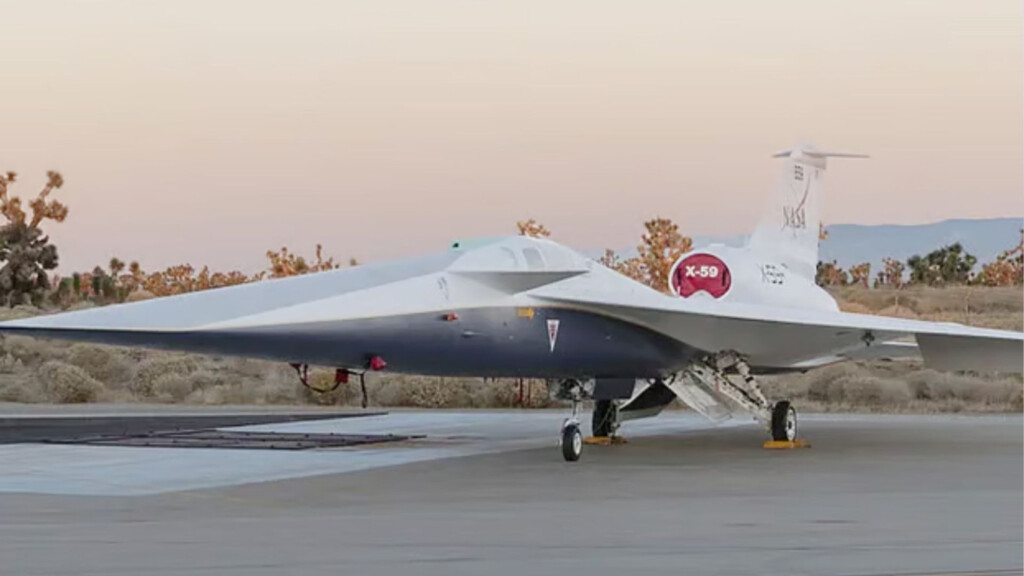
After years of meticulous engineering and high expectations, the X-59 Quiet Supersonic Technology (QueSST) aircraft has successfully completed its historic maiden flight. Developed through a high-stakes collaboration between NASA and Lockheed Martin’s Skunk Works, this experimental jet represents a paradigm shift in aviation history: the ability to break the sound barrier without the earth-shattering “sonic boom” that has relegated supersonic travel to the oceans for over half a century.
A Landmark Journey in California
The inaugural test took place in the clear skies over California. The X-59 departed from the U.S. Air Force Plant 42 in Palmdale and touched down gracefully at NASA’s Armstrong Flight Research Centre on Edwards Air Force Base. Covering a distance of roughly 26 miles, this short but pivotal journey serves as the official commencement of a rigorous flight-testing phase. Project officials confirmed that the aircraft performed exactly as predicted, meeting all aerodynamic and systems benchmarks during the sortie.
Silencing the Sonic Boom
The core mission of the X-59 is to mitigate the sonic boom—the explosive noise generated when an object travels faster than the speed of sound. Since 1973, supersonic flight over land has been prohibited in the United States due to the structural damage and noise pollution caused by these shockwaves. However, following a 2025 executive order by President Donald Trump, the ban was lifted to pave the way for a new era of high-speed commercial travel.
Instead of a thunderous blast, the X-59’s unique geometry is designed to disperse shockwaves, resulting in a muffled “thump” that NASA equates to the sound of a car door closing down the street.
Technical Specifications and Performance
The X-59 is a marvel of unconventional design. To achieve its sleek profile, the aircraft features a long, tapered nose that makes a traditional forward-facing cockpit window impossible. Instead, pilots navigate using the External Vision System (XVS), a high-definition 4K monitor that provides a real-time view of the sky ahead.
| Feature | Specification |
|---|---|
| Length | 99.7 Feet |
| Wingspan | 29.57 Feet |
| Engine | General Electric F414-GE-100 |
| Maximum Speed | Mach 1.5 (Approx. 990 mph) |
| Cruising Speed | Mach 1.42 (Approx. 940 mph) |
| Primary Technology | Quiet Supersonic Technology (QueSST) |
The “Quesst” for Commercial Supersonic Travel
As part of NASA’s Quesst mission, the X-59 will soon begin overflying various American communities. Researchers will gather data and public feedback regarding the noise levels experienced on the ground. This data will be shared with international regulatory bodies to help establish new, noise-based standards for supersonic flight, potentially reducing transcontinental travel times by half.
Originally slated for 2021, the project faced several delays before achieving this successful October 2025 flight. With this milestone achieved, the dream of flying from New York to Los Angeles in just over two hours is no longer a relic of the Concorde era, but a nearing reality.