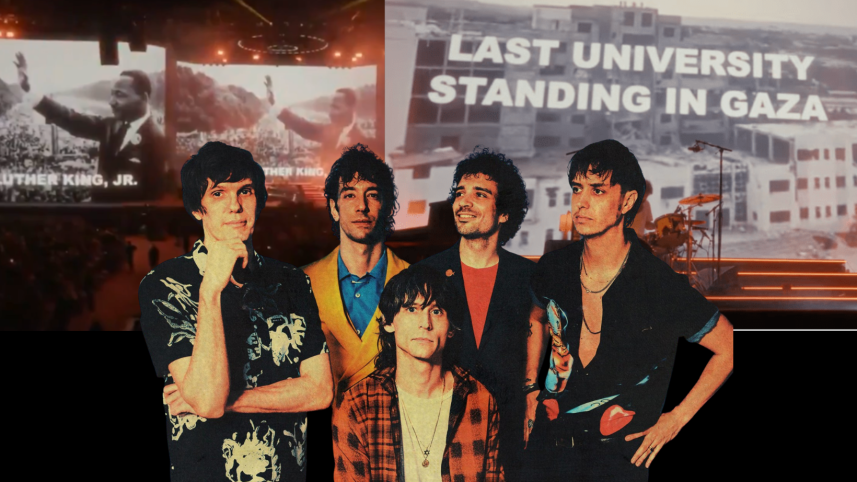
The Strokes concluded their second-weekend performance at the Coachella Valley Music and Arts Festival with a striking visual montage that critiqued United States foreign intervention and referenced a series of historical and contemporary geopolitical events, including recent conflicts in Gaza and Iran.
The sequence was displayed across the main stage screens during a performance of Oblivius, a song the American rock band had not performed live for approximately a decade. As the visuals unfolded, frontman Julian Casablancas repeatedly delivered the lyric “What side you standing on”, reinforcing the tone of political questioning suggested by the accompanying imagery.
According to Variety, the montage incorporated references to alleged involvement by US intelligence agencies in political developments across Latin America and the Middle East. It cited, among other events, the 1953 removal of Iranian Prime Minister Mohammad Mossadegh and the 1973 overthrow of Chilean President Salvador Allende—both widely documented historical episodes in international relations discourse.
The presentation also referenced the deaths of Panamanian leader Omar Torrijos and Ecuadorian President Jaime Roldós in 1981, alongside suggestions of possible external involvement. These claims remain contested and are not universally accepted within historical or investigative accounts. In addition, the montage alluded to a 1999 civil trial concerning the assassination of civil rights leader Martin Luther King Jr, while noting subsequent findings by the United States Department of Justice that found no evidential basis supporting the verdict cited in that case.
The visual sequence concluded with footage of recent bombing scenes in Iran and Gaza, ending abruptly on an image of a military bomber aircraft as the performance closed. The combination of historical references and contemporary conflict imagery formed a continuous narrative arc within the staging.
Coachella, an annual music and arts festival held in California, has increasingly served as a platform for artists incorporating political commentary into live performances. The Strokes’ presentation was among the most explicit examples of such commentary in this year’s edition of the festival. It followed previous controversy involving the Irish group Kneecap, who also used their Coachella appearance to make critical remarks regarding Israel’s military actions.
Unlike earlier incidents, the broadcast of The Strokes’ set appeared to retain the full visual sequence during the official livestream, ensuring that the montage remained visible to a global audience without interruption.
Selected references within the montage
| Year | Event | Figures involved | Nature of reference in montage |
|---|---|---|---|
| 1953 | Iranian political upheaval | Mohammad Mossadegh | Alleged foreign-backed removal |
| 1973 | Chilean coup d’état | Salvador Allende | Military overthrow referenced |
| 1981 | Leadership deaths | Omar Torrijos / Jaime Roldós | Suggestion of disputed involvement |
| 1999 | Civil court ruling | Martin Luther King Jr case | Referenced verdict, later disputed by authorities |
| 2020s | Regional conflicts | Gaza / Iran | Contemporary bombing imagery |
The performance added to a growing pattern of politically charged artistic expression on major festival stages, where visual media is increasingly used alongside music to convey broader social and historical commentary.