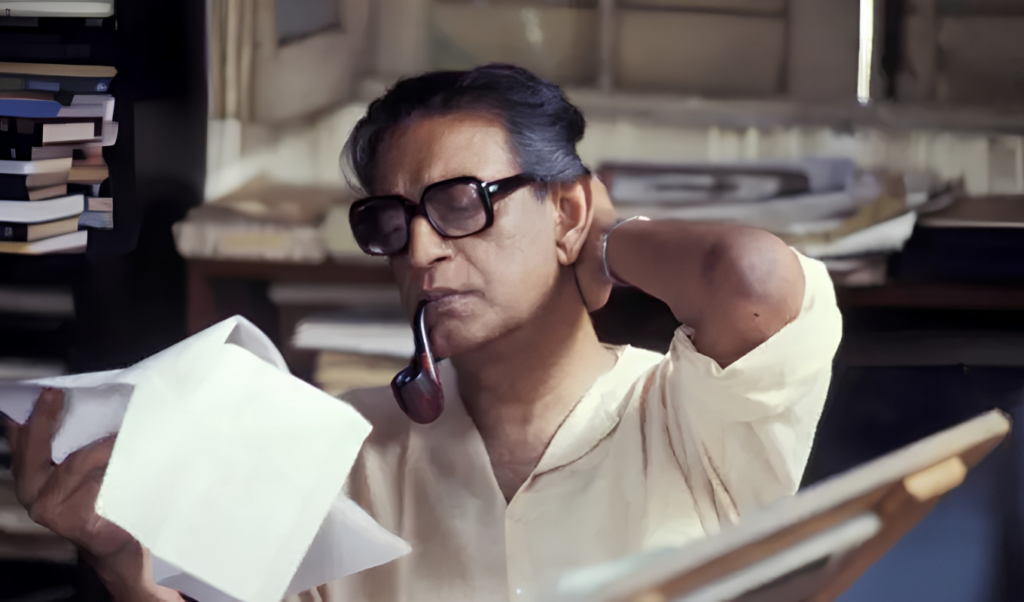
Satyajit Ray remains a pre-eminent figure in world cinema, transcending his Bengali roots to become a titan of global arts. Born in Calcutta on 2 May 1921, Ray was a polymath whose genius spanned filmmaking, literature, music composition, and graphic design. His artistic foundation was deeply rooted in his lineage; his father, Sukumar Ray, was a brilliant exponent of Bengali children’s literature, while his grandfather, Upendrakishore Ray Chowdhury, was a pioneering writer, painter, and innovator in printing technology.
Despite this illustrious background, Ray’s early life was marked by hardship. Following the death of his father when he was just three years old, he was raised by his mother, Suprabha Devi. Ray’s academic journey took him to Presidency College, Calcutta, and later to Visva-Bharati University in Santiniketan, founded by Rabindranath Tagore. Although he intended to study there for five years, he departed in 1943 to return to Calcutta.
Ray began his professional career at a British advertising agency, earning a modest monthly salary of 80 rupees. His transition toward cinema was catalysed by two significant encounters: meeting French director Jean Renoir during the filming of The River in Calcutta, and viewing Vittorio De Sica’s Bicycle Thieves in London. These experiences, combined with his founding of the Calcutta Film Society in 1947, steered him toward realism in storytelling.
In 1955, Ray released his debut masterpiece, Pather Panchali. The film garnered 11 international awards, including the “Best Human Document” prize at the Cannes Film Festival. This was followed by Aparajito and Apur Sansar, forming the world-renowned “Apu Trilogy”. Aparajito further solidified his international standing by winning the Golden Lion at the Venice Film Festival.
Key Milestones in Ray’s Cinematic Career
| Year | Film | Language | Notable Significance |
| 1955 | Pather Panchali | Bengali | Debut; Winner of “Best Human Document” at Cannes |
| 1956 | Aparajito | Bengali | Winner of the Golden Lion at Venice Film Festival |
| 1958 | Jalsaghar | Bengali | Exploration of the decline of the landed gentry |
| 1962 | Kanchenjungha | Bengali | Ray’s first original screenplay and first colour film |
| 1964 | Charulata | Bengali | Regarded as one of his finest works; based on Tagore |
| 1977 | Shatranj Ke Khilari | Hindi/Urdu | His first non-Bengali film and most expensive production |
| 1984 | Ghare Baire | Bengali | Notable for including his first on-screen kiss |
| 1991 | Agantuk | Bengali | Ray’s final completed feature film |
Beyond the director’s chair, Ray’s literary contributions were equally transformative. He created iconic characters such as the private investigator Feluda and the scientist Professor Shonku. His marriage to Bijoya Das in 1949 produced a son, Sandip Ray, who became a notable filmmaker in his own right.
Following a heart attack in 1983, Ray’s health declined, requiring his son’s assistance to complete Ghare Baire. His final trilogy—Ganashatru, Shakha Proshakha, and Agantuk—was markedly more dialogue-driven. In 1992, shortly before his death on 23 April, Ray received an Honorary Academy Award for lifetime achievement. His other accolades include the Bharat Ratna, the Dada Saheb Phalke Award, and the Legion of Honour from France.