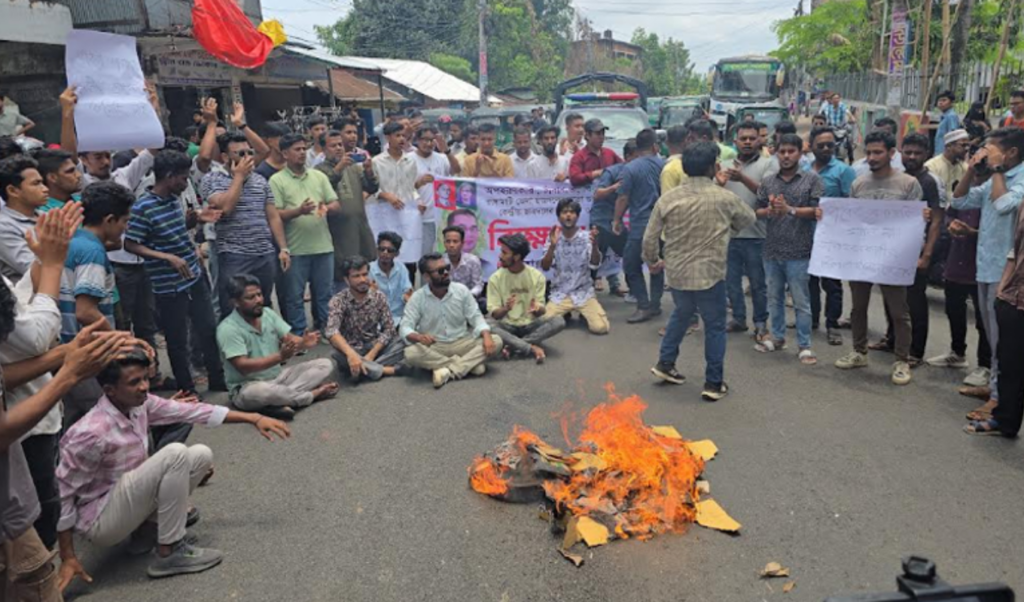
On Monday, 4 May 2026, the political landscape in Barisal City was marked by significant unrest as aggrieved members of the Jatiyatabadi Chhatra Dal (JCD)—the student wing of the Bangladesh Nationalist Party (BNP)—staged a robust protest. The demonstration was triggered by the announcement of the new Barisal Metropolitan Chhatra Dal committee, which protesters claim has systematically excluded dedicated and “tested” activists in favour of questionable appointments.
The unrest commenced in the evening when dozens of disillusioned JCD workers gathered at the Amtala Crossing, a strategic junction within the city. The demonstrators proceeded to establish a blockade on the Dhaka-Kuakata Highway, a vital arterial route for regional transport. The obstruction caused an immediate cessation of vehicle movement, resulting in extensive tailbacks on both sides of the highway. Passengers, commuters, and transport workers were subjected to significant hardship as the gridlock persisted during the peak evening hours.
Allegations of Marginalisation and Lack of Meritocracy
The protest was led by prominent local JCD figures, including Asadullah Hawlader and Redwan Khan Rakib, both of whom were excluded from the newly sanctioned metropolitan committee. Speaking to observers at the scene, the leaders articulated their grievances, asserting that the new leadership structure fails to reflect the sacrifices made by grassroots activists during the party’s most challenging periods.
“We have been on the front lines during the party’s most difficult times, leading movements and facing the brunt of legal harassment, arrests, and state oppression,” stated Asadullah Hawlader and Redwan Khan Rakib. “Despite our dedication, we have been conspiratorially excluded from the newly announced metropolitan committee.”
The protesters clarified that their objective was not to dismantle the entire committee but to ensure the inclusion of those who have historically suffered for the party’s cause. They emphasised that for the vision of a “new Bangladesh” under the leadership of BNP Acting Chairman Tarique Rahman to be realised, the party must first prioritise the evaluation and inclusion of its most loyal and persecuted members.
Police Intervention and Resolution of the Blockade
The blockade remained in effect until senior leaders from the Barisal district BNP and the Jatiyatabadi Yuva Dal (the party’s youth wing) arrived at the scene. Following a series of negotiations and assurances that their grievances would be formally communicated to the central leadership in Dhaka for further review, the protesters agreed to vacate the highway.
Al Mamun Ul Islam, the Officer-in-Charge (OC) of the Barisal Kotwali Model Police Station, confirmed the incident. He noted that although a group of disgruntled Chhatra Dal activists had indeed gathered at the Amtala Crossing to register their protest, they dispersed before the police could arrive in full force. He further stated that the situation in the surrounding areas returned to normal shortly after the blockade was lifted and that law enforcement remains vigilant to prevent any further disruption of public order.
Broader Organisational Context
The protests in Barisal follow a wider trend of internal reorganisations within the JCD. On Saturday, 2 May 2026, the JCD central leadership, under President Rakibul Islam and General Secretary Nasir Uddin, approved new committees for 29 units nationwide, including districts, metropolitan areas, and universities. While the central body has described these changes as essential for “increasing the organisation’s dynamism,” the Barisal incident underscores the persistent challenge of balancing central directives with grassroots expectations during the transition of leadership. For now, the Barisal Metropolitan Chhatra Dal remains in a state of functional tension as the excluded leaders await a formal response from the high command.