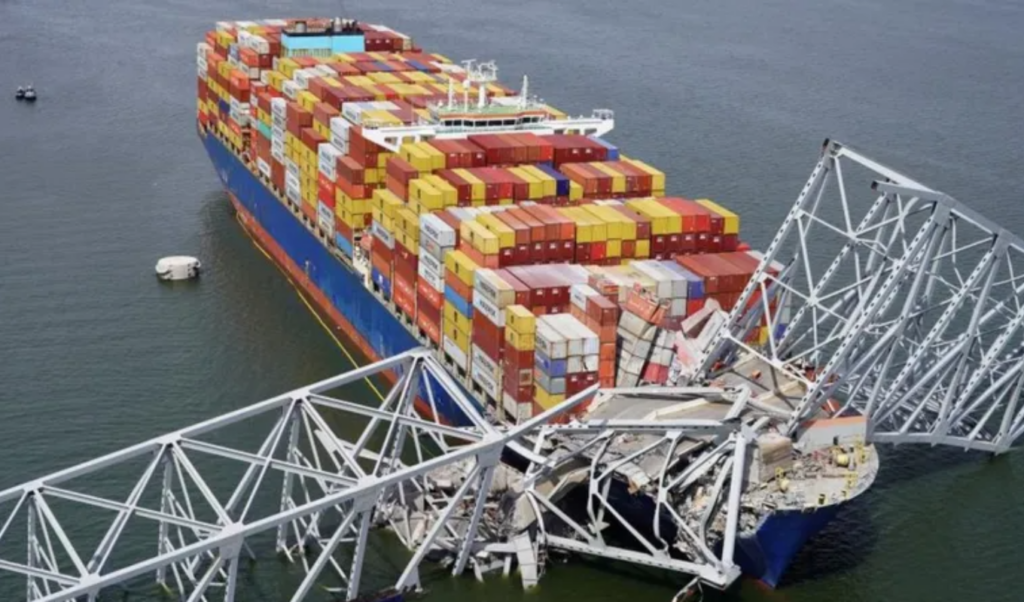
The global marine insurance sector is navigating a transformative fiscal challenge as updated estimates for the collapse of Baltimore’s Francis Scott Key Bridge now exceed $2.8 billion (£2.23 billion). This figure, detailed in a comprehensive market analysis by Howden Re in early 2026, confirms the catastrophe as the most significant marine insurance loss on record. This revised total represents a substantial increase from the initial $1.5 billion reserves established shortly after the March 2024 incident, when the Singapore-flagged container vessel, the M/V Dali, collided with a primary support pier.
Redefining Historical Benchmarks
Before the Baltimore incident, the industry’s primary benchmark for marine liability was the Costa Concordia disaster of 2012. The grounding of the luxury cruise liner off the Italian coast resulted in approximately $1.6 billion in insured losses. The Baltimore collapse has now exceeded this historical peak by more than $1.2 billion, fundamentally altering catastrophe modelling expectations within the marine and specialty reinsurance sectors.
Unlike the Costa Concordia, where costs were largely driven by a decade of intricate salvage and litigation, the Baltimore loss is primarily dictated by:
-
Infrastructure Replacement: The immense capital required to reconstruct a vital transport artery.
-
Third-Party Liabilities: Complex legal and economic claims arising from the blockage of a major international port.
Primary Drivers of the Valuation Surge
The upward revision to $2.8 billion is predominantly attributed to a landmark settlement framework between the State of Maryland and the insurer Chubb. This agreement alone accounts for roughly $2.5 billion of the total, covering the state’s property claims and facilitating the urgent commencement of a replacement crossing.
Beyond the physical structure, several complex liability streams have contributed to the final figure:
-
Wreck Removal: Extensive operations by the US Army Corps of Engineers to clear the shipping channel.
-
Lost Toll Revenue: The Maryland Transportation Authority (MDTA) faced severe deficits; the bridge previously facilitated the transit of 11.5 million vehicles annually.
-
Pollution Liabilities: Managing environmental risks associated with the vessel’s cargo and fuel.
-
Wrongful Death Settlements: Legal compensation for the families of the six workers lost in the collapse.
Risk Concentration in Reinsurance and Retrocession
The financial burden of the Baltimore disaster is expected to bypass primary insurers, falling instead upon the global reinsurance and retrocession markets. This is a direct consequence of how marine liability is structured via the International Group of P&I Clubs (IG), which covers 90% of global ocean-going tonnage through a sophisticated pooling mechanism and an extensive excess-of-loss reinsurance “tower.”
While initial fears suggested the total $3 billion limit of the IG’s reinsurance placement might be exhausted, the final settlements did not rely on the statutory shipowner liability limits under the Limitation of Liability Act of 1851. Consequently, the losses have permeated multiple layers of the reinsurance tower. For certain market participants, a singular event of this magnitude represents a significant portion of their annual capital allocation for specialty risks.
Market Resilience and the Path to 2030
Despite the unprecedented scale of the claim, the broader (re)insurance market has demonstrated the capacity to absorb the loss without a systemic failure. Marine and energy portfolios are traditionally managed alongside “peak” natural catastrophe (nat-cat) exposures, such as Atlantic hurricanes, where single-event losses can exceed $100 billion.
Nevertheless, the Baltimore incident has served as a strategic “speed-bump,” tempering the trend of falling premium rates in the marine sector. During the April 2026 renewals, reinsurers showed increased scrutiny regarding risk appetite for large-scale infrastructure and P&I liabilities. While fresh capital inflows have prevented a full “hard market,” the industry remains vigilant. The incident remains a definitive example of a “long-tail” claim, with legal and reconstruction activities projected to continue until the replacement bridge’s anticipated opening in late 2030.