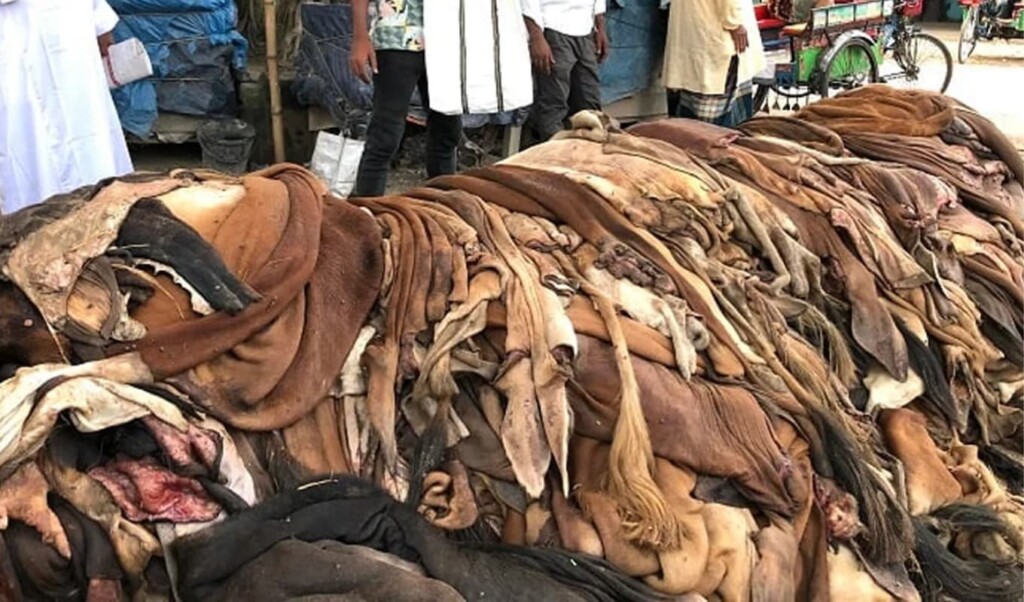
The domestic raw hide market across Bangladesh has experienced a sharp price devaluation during the current Eid-ul-Adha festive season, with transaction values collapsing well below the statutory rates mandated by the government. Despite the Ministry of Commerce increasing the official price of salted cowhide by BDT 2 per square foot compared to the previous year’s fiscal index, seasonal traders and wholesale merchants faced a depressed market, with raw hides trading at BDT 150 to BDT 200 less per unit than last year’s averages. Concurrently, wholesale buyers and tanners showed almost no interest in purchasing goat skins, causing that specific market segment to remain stagnant.
This sharp domestic price drop stands in contrast to the broader export performance of the sector. Data shows that while Bangladesh’s outbound shipments of leather and finished leather goods have grown steadily over the last two fiscal years, the local raw material market has failed to see any corresponding price recovery, leaving small-scale holiday collectors unable to secure government-appraised returns.
Analysis of Appraised Tariffs Versus On-Site Cash Transactions
The Ministry of Commerce determines the seasonal price framework for salted hides each year following consultations with trade syndicates and industrial manufacturing groups. On 13 May, the Minister for Commerce, Khandaker Abdul Muktadir, finalized the seasonal tariff structure. For the capital city of Dhaka, the baseline value for salted cowhide was set between BDT 62 and BDT 67 per square foot, a minor adjustment from the BDT 60 to BDT 65 benchmark enforced during the prior holiday season.
Standard leather industry classifications group cowhides into three distinct volumetric brackets based on surface area dimensions:
-
Large Hides: 31 to 40 square feet
-
Medium Hides: 21 to 30 square feet
-
Small Hides: 16 to 20 square feet
Under these government-sanctioned parameters, a processed, salted small hide should mathematically command a baseline value ranging from BDT 990 to BDT 1,200. Medium salted hides are valued between BDT 1,300 and BDT 1,850, while premium large salted hides should attract competitive bids between BDT 1,900 and BDT 2,600.
However, because seasonal transactions operate almost exclusively on raw, untreated hides during the immediate 48-to-72-hour window following ritual slaughter, standard processing overheads must be factored into the final price. Industry analysts estimate that curing an individual raw hide requires an average overhead expenditure of BDT 350 to cover chemical salt procurement and physical labor wages.
Subtracting these processing liabilities establishes the realistic target value for raw, uncured hides across Dhaka’s primary collection points: small raw hides should trade between BDT 650 and BDT 850; medium units between BDT 950 and BDT 1,500; and large premium units between BDT 1,550 and BDT 2,300.
The sharp divergence between these mathematically adjusted target values and the actual cash transactions recorded across key collection points on Eid day is detailed in the table below:
| Hide Classification | Surface Area Profile | Adjusted Raw Target Value | Actual Dhaka Field Price | Post-Processing Deficit |
| Small Cowhide | 16 to 20 sq. ft. | BDT 650 – BDT 850 | BDT 250 – BDT 400 | BDT 400 – BDT 450 |
| Medium Cowhide | 21 to 30 sq. ft. | BDT 950 – BDT 1,500 | BDT 500 – BDT 650 | BDT 450 – BDT 850 |
| Large Cowhide | 31 to 40 sq. ft. | BDT 1,550 – BDT 2,300 | BDT 700 – BDT 800 | BDT 850 – BDT 1,500 |
| Goat Skin | Standard Volumetric | Not Explicitly Appraised | BDT 5 – BDT 10 | Complete Market Stagnation |
Field Realities Across Dhaka’s Wholesale Trading Hubs
Field assessments conducted across Dhaka’s primary trading hubs—including Mohammadpur Town Hall, Dhanmandi, Science Laboratory, and the central Posta merchant district in Lalbagh—confirmed widespread price depreciation. Medium cowhides, which consistently fetched BDT 700 to BDT 800 last year, dropped to a trading band of BDT 500 to BDT 650. Concurrently, goat skins collapsed to nominal values of BDT 5 to BDT 10 per unit, extending a multi-year trend of minimal returns for this commodity.
At the Dhanmandi collection zone, independent seasonal trader Faruk Hossain, who has worked the holiday market for eight consecutive years, described the pricing challenges. Having amassed 15 mixed cowhides from Kalabagan, Hossain attempted to negotiate a wholesale unit price of BDT 1,000 with a commercial middleman, Mohammad Rubel. Rubel refused to exceed a counter-offer of BDT 650. Hossain subsequently approached a corporate tanner procurement team stationed nearby at the Science Laboratory junction, only to receive a lower quote of BDT 600.
“Last year, I cleared hides of identical quality for BDT 800 to BDT 900 per unit,” Hossain noted. “Given the current conditions, I was prepared to sell at a loss for BDT 750, but the bidding stayed flat at BDT 650.”
Primary supply networks in the Posta district reported even lower valuations than those observed at the Science Laboratory crossroads. Large and medium cowhides topped out at BDT 500 to BDT 700, while small hides faced outright rejection from several warehousing agents. Those who accepted small hides capped their payout limits at BDT 250 to BDT 300 per unit, a drop from last year’s Posta baseline of BDT 700 to BDT 900.
At the Lalbagh Balur Math collection depot, Abdul Kader, the Principal of the Uttara-based Nurul Quran Madrasah, faced similar conditions while trying to liquidate an inventory of approximately 150 donated raw hides. Corporate agents refused to offer quotes higher than BDT 550 per unit.
“We logged substantial transport overheads to move this bulk inventory via freight trucks to this central hub,” Kader explained. “We lack the storage infrastructure to preserve this stock ourselves, meaning we are forced to liquidate at whatever cash rate the buyers dictate. Last year, we cleared comparable units for BDT 750. The government issues public price declarations but fails to deploy field enforcement teams to stabilize the actual market.”
This domestic price drop extended well beyond the capital:
-
Chittagong Port Authority Jurisdiction: Regional hides changed hands within a baseline bracket of BDT 200 to BDT 600, with most independent sellers failing to breach the BDT 350 mark. At the Choumuhani temporary holiday trade market, regional merchant Mohammad Didar Hossain detailed his operational losses after accumulating 40 units at an average cost of BDT 400 each, excluding transport. Upon arrival at the central depot, local agents refused to quote prices higher than BDT 150 to BDT 200.
-
Savar Tannery Estate (Dhaka Outskirts): At the main gates of the central industrial complex, raw stock from surrounding rural districts changed hands for BDT 300 to BDT 500. Mufti Mohammad Abul Hasan Shahzali, representing a charitable madrasah in Dhamrai, attempted to offload 50 premium cowhides but faced maximum offers of BDT 300 to BDT 400, contrasted against the BDT 800 to BDT 900 returns his institution achieved last season.
Supply Volatility and Macroeconomic Targets
According to official projections published by the Department of Livestock Services (DLS), the total volume of sacrificial animals prepared for the festive season stood at roughly 12.33 million units, measured against an estimated nationwide consumer demand of 10.11 million units. While exact slaughter figures remain unquantified, anticipation of broader macroeconomic pressures prompted the Bangladesh Tanners Association (BTA) to adjust their aggregate procurement targets downward to 7.5 to 8.0 million hides, compared to the 8.0 to 8.5 million units targeted the previous year.
Field reports confirm that overall raw supply volumes contracted during the opening phase of the holiday. At the metropolitan Town Hall market, seasonal trader Umaer Hossain reported buying just 23 units by early afternoon, compared to over 150 hides secured during the identical timeframe last year, suggesting a lower overall slaughter rate.
Institutional Disconnect and Conflicting Sector Explanations
The structural failure to enforce official prices is a long-standing issue in the sector. Raw hide values last peaked during the 2013 holiday season, when cowhide consistently achieved returns of BDT 85 to BDT 90 per square foot. In the years that followed, structural inefficiencies triggered a steady downward trend, culminating in a severe market collapse in 2019. During that period, zero-value returns forced merchants to dump or bury bulk stockpiles nationwide, resulting in an estimated BDT 2.42 billion loss in raw materials. By 2020, baseline values bottomed out at BDT 35 to BDT 40 per square foot. Despite incremental increases to the official rate over the last five years, actual market transactions have consistently failed to meet government targets.
Stakeholders from different parts of the supply chain offer conflicting explanations for this persistent pricing gap:
-
The Local Brokers and Middlemen: Primary collectors and local purchasing agents argue that tanners refuse to offer commitments that match the government’s higher price targets. Wholesale collector Mohammad Shahjahan, who operated across Kalabagan buying stock at an average of BDT 650, noted that industrial processing plants passed down rigid pricing caps due to rising input costs. “The industrial tanneries explicitly informed our syndicates that escalating chemical costs and manufacturing overheads mean they will not honor rates above BDT 600 to BDT 700. We are forced to compress our buying rates by BDT 100 to BDT 150 compared to last season to protect a razor-thin profit margin of BDT 50 to BDT 60 per hide.”
-
The Ministry of Commerce: Commenting on the price gap, the Secretary of the Ministry of Commerce (Routine Duties), Mohammad Abdur Rahim Khan, attributed the low initial prices to a lack of immediate preservation. “Our field directives focus heavily on ensuring that merchants apply salt preservation methods immediately following slaughter. Raw, untreated hide naturally commands a lower value due to rapid degradation risks. We expect that once these hides are properly salted and cured, transactions will align with the official pricing framework.”
-
The Wholesalers’ Association: Mohammad Tipu Sultan, President of the Bangladesh Hide and Skin Merchants Association (BHSMA), offered a different view of the market, claiming that most central transactions occurred within acceptable boundaries. “Raw hide procurement relies on rapid visual assessment rather than precise surface measurement at the point of collection, which can naturally result in minor variations of BDT 50.”
-
The Industrial Tanners: The Bangladesh Tanners Association (BTA) rejected claims of market depression. BTA Senior Vice-Chairman Mohammad Sakhawat Ullah asserted that baseline prices had actually improved over last year’s figures. “Our internal monitoring indicates that current purchase values are up by BDT 20 to BDT 50 per unit. My personal procurement teams successfully bought raw stock within a standard bracket of BDT 650 to BDT 950.”
Environmental Hurdles to International Export Growth
The primary long-term obstacle holding back raw hide values is rooted in environmental compliance failures at the processing stage. Data published by the Export Promotion Bureau (EPB) shows that during the initial ten months of the current 2025–26 fiscal year (July–April), Bangladesh’s leather and leather-product export revenues reached USD 990 million, representing a 6 percent expansion compared to the corresponding period in the prior fiscal year, which closed at an aggregate value of USD 1.15 billion.
Despite these revenue gains, economists point out that the sector is heavily underperforming due to ongoing environmental problems at the Savar Tannery Estate in Hemayetpur. The state-initiated relocation project from Hazaribagh, which began in 2003, has failed to establish a fully compliant manufacturing zone after 21 years of development.
The 200-acre Savar estate remains unable to secure certification from the international Leather Working Group (LWG) because its Central Effluent Treatment Plant (CETP) is consistently under-capacitated, resulting in toxic waste spillage into the adjacent Dhaleshwari River. As a direct consequence, major consumer brands from Europe and North America are legally restricted from buying Bangladeshi leather directly. This leaves mainland Chinese firms as the dominant buyers for the country’s leather output, allowing them to leverage their market position to keep purchase prices low.
Dr Mohammad Abu Yusuf, Professor at the Department of Development Studies, University of Dhaka, and Executive Director of the Research and Policy Integration for Development (RAPID), emphasized that the path to a structural recovery is clear but requires implementation.
“The structural vulnerabilities and potential solutions for the domestic leather sector have been extensively documented for decades,” Dr Yusuf stated. “The core issue is a long-standing lack of regulatory will to complete critical environmental infrastructure. If the state executes a strict, two-year corrective roadmap focused on repairing the CETP and helping individual factories build standalone treatment units, at least 15 to 20 operational tanneries could quickly secure LWG certification. This would open direct access to western markets, potentially driving annual sector export revenues up to USD 10 billion or USD 12 billion. Once that level of global demand is unlocked, domestic raw hide prices will naturally stabilize without requiring government intervention.”