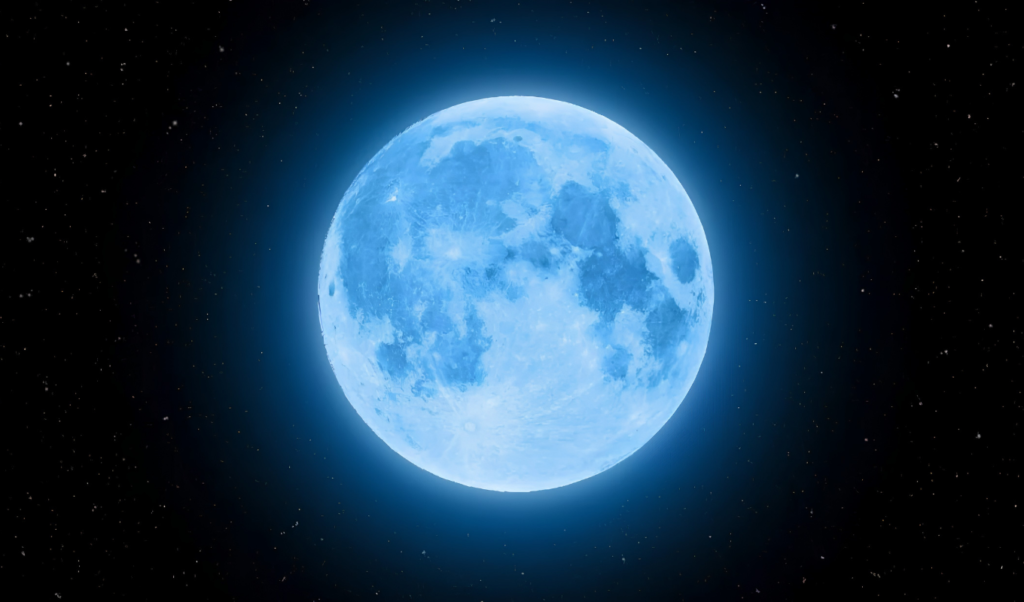
A rare and remarkable celestial event is set to unfold in the night sky on Sunday, 31 May 2026. According to the United States National Aeronautics and Space Administration (NASA), millions of spectators across Asia, Australia, Europe, and the Americas will be able to observe a “Blue Moon,” provided that local weather conditions remain clear.
The event marks the first occurrence of a Blue Moon since August 2023. This brings to an end a nearly three-year hiatus, offering stargazers worldwide a unique opportunity to witness this specific lunar phenomenon.
The Astronomy Behind the Phenomenon
Despite its evocative name, a Blue Moon does not actually appear blue. Astronomers clarify that the Moon will retain its characteristic silvery-white or striking golden hue as it rises in the eastern sky. In astronomical terms, a Blue Moon refers to the second full moon that occurs within a single calendar month.
Because the lunar cycle—specifically a synodic month—lasts approximately 29.5 days, the discrepancy between the lunar cycle and the standard calendar year creates an overlap every two to three years. This alignment occurs precisely seven times within a 19-year Metonic cycle.
The phrase “once in a blue moon” dates back to the 16th century in Western society, where it was colloquially used to describe an impossible or highly improbable event. However, history records a notable exception to the lunar colour palette. Following the cataclysmic eruption of the Krakatoa volcano in Indonesia in 1883, vast quantities of ash and sulphur dioxide were propelled into the upper atmosphere. This atmospheric pollution selectively scattered light, causing the Moon to visibly appear blue to observers on the ground for a temporary period.
A Concurrent ‘Micro Moon’
The significance of the event on 31 May is heightened by the fact that it is also a “Micro Moon”. A Micro Moon occurs when a full moon coincides with “apogee”—the specific point in the Moon’s elliptical orbit where it is furthest from Earth.
During this particular full moon, the satellite will be situated approximately 406,093 kilometres (252,334 miles) away from Earth. This distance is significantly greater than the average orbital distance of 384,400 kilometres. Consequently, scientists have confirmed that this will be the furthest and smallest full moon of the entirety of 2026.
| Lunar Phase Metric | Distance in Kilometres | Distance in Miles | Visual Size Relative to Average |
| Average Lunar Distance | 384,400 km | 238,855 miles | Standard Baseline |
| 31 May 2026 Full Moon | 406,093 km | 252,334 miles | Approximately 10% Smaller |
Due to this increased distance, the Moon will appear roughly 10 per cent smaller than a standard full moon. However, astronomers note that this subtle variation in size is rarely discernible to the unaided human eye.
Viewing Times and Advice
While observers in the Americas and Europe witnessed the peak fullness of the Moon on the night of 30 May, skywatchers in Asia—including Bangladesh—will see the Moon at its brightest and most completely illuminated state on the evening of Sunday, 31 May.
Meteorologists have assured the public that no specialised equipment, such as expensive telescopes or protective eyewear, is necessary to view the event safely. The phenomenon can be observed clearly with the naked eye.
The optimum viewing window is predicted to be early in the evening, specifically between 17:30 and 18:30, as the Moon sits close to the horizon. At this low angle, light passing through the denser layers of the Earth’s atmosphere will tint the lunar surface, presenting a vivid orange or golden glow. This creates an ideal window for photography via smartphones. Following tonight’s event, the next Blue Moon will not occur until 31 December 2028.