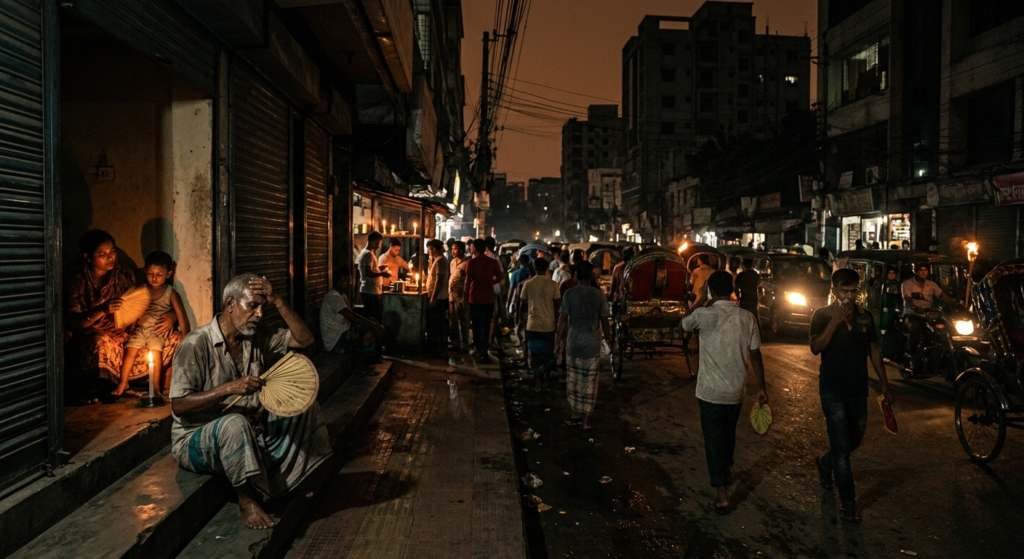
A major power grid failure plunged several central neighbourhoods of Dhaka into darkness on Saturday, bringing routine life to a complete standstill for nearly five hours. The unexpected blackout, which struck densely populated and commercial hubs including Moghbazar, Banglamotor, Kawran Bazar, and Hatirpool, left residents, business owners, and commuters facing severe disruption amidst sweltering summer temperatures. Preliminary reports from the electricity supply authorities indicate that a technical fault within the power transmission network triggered the widespread collapse.
The prolonged outage quickly led to a domestic crisis across the affected areas as electric water pumps stopped functioning, triggering an acute water shortage in numerous residential high-rises. Inside apartments, the stifling heat became unbearable without fans or air conditioning, causing immense distress to vulnerable citizens, particularly children, the elderly, and the unwell. Desperate for relief, many residents abandoned their suffocating homes to gather on the streets and in open spaces.
Commercial operations in Kawran Bazar and Banglamotor—two of the capital’s busiest economic centres—bore the brunt of the disruption. Corporate offices, retail shops, and restaurants were forced to halt or severely scale back their activities. While larger establishments relied on standby diesel generators to keep minimal services running, the escalating fuel costs eroded their daily profit margins. Smaller traders without alternative power sources suffered a near-total loss of business, reporting a drastic drop in sales as customers stayed away from dark and humid shops.
The crisis extended beyond immediate power loss, severely impacting digital infrastructure and urban mobility. As backup batteries at local mobile towers depleted over the five-hour period, telecommunication networks deteriorated, disrupting mobile internet and voice calls. Simultaneously, automated traffic signalling systems failed at key intersections. This network collapse triggered gridlock along major thoroughfares, forcing traffic police to manage the chaotic vehicular flow manually in the intense heat.
Engineers from the power distribution companies were deployed immediately after the fault was identified to undertake emergency repairs. Technicians worked to isolate the damaged transmission components, gradually restoring electricity to the affected sectors in a phased manner by the evening. Following the incident, local residents and business groups urged authorities to modernise the city’s ageing electrical infrastructure and establish reliable backup grids to prevent such prolonged outages in the future.