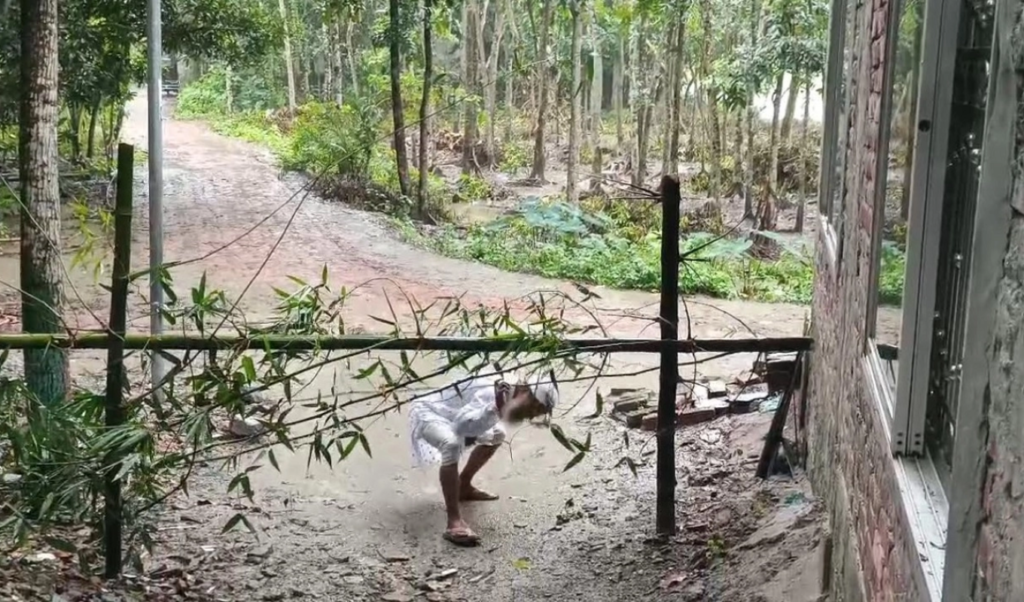
A bitter property dispute in Chandpur’s Matlab Uttar upazila culminated in public outrage after a local resident erected a bamboo barricade across the primary entrance of a village mosque, severely restricting access for worshippers. The incident took place at the Bhuiyakandi Dakshinpara Baitul Aman Jame Mosque in the Durgapur Union, leaving local residents struggling to attend daily congregational prayers.
According to local accounts, the sanctuary’s origin dates back to 1982, when three brothers—Shafiqul Islam, Rafiqul Islam, and Monir Hossain—jointly donated three decimals of land to establish a place of worship for the surrounding community. At a later stage, to resolve technical record complexities and accommodate expansion, Shafiqul and Monir donated an additional decimal of land. For decades, the mosque operated smoothly on the designated site, with villagers raising communal funds to construct a permanent concrete structure.
Tensions have nevertheless brewed over the past eight years. Mosque management officials and local residents allege that Rafiqul Islam has repeatedly obstructed ongoing infrastructure development and maintenance projects. Community members further claimed that he previously chopped down trees belonging to the mosque compound without committee authorization. The long-standing disagreement escalated dramatically on Monday when worshippers arriving for morning prayers discovered a freshly constructed bamboo fence barring the main gateway.
Worshippers expressed deep dismay over the physical barrier, pointing out that squeezing past the obstruction creates severe inconvenience, particularly for elderly and infirm members of the congregation. Sahanur Alam, the general secretary of the mosque management committee, noted that locking out the public from a shared place of worship has disrupted routine religious observances and urged administrative authorities to step in swiftly.
Idris Ali Pradhan, president of the mosque management committee, clarified that the permanent structure was built with collective financial contributions from local families on the donated plot. However, Rafiqul recently put forward a fresh claim, asserting that a portion of the building encroaches onto his personal property. Although community elders sought to convene a formal dialogue among all three brothers to review the land deeds, the meeting never materialized, and the entrance was abruptly enclosed without prior notice.
Refuting the allegations of deliberate malice, Mohammad Rafiqul Islam insisted that the fence stands entirely within his private land boundaries rather than on mosque property. He maintained that both internal and external sections of the structure fall within his legal plot line and alleged that certain members of the management committee had previously threatened to expel him from the premises. Rafiqul confirmed that he has lodged a formal written complaint with the local police station to assert his land rights.
Matlab Uttar Upazila Nirbahi Officer (UNO) Mahmuda Kulsum Moni stated that the local administration views any unauthorized blockade of public thoroughfares or religious institutions with gravity. She assured the public that officials will convene discussions with both parties to mediate a peaceful and lawful resolution once formal communications are established. Land ownership disagreements involving religious institutions remain a persistent social challenge across rural Bangladesh, where vague boundaries and informal land deeds frequently trigger friction between private owners and local committees.