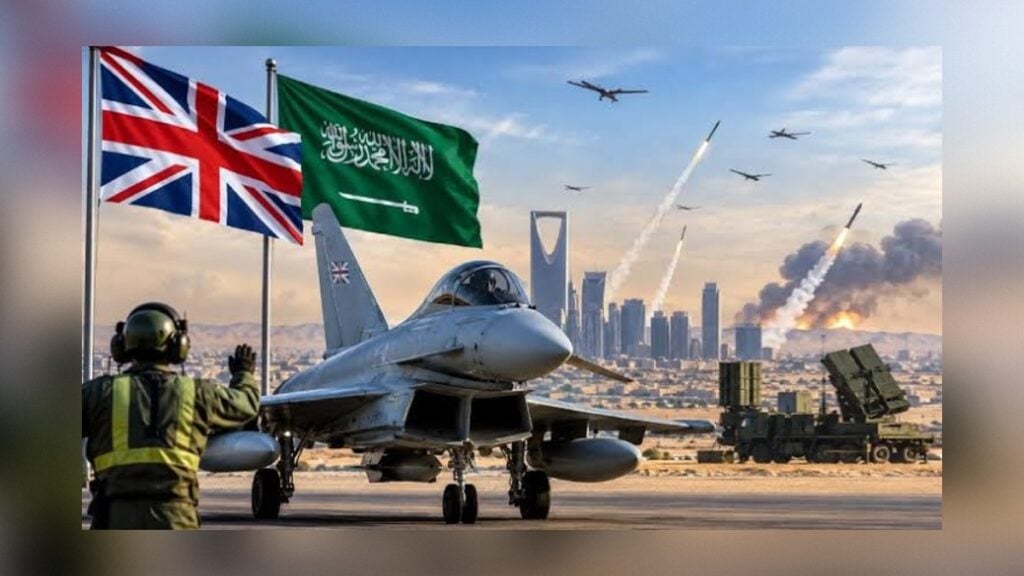
The United Kingdom has announced plans to deploy Royal Air Force (RAF) Typhoon fighter jets to Saudi Arabia to strengthen the kingdom’s defences against missile and drone attacks by Yemen’s Iran-backed Houthi rebels.
The decision follows a series of deadly strikes targeting Saudi cities, airports and critical energy infrastructure, raising concerns about regional security and the potential consequences for international energy supplies.
In a statement issued on Tuesday, British Defence Secretary Wes Streeting confirmed that the aircraft would operate exclusively in a defensive capacity. He stressed that the deployment was intended to protect Saudi territory rather than conduct offensive operations against Houthi positions in Yemen.
The British government said RAF Typhoon aircraft would assist in safeguarding Saudi cities and strategically important facilities from aerial threats, particularly missiles and unmanned drones launched by the Houthis.
The Ministry of Defence also announced an extension of existing British military assistance that enables Saudi fighter aircraft to receive fuel from other aircraft while airborne. This capability allows military jets to remain operational for longer periods without returning to their bases for refuelling.
The additional support represents an expansion of the United Kingdom’s existing military cooperation with Saudi Arabia, where British personnel and equipment are already involved in efforts to strengthen the kingdom’s aerial defences.
Deadly Attacks Prompt Additional Military Support
The announcement comes after Houthi forces carried out attacks on Riyadh, the Saudi capital, and energy facilities situated along the country’s coastline.
Saudi authorities reported last week that Houthi attacks targeting the kingdom’s airports had killed 19 people.
One of the deadliest incidents occurred on 10 October, when a missile struck Riyadh International Airport, killing 13 people and injuring 308 others.
The attack was described as the deadliest to hit Saudi Arabia in more than a decade, highlighting the severity of the security challenges facing the kingdom.
The scale of the casualties has intensified concerns about the vulnerability of civilian infrastructure to missile and drone strikes. Airports are particularly sensitive targets because attacks can endanger passengers, disrupt aviation operations and affect transport connections.
Saudi Arabia’s energy facilities are another significant concern. As one of the world’s major oil-producing countries, the kingdom plays an important role in international energy markets, making the security of its production and export infrastructure a matter of wider economic interest.
The British decision to provide additional aerial protection comes against this backdrop of heightened regional instability.
Britain Emphasises Defensive Nature of Deployment
Defence Secretary Wes Streeting strongly condemned the repeated Houthi attacks on Saudi Arabia, describing them as unacceptable acts of aggression against a country with which Britain maintains close relations.
He said the strike on Riyadh’s international airport demonstrated the willingness of Houthi forces to aggravate an already volatile regional security situation.
Streeting explained that the seriousness of the attacks had prompted him to authorise further British military assistance.
According to the defence secretary, RAF Typhoon fighter jets will conduct defensive air operations designed to help protect Saudi airspace from incoming missiles and drones.
He made clear that the aircraft would not be deployed to launch attacks against the Houthis themselves.
The distinction is significant because it defines the limits of Britain’s announced military involvement. Rather than undertaking offensive missions in Yemen, the British aircraft are expected to contribute to defensive operations within Saudi airspace.
Streeting also said the deployment would build upon the British military presence already established in Saudi Arabia.
British equipment and personnel have been assisting the kingdom in responding to aerial threats, and the additional aircraft are intended to reinforce those existing arrangements.
The extension of air-to-air refuelling support forms another part of the assistance package, helping Saudi aircraft maintain their operational capabilities during defensive missions.
Yemen’s Civil War Remains Central to Conflict
The escalation in attacks against Saudi Arabia is closely connected to Yemen’s prolonged civil war.
The Iran-backed Houthi movement has been fighting forces associated with Yemen’s internationally recognised government, which receives support from Saudi Arabia.
The Houthis control significant areas of Yemen, including the capital, Sanaa, and have remained a central force in the country’s conflict.
Saudi Arabia’s involvement in supporting the internationally recognised Yemeni government has made the kingdom a target of Houthi military operations.
The Houthis have presented their attacks on Saudi territory as retaliation for strikes by Saudi-backed Yemeni government forces against areas under Houthi control.
This cycle of military action and retaliation has contributed to tensions extending beyond Yemen’s borders.
Missile and drone attacks against Saudi Arabia demonstrate how the conflict can affect neighbouring countries and threaten infrastructure far removed from the main battlefields.
The latest British announcement also reflects the security challenges associated with protecting civilian populations and essential facilities from aerial attacks.
Although the United Kingdom has explicitly ruled out using the newly deployed aircraft for offensive strikes against the Houthis, the continuing conflict in Yemen remains an important factor behind the decision to strengthen Saudi Arabia’s defences.
Rising Energy Costs Add to British Concerns
The military announcement comes as the British government faces growing concerns over rising domestic energy prices.
Gas and electricity costs have been increasing in the United Kingdom, creating additional pressure on the government as it considers the wider implications of instability in major energy-producing regions.
Reporting from London, Al Jazeera journalist Camille Nedelec said the British government’s concerns about rising energy prices had also influenced its decision to provide additional military assistance to Saudi Arabia.
The security of Saudi Arabia’s energy infrastructure carries significance beyond the kingdom itself.
Disruption to major production facilities or export operations could create uncertainty in international energy markets, particularly when global supplies are already subject to economic and geopolitical pressures.
For Britain, developments affecting energy-producing countries are relevant to broader concerns about energy security and the cost of living.
The relationship between regional stability and energy markets helps explain why attacks on Saudi infrastructure have attracted international attention.
Nevertheless, the British government’s publicly stated purpose for deploying Typhoon aircraft remains the protection of Saudi cities and critical facilities against Houthi missile and drone attacks.
The decision reinforces existing defence cooperation between London and Riyadh at a time when the consequences of Yemen’s conflict are increasingly affecting regional security.
With Houthi attacks continuing to threaten Saudi territory, the additional British military support is intended to improve the kingdom’s ability to respond to aerial threats while maintaining a defensive role for RAF personnel and aircraft.