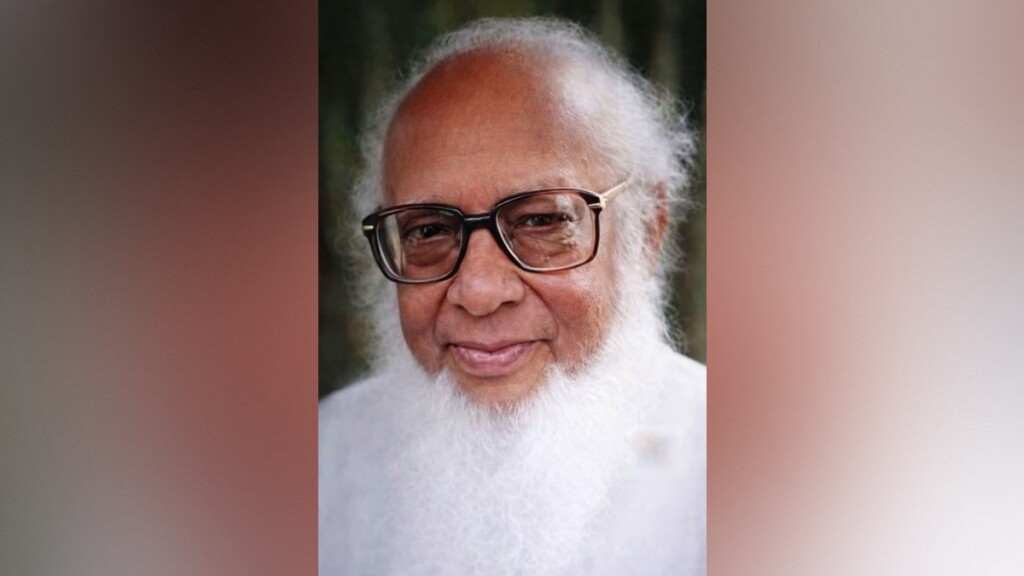
“Literature and culture play an immense role in enriching the human mind and intellect—Professor Syed Ali Ahsan’s life and work stand as a unique testament to this truth.”
Birth and Family Heritage
An illustrious son of Bengali literature, education and culture, Professor Syed Ali Ahsan was born on 26 March 1920 in the village of Alokdia in Magura district.
Father: Syed Ali Hamed (School Inspector)
Mother: Syeda Kamrunnahar Khatun (daughter of Syed Mokarram Ali, a zamindar and pir of Agla village in Nawabganj upazila of Dhaka)
Distinguished Academic Life and the Beginning of His Literary Career
From an early age, he had a deep passion for literature and culture. His multifaceted talents began to flourish during his student years. At that time, his stories, essays and poems were regularly published in the renowned literary journals ‘Azad’, ‘Monthly Mohammadi’ and ‘Saugat’. In his formal education, he successfully obtained his bachelor’s and master’s degrees from the Department of English at the University of Dhaka.
Career and Intellectual Movements
Throughout his illustrious career, Professor Syed Ali Ahsan provided leadership to several of the country’s leading educational and cultural institutions:
Anti-British Movement: During his student years, he actively participated in the anti-British independence movement.
Literary Movement: He was the founding general secretary of the ‘East Pakistan Literary Society’. During this period, he developed a strong intellectual movement that brought together Bengali puthi literature and Muslim heritage.
Teaching and Professorship:
1949: Joined the Department of Bengali at the University of Dhaka as a teacher.
1954: Appointed Head of the Department of Bengali at the University of Karachi.
1960–1967: Served as Director of the Bangla Academy, making an outstanding contribution to the promotion of the Bengali language and culture.
1967: Joined the University of Chittagong as a Professor in the Department of Bengali and served as Dean of the Faculty of Arts.
Role in the Great Liberation War
In March 1971, at the beginning of the Liberation War, he went to India. Based in Kolkata, he worked tirelessly throughout the nine-month-long war to build public support for Bangladesh’s independence. As a fearless voice of the Swadhin Bangla Betar Kendra, his writings and powerful speeches made a significant contribution to presenting Bangladesh’s Liberation War to the international community.
Nation-Building and National Responsibilities
His contribution to national policymaking and the establishment of institutional foundations in post-independence Bangladesh remains unforgettable:
1972: He was appointed Vice-Chancellor of the newly established Jahangirnagar University and played a significant role in developing it into a modern educational institution.
National Activities: He led several visionary national initiatives, including the finalisation of the Bengali version of the Constitution of Bangladesh, the English translation of the national anthem, the formulation of the constitution of the Shilpakala Academy, and the merger of the Bangla Academy and the Bangla Development Board.
Other Important Positions:
27 September 1975: Vice-Chancellor of the University of Rajshahi.
1977: Member of the President’s Advisory Council responsible for the Ministries of Education, Culture, Sports and Religion.
1989: National Professor and Chairman of the University Grants Commission.
Notable Works
His contributions to research, literary criticism and creative literature enriched the treasury of Bengali literature. Among his notable works are:
Nazrul Islam
The Poetry of Walt Whitman
Padmavati
Rabindranath: An Introduction to the Evaluation of Poetry
German Literature
Madhusudan: The Poet, Poetry and Poetic Philosophy
Kathabichitra: World Literature
History of Bengali Literature: The Ancient Period
History of Bengali Literature: The Medieval Period
The Chronicle of Bengali Literature: The Modern Period
Honours and Recognition
For his outstanding contributions to the Bengali language and literature, he received the nation’s highest state honours:
Bangla Academy Award (1967)
Ekushey Padak (1983)
Independence Award (1987)
Passing
On 25 July 2002, this eminent intellectual and remarkable personality passed away. His work, ideals and patriotism will forever remain a source of inspiration in the hearts of the Bengali people.
We pay our deepest respects to his memory.