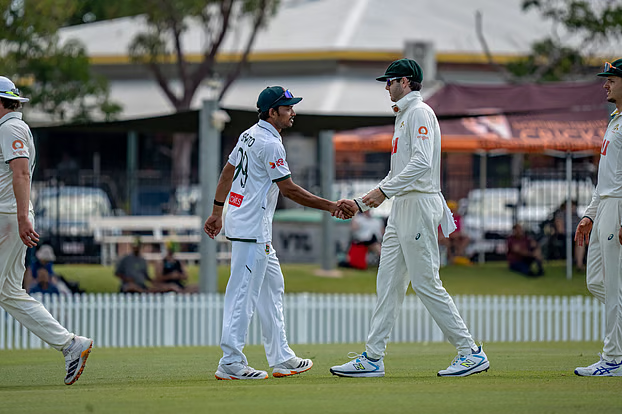
Bangladesh suffered a heavy 38-run innings defeat against a Cricket Australia XI in a three-day practice match at Marrara Oval in Darwin, raising serious concerns over their batting ahead of the Test series against Australia.
After being bowled out for 263 in their first innings, Bangladesh allowed the Cricket Australia XI to post 355, conceding a 92-run lead. The visitors then endured a dramatic collapse in their second innings, losing all 10 wickets for just 54 runs and failing to erase the deficit.
Bangladesh had already lost two wickets for 19 runs by the close of the second day’s play. Their troubles deepened rapidly on the final day, when the remaining eight wickets fell in only 17 overs. The innings lasted just 54 runs, underlining the severity of the collapse.
Left-arm fast bowler Campbell Thompson was the chief destroyer. The 22-year-old claimed eight of Bangladesh’s 10 wickets, while off-spinner Corey Rocchiccioli took the other two. Thompson’s performance was particularly striking given his limited experience in competitive cricket. He has yet to make his international debut and had played only two first-class matches before this fixture, taking three wickets. His List A record stood at one wicket from two matches.
TanZid Hasan was the only Bangladesh batter to reach double figures in the second innings. Resuming his innings unbeaten, the opener scored 22 from 41 deliveries before being dismissed. Mehedi Hasan Miraz, who had made a century in the first innings, managed only six from 19 balls in the second.
Najmul Hossain, Taskin Ahmed and Ebadot Hossain were dismissed without scoring. The rest of the batting line-up also failed to offer meaningful resistance, leaving Bangladesh with little chance of mounting a recovery after conceding the first-innings deficit.
Miraz’s century had been one of the few bright spots in Bangladesh’s first innings, but no other batter managed to score a half-century. That lack of support became even more damaging in the second innings, when the batting order collapsed almost completely against a relatively inexperienced bowling attack.
The result carries added significance because Bangladesh are using the match as preparation for a demanding Test assignment in Australia. Their first Test is scheduled to begin in Darwin on 13 August, with the second Test due to start in Mackay on 22 August.
Bangladesh will face Australia’s established Test attack in the series, including leading fast bowlers Mitchell Starc and Pat Cummins. The conditions in Australia are expected to present a significant challenge, particularly for batters who must cope with pace, bounce and sustained pressure.
The practice match was intended to provide valuable time in the middle before the Tests. Instead, Bangladesh’s second-innings capitulation has highlighted major questions over their ability to withstand pressure and build partnerships.
With the Test series only days away, the coaching staff and batting unit will have little time to address the shortcomings exposed in Darwin. The immediate priority will be to restore confidence, improve shot selection and, above all, ensure that one early wicket does not trigger another collapse.