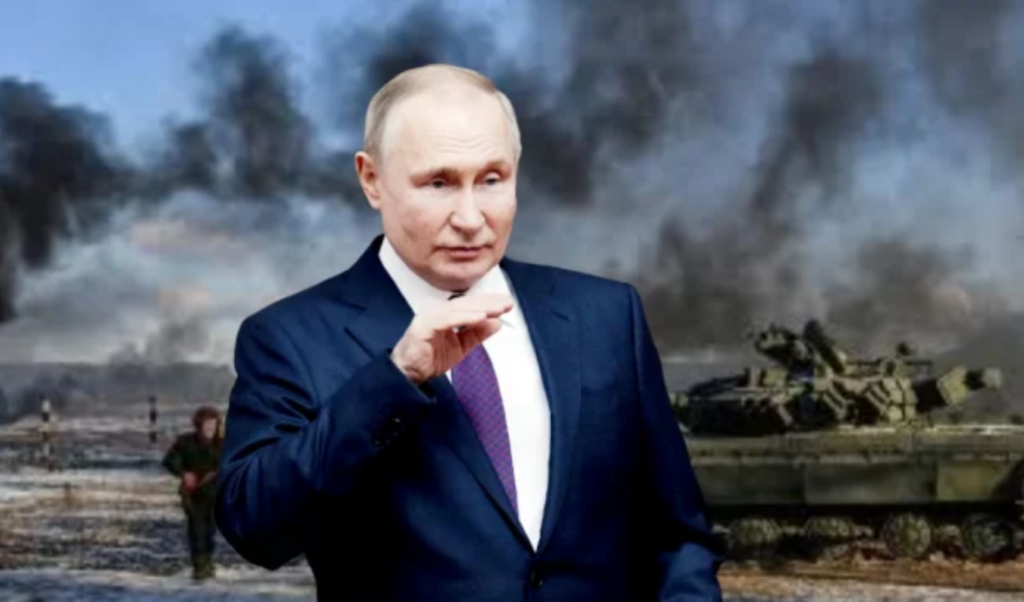
WASHINGTON — United States intelligence agencies have issued a stark warning indicating that Russian President Vladimir Putin could launch limited military operations against a NATO member state over the coming years to test the collective resolve and unity of the Western alliance.
According to a recently disclosed US intelligence assessment first reported by The Wall Street Journal, American officials have outlined several potential conflict scenarios. These range from targeted, small-scale border incursions to high-impact cyber offensives aimed at probing the alliance’s commitment to Article 5—the foundational mutual defense clause dictating that an attack against one member state constitutes an attack against all.
Intelligence analysts suggest that Moscow’s goal would not be to trigger an all-out war with NATO or invite a massive military response. Instead, Putin appears to be calculating ways to undermine Allied coherence through calibrated, sub-threshold aggression, with the Baltic states or Poland identified as the most vulnerable targets.
Growing Threats along NATO’s Eastern Flank and Infrastructure
Western security officials believe that if Putin finds himself unable to secure a favourable diplomatic resolution in Ukraine, he may attempt to escalate tensions directly within NATO territory. This assessment comes amidst a rising pattern of Russian airspace violations and suspected sabotage incidents across Europe.
Recent security breaches highlight the growing vulnerability along NATO’s eastern frontier:
-
Romania (May 2026): An explosive-laden drone struck a residential building inside Romanian territory, injuring two civilians.
-
Poland (September 2025): NATO fighter jets were scrambled to intercept and shoot down multiple Russian drones that breached Polish airspace during an attack on western Ukraine.
-
Germany (August 2026): Security services discovered a drone fitted with military-grade explosives near a major German airport. US defense officials suspect Russian intelligence involvement.
Addressing the airport incident, German Interior Minister Alexander Dobrindt characterized the presence of armed drones near critical infrastructure as a major security threat, hinting at foreign state involvement. The incident prompted German Chancellor Friedrich Merz to convene an emergency meeting of the National Security Council to evaluate domestic defense vulnerabilities.
Depleted US Interceptor Stockpiles and Ukrainian Casualties
The timing of the intelligence report coincides with serious concerns regarding United States munitions stockpiles. Prolonged military engagements and air defense deployments in the Middle East against Iranian threats have severely strained American inventories, complicating long-term strategic planning for potential conflicts involving NATO or the Indo-Pacific region.
US defense figures indicate that approximately 80 per cent of the military’s Terminal High Altitude Area Defense (THAAD) interceptor missiles and nearly half of its Patriot air defense missile stockpiles have been expended in recent operations.
This shortage arrives as civilian casualties in Ukraine rise sharply. United Nations data reveals that long-range Russian missile and drone strikes caused 60 per cent more civilian casualties between January and June 2026 compared to the same period last year. A recent overnight barrage killed 17 civilians in Ukraine after local defense systems failed to intercept incoming Russian ballistic missiles.
While US President Donald Trump publicly posted on Truth Social that national armaments remain robust and production is scaling rapidly, sources confirm he expressed frustration during a recent cabinet meeting at Camp David over depleted interceptor reserves. Meanwhile, diplomatic efforts to negotiate a ceasefire between Moscow and Kyiv remain stalled, with Western sanctions failing to halt Russian offensive operations in eastern Ukraine. NATO military spokesman Martin O’Donnell declined to comment on specific intelligence findings, but reiterated that the alliance maintains a state of continuous readiness to defend every inch of member territory.