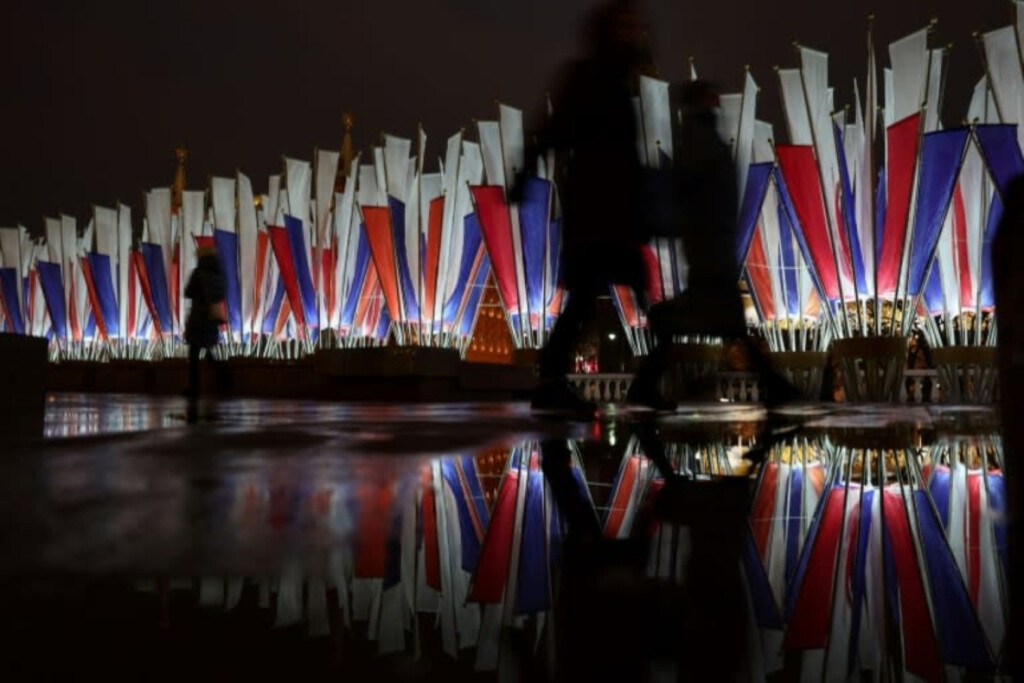
Moscow, February 23, 2025 (BSS/AFP) – In today’s Russia, opposing the government’s military campaign in Ukraine has become a dangerous choice, forcing critics into silence. These quiet dissenters, now referred to as the “new silent ones,” live under the shadow of repression, much like Soviet-era dissidents.
Since Russia launched its “special military operation” in Ukraine three years ago, the Kremlin has intensified its crackdown on any form of opposition. Public dissent is met with severe consequences, with hundreds prosecuted for speaking against the war. In one recent case, a Moscow court sentenced a pensioner to eight years in prison for denouncing alleged crimes committed by Russian troops.
While many who oppose the war have fled the country, those who remain have been forced into silence. According to Denis Volkov, head of the independent Levada Centre—an organization officially branded as a “foreign agent” by Russian authorities—between 20% to 25% of Russians do not support the government but have chosen to “turn in on themselves.”
Living in Fear
The “new silent ones” exist in a precarious position, condemned both by Kremlin loyalists, who brand them as “traitors,” and by Russian expatriates, who accuse them of being “conformists.”
“We stay here without venturing into the public space because whoever speaks out ends up in prison,” commented one social media user on a discussion about this silent resistance. Facebook, now banned in Russia, remains accessible only through virtual private networks (VPNs), serving as one of the few platforms where muted voices can still share their thoughts.
Maria, a 51-year-old data analyst from Moscow, knows the risks of speaking out. She initially tried to challenge her colleagues’ support for the war but found it futile. When she suggested to her manager that their company relocate to help younger employees avoid military conscription, she was swiftly fired.
“It’s been almost three years since I became one of the silent ones,” she said. “It feels like an early retirement—or worse, like being buried alive.”
A Constant Struggle for Self-Censorship
For others, the struggle is one of constant self-censorship. Vasily, a graphic designer, has been a long-time critic of the Kremlin but now finds himself in a suffocating routine.
“I have to constantly check myself. I avoid reading certain books in the metro, I no longer follow my favorite bloggers, and I have to be careful about what I say in the office,” he said.
For some, artistic expression offers a quiet escape. Ekaterina, an artist in her 60s, copes by painting portraits of musicians and poets. “I miss freedom,” she admitted. “I always have to control myself. I find solace in drawing flowers and withdrawing into my own world.”
Even well-known public figures have taken to silence. Russian rock star Yury Shevchuk, once an outspoken critic of the government, has resigned himself to this new reality. “Some choose to sing, I choose to stay silent,” he said. His concerts were banned after he criticized what he called “fake patriotism” in 2022.
While mass protests are no longer an option for many, Shevchuk believes the silent resistance still has meaning. “The new silent ones do not take to the barricades, because at this moment, it wouldn’t achieve much,” he explained. “But they are doing good in their own ways. Thanks to them, Russia will survive.”
A Legacy of Repression
The climate of fear and suppression in modern Russia echoes the Soviet era, when dissidents were forced into silence, exile, or worse. Despite state control over media and public discourse, opposition still lingers beneath the surface.
The question remains: Will the silence eventually give way to resistance, or will history repeat itself, with an entire generation forced to live in quiet defiance?