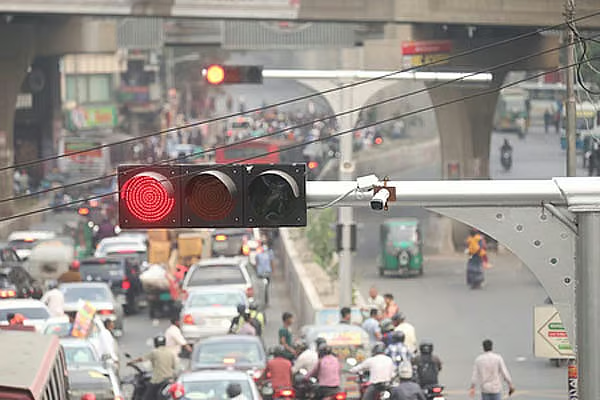
Dhaka is set to receive 50 additional automated traffic signals as part of a new initiative aimed at improving traffic management and restoring discipline on the capital’s increasingly congested roads. The project is expected to cost around Tk 100 crore, putting the average expenditure at approximately Tk 2 crore for each signal installation.
The proposed spending will cover considerably more than the traffic lights themselves. The project includes signal poles and foundations, steel barriers, electrical connections, traffic police control rooms, road excavation, cameras, control boxes, tablets and other technological and civil infrastructure required to operate the system.
According to officials from the two city corporations, 28 signals will be installed within the jurisdiction of Dhaka North City Corporation, at an estimated cost of about Tk 55 crore. Another 22 locations under Dhaka South City Corporation will require roughly Tk 44 crore. The combined estimated expenditure therefore stands at nearly Tk 99 crore, excluding future maintenance costs.
Officials said the decision followed a meeting at the Prime Minister’s Office on 18 July, where instructions were reportedly issued to introduce another 50 automated traffic signals in an effort to address congestion and improve road discipline. The Ministry of Local Government subsequently allocated Tk 50 crore each to the two city corporations.
The installation work will be divided between contractors appointed by the city corporations and Bangladesh University of Engineering and Technology (BUET). Contractors will undertake civil works, including the construction of steel barriers extending 50 metres on either side of each signal, traffic police control rooms, signal-pole foundations, electrical connections and road cutting.
BUET, meanwhile, will be responsible for designing the traffic signal system and supplying equipment such as signal lights, control boxes, tablets and cameras. The university will also conduct surveys of traffic movement to support the design and operation of the systems.
In Dhaka North, around Tk 43 crore has been earmarked for civil works across the 28 locations. Steel barriers account for about Tk 8.36 crore, while signal poles will cost approximately Tk 8.21 crore. Foundations are estimated at Tk 5.70 crore and electrification at around Tk 4 crore. Other works, including control boxes, road excavation and traffic signs, will require roughly Tk 16 crore. A further Tk 12 crore is allocated for BUET’s consultancy and the purchase of signals and associated equipment.
For Dhaka South’s 22 locations, civil works are estimated at Tk 35 crore, while about Tk 9 crore will go to BUET-related work and equipment.
The latest initiative follows an earlier effort to introduce automated signals at selected major intersections. Seven locations, including InterContinental Hotel, Banglamotor, Sonargaon, Farmgate, Bijoy Sarani, the Prime Minister’s Office and Jahangir Gate, were initially brought under the new system. Artificial intelligence-enabled cameras were subsequently added by the traffic authorities.
The system is intended to make traffic control less dependent on manual intervention. Officials and traffic police have reported encouraging results, particularly in ensuring that motorists respond to red signals more consistently. Traffic officers have also said that automated signals can make roadside enforcement easier, although battery-powered rickshaws remain a challenge at some intersections.
BUET has played a central role in developing the signal technology, with the Dhaka Transport Coordination Authority, the two city corporations, BUET and Dhaka Metropolitan Police involved in overseeing the experimental system.
Urban planner Adil Muhammad Khan has said that the use of artificial intelligence to identify signal violations and impose immediate penalties can encourage greater compliance with traffic rules. The effectiveness of the expanded system, however, will ultimately depend on proper maintenance, reliable electricity, enforcement against violations and coordinated management across the city’s road network.
With 50 more locations now planned, the project represents a substantial investment in Dhaka’s traffic infrastructure. Whether the expenditure translates into sustained improvements in congestion and road discipline will depend not only on the installation of the equipment but also on how consistently the automated system is operated and maintained.