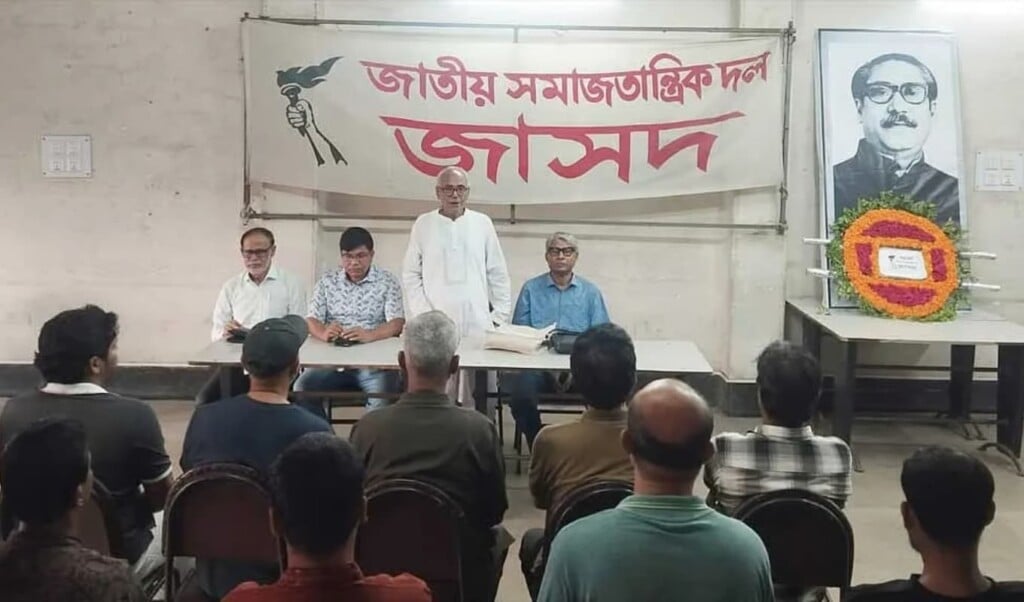
Leaders of the Jatiya Samajtantrik Dal (JSD) have asserted that the assassination of Founding Father Bangabandhu Sheikh Mujibur Rahman on 15 August 1975 and the recent political changeover on 5 August 2024 are inextricably linked, describing both events as acts of revenge by anti-liberation forces.
Addressing a discussion meeting on Saturday afternoon at the Colonel Taher Auditorium within the party headquarters on Bangabandhu Avenue, Dhaka, JSD figures maintained that the historic defeat suffered by hostile elements during the 1971 Liberation War continues to drive contemporary political vendettas. The event began with party members placing floral wreaths before the portrait of Sheikh Mujibur Rahman and observing a minute’s silence in memory of the victims of the 1975 tragedy.
A press statement released by JSD highlighted that speakers characterised 15 August as an exceptionally dark day not only within the national timeline of Bangladesh, but across global political history. They emphasised that the coordinated killing of Sheikh Mujibur Rahman alongside most of his family members remains one of the most devastating political massacres of the modern era.
Drawing a direct connection between historical and current developments, the speakers argued that the underlying geopolitical and ideological dynamics of the August 1975 tragedy reappeared during the regime change in August 2024. In their view, persistent adversaries of the nation’s independence are systematically pursuing retribution to satisfy long-standing political grudges.
The discussion also highlighted the legal challenges encountered by JSD President Hasanul Haq Inu over several decades. Speakers drew parallels between the verdict handed down to Inu by a military court during the administration of Ziaur Rahman and his subsequent proceedings before the International Crimes Tribunal, characterising both as part of an uninterrupted historical pattern.
The session was chaired by JSD Central Committee Vice-President Shafiuddin Miah. Prominent contributors to the discussion included Central Committee Member Saifuzzaman Badsha, Joint General Secretary Abdullahil Kajjum, Office Secretary Sajjad Hossain, National Youth Jote President Shariful Kabir Swapan, and Bangladesh Chhatra League (Scientific Socialism) Vice-President Golam Kibria.
The event takes place amid a broader shift in the legal status of the national day of remembrance. Following the events of 15 August 1975, the Awami League government designated the date as National Mourning Day and declared a public holiday in 1996. The decision was overturned by the BNP-led four-party alliance in 2001, only for the High Court to reinstate the holiday in 2008 following a writ petition. However, after the political transition in 2024, the interim administration headed by Chief Adviser Professor Muhammad Yunus filed a leave to appeal against the 2008 ruling. On 2 December 2024, an Appellate Division bench led by former Chief Justice Syed Refaat Ahmed stayed the High Court judgment, effectively ending the official holiday and government-sponsored observances.