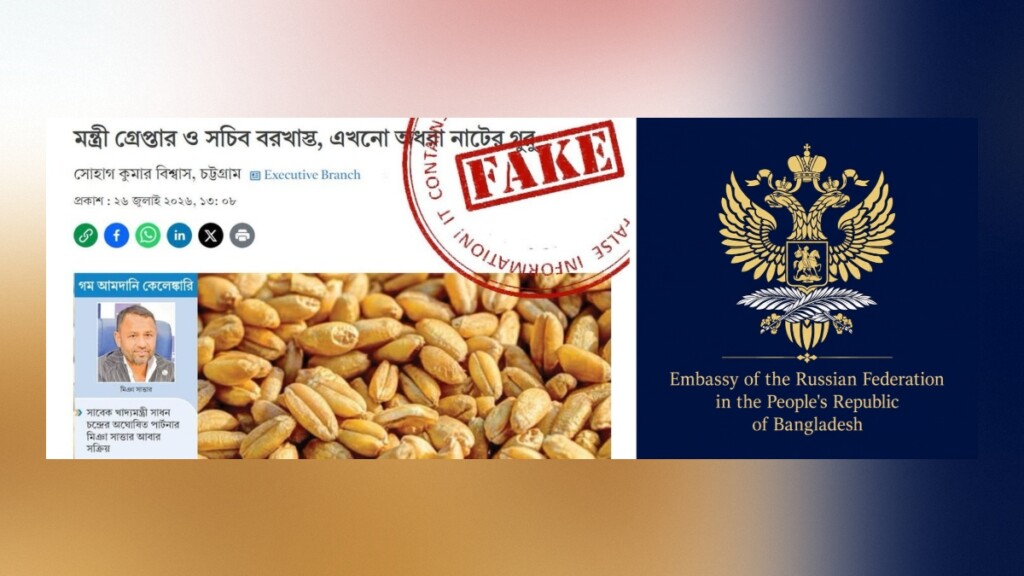
The Russian Embassy in Dhaka has characterized allegations of corruption involving government-to-government (G2G) wheat imports from Russia as “baseless” and “unsubstantiated.” In a press statement issued on Tuesday by its press wing, the embassy also addressed media reports raising questions about major Russian-backed energy and infrastructure initiatives in Bangladesh, including the Rooppur Nuclear Power Plant.
According to the embassy, recent media reports alleging financial improprieties in G2G wheat procurement and criticizing bilateral energy projects are “biased and unfounded.” The diplomatic mission asserted that such coverage attempts to undermine the robust bilateral relationship between Russia and Bangladesh, as well as Russia’s long-standing contributions to Bangladesh’s food and energy security.
Strict Quality Control and Transparent Procurement
The embassy stated that all wheat purchases between the governments of Russia and Bangladesh are conducted with full transparency, adhering strictly to international commercial standards through designated state entities. Under the framework of the intergovernmental agreement, contract execution remains under the direct supervision of state authorities from both nations, eliminating opportunities for unauthorized third parties or intermediaries to influence pricing.
Furthermore, the statement highlighted that all agricultural exports from Russia undergo stringent quality control to meet international phytosanitary standards and specific technical criteria set by Bangladesh. Official Russian inspection bodies issue quality certificates at the Port of Chittagong prior to discharge. Upon arrival, the Directorate General of Food and local port authorities conduct physical and laboratory inspections, rendering claims of sub-standard or defective wheat deliveries groundless.
The embassy also dismissed claims regarding the origin of the wheat shipments as “entirely baseless,” framing them as part of a politically motivated narrative. It emphasized that Russia operates in strict compliance with international law, exporting grain sourced exclusively from its domestic agricultural sector.
Nuclear and Energy Projects Free of Irregularities
In addition to agricultural cooperation, the embassy highlighted major energy undertakings as enduring symbols of strategic collaboration between the two nations.
Addressing concerns over the Rooppur project, the statement noted that Russia’s state atomic energy corporation, Rosatom, alongside its subcontractors, adheres to global technical, financial, and safety benchmarks. Consequently, the embassy stated there is no scope for unauthorized third-party involvement or financial irregularities within the project.
The release also referenced the role of Gazprom EP International, which has operated in Bangladesh since 2012 to boost domestic energy capacity. Utilizing advanced drilling technologies, Gazprom has completed over 20 gas wells across Bangladesh, notably in key gas fields in Bhola, aiding national gas production to meet growing industrial and power generation demands.
Russia Reaffirms Strategic Partnership
Reiterating its commitment to the region, the embassy stated that Russia considers Bangladesh a key and trusted strategic partner. Amid shifting global economic dynamics and heightened energy security concerns, Russia reaffirmed its intent to remain a reliable supplier of high-quality agricultural commodities and technical expertise in the energy domain.
The diplomatic mission expressed confidence that bilateral cooperation will continue on the principles of equality and mutual interest. Concurrently, it called upon Bangladeshi media outlets to adhere to professional standards and rely on verified facts, thereby safeguarding the long-standing friendly and commercial ties between Bangladesh and Russia.
By Senior Reporter