The two most critical components of Dhaka’s future public transport system—MRT Line-1 and MRT Line-5 North—are now facing a massive financial blow. A proposal has been submitted to increase the combined cost of these two projects, originally approved during the Awami League government’s tenure, by 121,424 crore taka ($1.21 trillion BDT).
In August 2024, following a change in government, the interim administration led by Muhammad Yunus stepped in just as the projects reached the crucial stage of tendering and contractor appointment. Citing concerns over inflated costs, the government suspended key operational processes and initiated a thorough review.
However, rather than lowering costs, the decision to halt progress delayed execution significantly. During the intervening period, the value of the US dollar surged by nearly 46.5% compared to 2019 levels. Domestically, inflation remained persistently high, while global prices for construction and industrial raw materials climbed sharply. Furthermore, new bids submitted by contractors came in drastically higher than previous estimations. Consequently, the very projects paused to curb overspending have returned with a far heavier financial burden.
This development raises a crucial economic question: How much money did the state actually save by suspending these projects to prevent overspending, and how much additional expenditure was generated as a direct result of the delay?
Initiated Under Awami League, Stalled Under Yunus
Although preliminary concepts for MRT Line-1 were drafted earlier, the project took its final shape under the Awami League administration. In 2019, approval was granted to construct the nation’s first underground metro rail connecting Airport to Kamalapur, along with an elevated section spanning New Market to Purbachal.
The total approved cost for the 31.24-kilometre MRT Line-1 stood at 52,561.43 crore taka. Japan provided approximately 39,450 crore taka in concessional loan assistance, while the Government of Bangladesh funded the remaining 13,111 crore taka. The original execution window was set from September 2019 to December 2026.
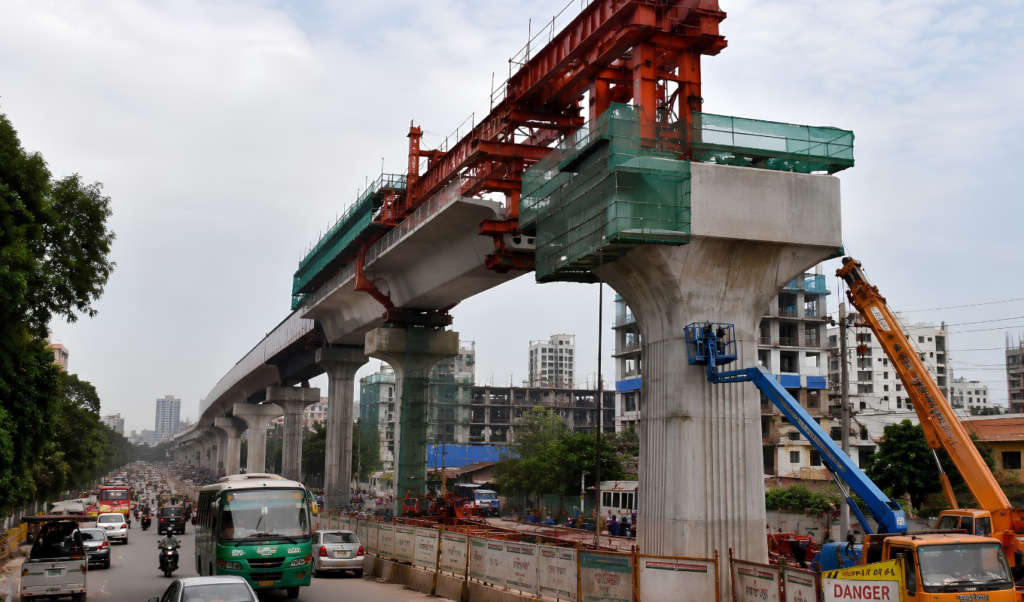
The alignment comprised a 19.87-kilometre underground section between Airport and Kamalapur, alongside an 11.36-kilometre elevated stretch from New Market to Purbachal, encompassing a total of 19 stations.
Concurrently, MRT Line-5 North received approval. Spanning approximately 20 kilometres from Hemayetpur to Vatara, this line included a 13.50-kilometre underground segment and a 6.50-kilometre elevated section, servicing 14 stations (nine underground). Its initial approved cost was set at 41,238.55 crore taka, with an execution timeline running from July 2019 to December 2028.
Combined, the original approved outlay for both projects totalled roughly 93,800 crore taka—a figure calculated when the national economy, exchange rates, raw material costs, and global supply chains were vastly different from current realities.
The Exchange Rate Factor: BDT 85 to BDT 124 per USD
The primary driver behind the budget revision lies in foreign exchange dynamics.
At the time of MRT Line-1’s approval, the exchange rate stood at approximately BDT 85 per US dollar. For MRT Line-5, the initial Development Project Proposal (DPP) pegged the dollar at BDT 84.50. However, the working papers for the revised budget now calculate the exchange rate at BDT 123.82 per dollar.
This reflects a 46.53% depreciation of the Bangladeshi Taka against the US dollar.
To put this into perspective: purchasing $1 billion worth of foreign equipment in 2019 at BDT 84.50 per dollar required BDT 8,450 crore. Today, acquiring the same $1 billion worth of equipment at BDT 123.82 per dollar costs BDT 12,382 crore.
Thus, even if foreign currency costs remain entirely static, the project expenditure in local currency rises by nearly 46% purely due to exchange rate adjustments.
This trend mirrors broader exchange rate shifts in Bangladesh over recent years. In FY2019–20, the average dollar rate was BDT 84.78. It rose to BDT 86.39 in FY2021–22, BDT 99.42 in FY2022–23, and approximately BDT 111 in FY2023–24. In May 2024, Bangladesh Bank introduced a crawling peg system, setting the mid-rate between BDT 110 and BDT 117, which subsequently drifted higher under market pressures.
Import-heavy infrastructure projects like metro rail systems feel this impact directly. Rolling stock, signalling equipment, electro-mechanical systems, specialized construction machinery, and advanced technologies must all be procured from international suppliers.
Global Inflation and Domestic Market Pressures
Exchange rate fluctuations tell only part of the story; global macroeconomic shocks have also played a major role since 2019. Pandemic-era supply chain disruptions drove up the costs of construction materials, industrial components, and freight. Subsequently, the Russia-Ukraine war in 2022 placed renewed pressure on energy prices, metals, raw materials, and international shipping.
In Bangladesh, these global factors collided with currency devaluation. The country faced higher dollar prices on international markets alongside a weaker domestic currency to purchase them.
The domestic construction market felt similar strains. Steeper prices for rebar, cement, fuel, transport, and labour pushed up the baseline cost of major infrastructure works. Consequently, comparing 2019 baseline estimates directly against 2026 market prices inevitably yields a stark disparity.
In its revised budget submission for MRT Line-5, the Dhaka Mass Transit Company Limited (DMTCL) explicitly cited foreign exchange shifts, global inflation, higher consultant fees, and price increases in rolling stock and electro-mechanical systems as the primary drivers of cost growth.
The Re-evaluation under the Interim Administration
These cost dynamics highlight why the interim government’s decision to pause the projects has drawn intense scrutiny.
When the administration led by Muhammad Yunus assumed office in August 2024, several critical construction packages for MRT Line-1 and Line-5 North were undergoing tendering and contractor selection.
Because the financial bids submitted by contractors significantly exceeded original estimates—in some cases coming in at more than double the initial allocations—the government paused the process for review.
For MRT Line-1, total contractor proposals across various packages reached nearly BDT 96,000 crore, against an original total project allocation of BDT 52,561 crore. Similarly, for certain underground packages on MRT Line-5 North, bids ranged between BDT 11,000 crore and BDT 15,000 crore, compared to initial engineering estimates of BDT 3,000 crore to BDT 4,000 crore.
Viewing these bids as excessive, the government halted contractor appointments to re-evaluate the procurement terms, initiating discussions with the Japan International Cooperation Agency (JICA).
However, official records show a distinct absence of formal investigative findings or documented evidence pointing to financial corruption or embezzlement as the primary reason for halting the projects. Instead, the freeze was triggered by the sharp gap between original allocations and the high commercial bids.
This raises a central question: Was the decision to pause major procurement processes driven purely by high commercial bids under the umbrella of political rhetoric, without documented proof of corruption?
Did the Pause Unintentionally Drive Costs Higher?
The decision to pause and re-evaluate these projects had an immediate economic consequence: lost time. Procurement and contractor selection processes that were close to completion were stalled. During this period of delay, currency devaluation progressed, inflation accumulated, and market prices for construction materials adjusted upward.
As a result, waiting to secure lower prices in 2024 ultimately made foreign currency procurement far more expensive. Instead of settling costs when the dollar was lower, the projects must now absorb exchange rates ranging between BDT 120 and BDT 124 per dollar. Consequently, any savings negotiated on contract prices risked being erased by currency depreciation.
Furthermore, delays often lead contractors to build higher risk premiums into their bids. Unsure of future exchange rate movements and material price volatility, bidding consortiums factor currency risks and cost escalation into their pricing models—particularly for complex underground civil works.
The core question remains: How much money was actually saved by halting tenders in 2024, compared to the additional costs generated by subsequent currency depreciation and inflation over the following two years?
Without a side-by-side financial breakdown, assessing the true economic efficacy of the pause remains difficult.
Extended Timelines and Escalating Overhead Costs
MRT Line-1 was originally scheduled for completion between September 2019 and December 2026. However, physical construction only commenced in February 2023. By early 2025, project officials acknowledged that meeting the original deadline was unfeasible, noting that several additional years would be required.
Similarly, the original completion target for MRT Line-5 North was December 2028. Revised proposals now extend that timeline to December 2034, with commercial operations targeted for January 2033.
A parallel extension proposal seeks to stretch MRT Line-5 North’s deadline to December 2035.
Timeline extensions involve more than just delayed operational dates. They prolong ongoing expenditure on project consultancy, site supervision, administration, land management, and logistics. Over extended periods, the cost of specialized services and materials naturally shifts alongside wider market conditions.
When a project’s execution period expands by five to seven years, its original financial estimates inevitably collide with a very different economic landscape.
Analyzing the Bids Beyond Exchange Rates
It would be oversimplifying to attribute the entirety of the cost increases solely to the interim government’s pause or currency depreciation.
In several construction packages, the discrepancy between estimated costs and commercial bids was exceptionally wide, suggesting other contributing factors.
For instance, one package under MRT Line-5 North carried an initial government estimate of BDT 3,443 crore. Consultants later revised this estimate to BDT 5,213 crore. However, the lowest commercial bid submitted came in at BDT 11,178 crore.
In another package, the original estimate of BDT 4,365 crore was revised upwards by consultants to BDT 6,126 crore, only to receive a lowest bid of BDT 15,527 crore.
This reveals three distinct financial benchmarks: the original government estimates, the subsequent consultant revisions, and the actual commercial bids from contractors.
Evaluating the overall cost escalation requires looking at all three layers rather than attributing the entire increase to exchange rates or inflation alone. Likewise, the responsibility cannot be laid exclusively on the previous government’s baseline projections or the current administration’s review process.
A thorough analysis must also account for contractor market competition, the limited pool of participating Japanese firms, complex underground engineering risks, contractual risk-allocation clauses, and design modifications.
Measuring the Net Financial Outcome
The core question surrounding the interim government’s decision comes down to net economic impact.
If the objective of rejecting high initial bids was to secure more competitive pricing, the government will need to demonstrate the exact savings achieved. At the same time, those savings must be weighed against the financial losses caused by project delays, including currency devaluation, inflation, and rising construction overheads.
Comparing these two variables will clarify whether the move protected public funds or inadvertently added to the final bill.
Back in 2024, decision-makers weighed original budget allocations against elevated contractor bids. By 2026, those same projects face a weaker exchange rate, elevated material costs, and an extended construction timeline.
Consequently, the financial cost of the time lost during the review process has itself become part of the projects’ total price tag.
Political Retaliation vs. Economic Realities
Distinguishing between political claims and verifiable data remains crucial.
Projects initiated under the previous administration faced systematic reviews under the interim government, and MRT Lines 1 and 5 North were no exception. While political motivations to question legacy projects were evident, key procurement processes were halted without published findings of financial wrongdoing.
If major urban transit projects were delayed primarily over pricing disputes without formal findings of corruption, questions naturally arise regarding the policy approach—a dynamic some transport experts have characterized as politically driven.
If a decision intended to curb spending ultimately leads to higher overall costs, the resulting financial impact warrants a clear public explanation.
Ultimately, if delaying infrastructure projects to prevent overspending results in a higher final cost to the taxpayer, that added expense must be factored into the decision’s overall evaluation.
The BDT 1.25 trillion cost escalation is more than just a figure on a ledger; it serves as a case study in public policy. The key issue now is whether a decision aimed at saving state funds succeeded, or whether it ultimately contributed to a larger financial burden.
— Senior Reporter