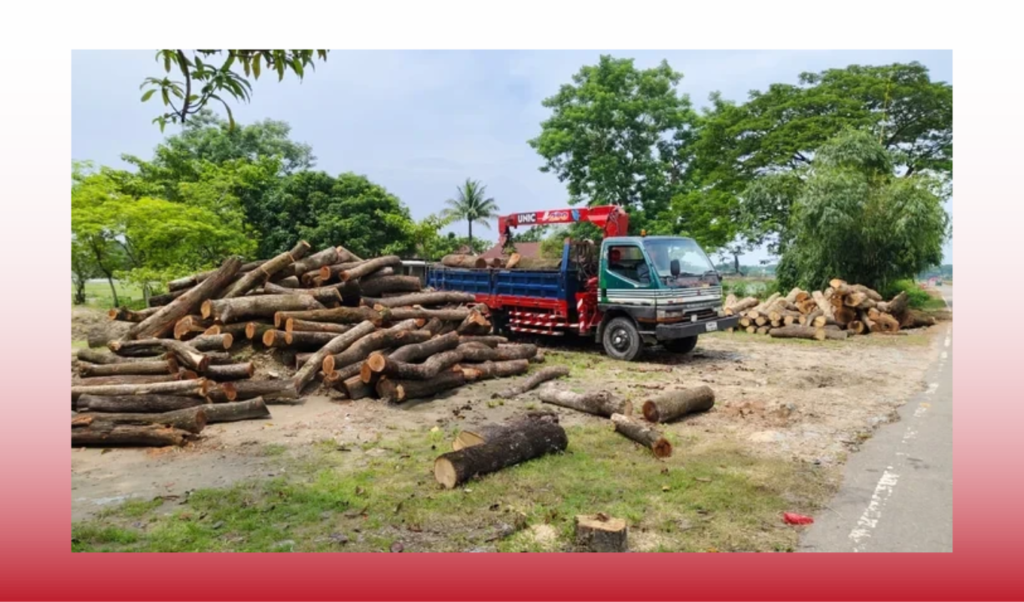
The felling of approximately 4,500 roadside trees along a 19-kilometre stretch of the Sunamganj-Sachna highway has sparked fierce public backlash, with highway authorities confirming that no road-widening scheme exists to justify the clearance. The logging operation, initiated by the Forest Department on land managed by the Roads and Highways Department (RHD), has triggered street demonstrations and stern warnings from environmental campaigners.
The logging has provoked deep resentment among residents, environmentalists, and civic groups across the haor district. Members of the Sunamganj District Haor and River Protection Movement formed a human chain at Iccharchar on Saturday, demanding an immediate halt to the operation. Protesters threatened to lay siege to the local forest office if authorities fail to suspend the tree-felling within 24 hours.
Although the Forest Department maintained that the felling was restricted to non-native timber species, residents alleged that mature indigenous fruit-bearing and shade trees were being cut down indiscriminately. Manik Mia, an Iccharchar resident, pointed to a freshly felled Java plum tree outside his homestead, noting that he had planted and nurtured it on government land to provide shade and fruit for schoolchildren and passers-by. Despite fierce opposition from neighbours, contractors proceeded to cut the trees down. Another villager, Abul Hossain, reported that despite tenders supposedly targeting exotic species such as Acacia (akashmoni) and raintree, indigenous varieties were being felled regardless of local protests.
Civil society leaders raised serious questions over the commercial terms and ecological impact of the operation. Raju Ahmed, president of the Haor and River Protection Movement, and general secretary Obaidul Haque revealed that 4,468 trees were auctioned off for 8.48 million taka, despite their actual timber value running into tens of millions. They argued that the state was incurring substantial financial losses, whilst the ecological services and shade provided to commuters could not be measured purely in monetary terms.
The trees date back to 2004, when roughly 20,000 saplings were planted along the corridor under a social forestry programme, tended for decades by local beneficiaries. In 2024, the department floated a tender to harvest 3,000 trees but stepped back following intense public outcry. Campaigners highlighted a 2025 High Court directive, stemming from a writ petition by Human Rights and Peace for Bangladesh (HRPB), which instructed the government to assess market values and disburse financial compensation directly to beneficiaries instead of felling trees. The ruling also mandated prior scrutiny by a seven-member committee headed by the Deputy Commissioner before any social forestry harvest.
Administrative inconsistencies have compounded public confusion. Sunamganj District Forest Officer Riaz Uddin claimed the felling received approval from the district committee. However, Additional Deputy Commissioner Motiur Rahman Khan stated that no such clearance had been granted during the tenure of the current Deputy Commissioner over the past three to four months, adding that historical records would require thorough verification. RHD Sub-Divisional Engineer Sajedur Rahman reiterated that no road-widening project is underway, confirming that the department had merely received an informational copy of the logging tender.
Defending the operation, Sylhet Divisional Forest Officer Mohammad Abdur Rahman stated that social forestry guidelines permit the felling of 10-year-old plantations to distribute revenue among designated beneficiaries and facilitate replanting. He explained that the auction followed formal applications by beneficiaries and was executed transparently through public notices across administrative divisions. Rahman added that exotic species would be replaced by native trees in accordance with the Forest Conservation Act 2026, giving assurances that native varieties would be spared. Addressing the High Court directive on financial compensation in lieu of felling, he noted that although the matter had been deliberated under the interim administration, the department had yet to receive an official gazette notification or formal policy guidelines to halt harvesting.