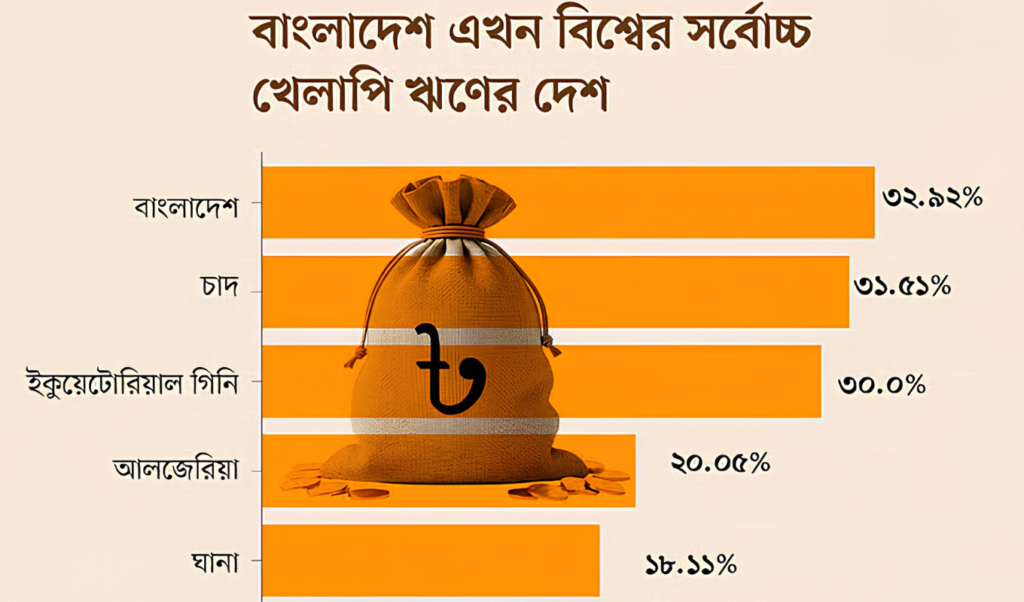
Bangladesh has emerged as the country with the highest proportion of non-performing loans in the world, with nearly one-third of all bank lending now classified as defaulted or non-performing. For every 100 taka lent by the country’s banking sector, almost 33 taka is currently tied up in non-performing loans, placing Bangladesh ahead of Chad, Equatorial Guinea, Algeria and Ghana based on the latest available international data.
According to Bangladesh Bank figures, non-performing loans in the country’s banking sector stood at Tk 606,555 crore at the end of June 2026, equivalent to 32.78 per cent of total outstanding loans. The ratio is also reported at approximately 32.92 per cent when assessed against comparable international indicators and available data.
The amount has continued to rise sharply. At the end of March 2026, non-performing loans stood at Tk 588,704 crore, meaning the banking sector recorded an increase of Tk 17,851 crore in just three months. The figure had previously reached a record Tk 644,515 crore in September 2025.
Industry insiders say a substantial portion of these bad loans did not suddenly emerge during the past two years. Instead, many financially distressed loans had remained outside the formal non-performing category for years through repeated rescheduling, special concessions and changes in accounting treatment during the previous Awami League government.
Following the political changes in the country, reviews of banks’ asset quality and audits conducted by domestic and international institutions have brought a clearer picture to light. Cases involving irregular lending, alleged fraud and loans granted under anonymous or concealed arrangements have increasingly been identified. As a result, a significant volume of loans that had previously appeared regular is now being recognised as non-performing.
The situation is particularly severe in five banks that have undergone consolidation, where more than 80 per cent of total loans are reportedly non-performing. Several other state-owned and private-sector banks are also facing situations in which more than half of their outstanding loans have fallen into the non-performing category.
Loans allegedly approved under political influence, weak regulatory oversight, fictitious or anonymous borrowing arrangements, a slowdown in business activity and energy shortages have all been identified as factors contributing to the deterioration of loan quality.
Bangladesh Leads the Global List
Based on the latest available figures from international financial indicators and national authorities, Bangladesh now occupies the top position among countries with the highest reported ratios of non-performing loans.
Chad ranks second, with a non-performing loan ratio of 31.51 per cent. The latest available figure for the Central African country dates back to December 2023. Although the data remain among the highest reported internationally, Chad has not subsequently submitted updated figures for the relevant international financial soundness indicators.
Equatorial Guinea occupies third place, with non-performing loans accounting for around 30 per cent of the country’s banking-sector lending. The ratio was higher in 2023, when it stood at 32.5 per cent, indicating some improvement despite remaining at an exceptionally high level.
Algeria ranks fourth. At the end of December 2025, the country’s non-performing loan ratio stood at 20.05 per cent, according to the latest available comparative data.
Ghana occupies fifth position, with non-performing loans accounting for 18.11 per cent of banking-sector lending during the first quarter of 2026. The figure represents an improvement from 20.6 per cent recorded in 2023, although the level remains significant.
Ukraine No Longer Leads the Rankings
Until recently, Ukraine had one of the highest non-performing loan ratios in the world. In 2023, its ratio stood at 37.4 per cent and rose to nearly 39 per cent following the severe economic disruption caused by Russia’s invasion.
Ukraine’s position began to improve from 2024 as banks intensified loan recovery efforts, restructured distressed debt and expanded lending to borrowers with comparatively stronger credit quality.
According to the country’s central bank, total loans in Ukraine’s banking sector increased by 133.7 billion hryvnia, or 10.3 per cent, during the first six months of 2025. Over the same period, the non-performing loan ratio fell to 27 per cent. At the exchange rate cited in the available data, one US dollar was equivalent to 44.61 hryvnia.
A major shift occurred in December 2025, when several state-owned banks, including the country’s largest bank, PrivatBank, wrote off substantial volumes of old non-performing loans from their balance sheets. The banking sector’s non-performing loan ratio had stood at 23.91 per cent on 1 December 2025 but fell sharply to 13.92 per cent by 1 January 2026.
The write-offs did not mean that borrowers were automatically released from their obligations. The loans had already been fully provisioned for, and removing them from banks’ primary balance sheets transferred them to off-balance-sheet accounting. Banks retained their legal right to pursue recovery from borrowers.
PrivatBank has continued legal efforts to recover outstanding funds both within Ukraine and in jurisdictions including London, Cyprus and Israel.
The downward trend has continued. According to Ukraine’s central bank, the country’s non-performing loan ratio fell further to 12.5 per cent by 1 July 2026, its lowest level in around 17 years. Ukraine has therefore moved well outside the group of countries with the five highest non-performing loan ratios.
How Bangladesh Reached the Top
The recent experiences of Bangladesh and Ukraine illustrate two sharply contrasting paths.
Ukraine reduced its non-performing loan ratio through a combination of loan recovery, restructuring, the removal of fully provisioned legacy bad loans from balance sheets and the expansion of higher-quality lending. These measures helped reduce both the volume and proportion of non-performing loans.
Bangladesh, meanwhile, has moved in the opposite direction. In June 2024, officially recognised non-performing loans in the country’s banking sector stood at Tk 211,391 crore. Within two years, the figure had climbed beyond Tk 600,000 crore.
The increase does not necessarily mean that all of these loans became problematic during that period. A large proportion had reportedly been distressed for years but remained outside the formal non-performing category because of repeated rescheduling, special facilities and accounting practices that allowed troubled loans to continue being shown as regular.
As stricter reviews of banks’ assets have been introduced, those hidden weaknesses have increasingly become visible.
Efforts to Reduce Bad Loans
Bangladesh Bank has taken steps to align loan classification and provisioning rules more closely with international standards. The asset quality of weaker banks is being reviewed, while the boards of several troubled institutions have been restructured. Risk-based supervision has also been introduced as part of broader efforts to strengthen oversight.
Paradoxically, stricter classification has contributed to the recent rise in officially reported non-performing loans. Loans that had previously been treated as regular are now being identified as distressed, resulting in a more realistic assessment of the banking sector’s financial health.
At the same time, borrowers have continued to receive various forms of relief. Rescheduling or writing off loans may reduce the reported stock of non-performing assets, but such measures do not automatically result in the recovery of money owed to banks.
International financial institutions have also indicated that stricter loan classification and further asset-quality reviews could reveal additional non-performing loans in Bangladesh’s banking sector.
Financial experts argue that a sustainable reduction in bad loans will require stronger action against wilful defaulters, including the seizure of assets and more effective recovery of outstanding funds. They have also stressed the need for faster disposal of loan-related cases, an end to political interference in bank management and lending decisions, and stronger safeguards to prevent the creation of new bad loans.
If these measures are implemented consistently, Bangladesh may be able to reduce its non-performing loan ratio over the medium term. However, analysts warn that a return to widespread rescheduling and repeated special concessions could produce only a temporary improvement in official figures while leaving the underlying weaknesses of the banking sector unresolved.