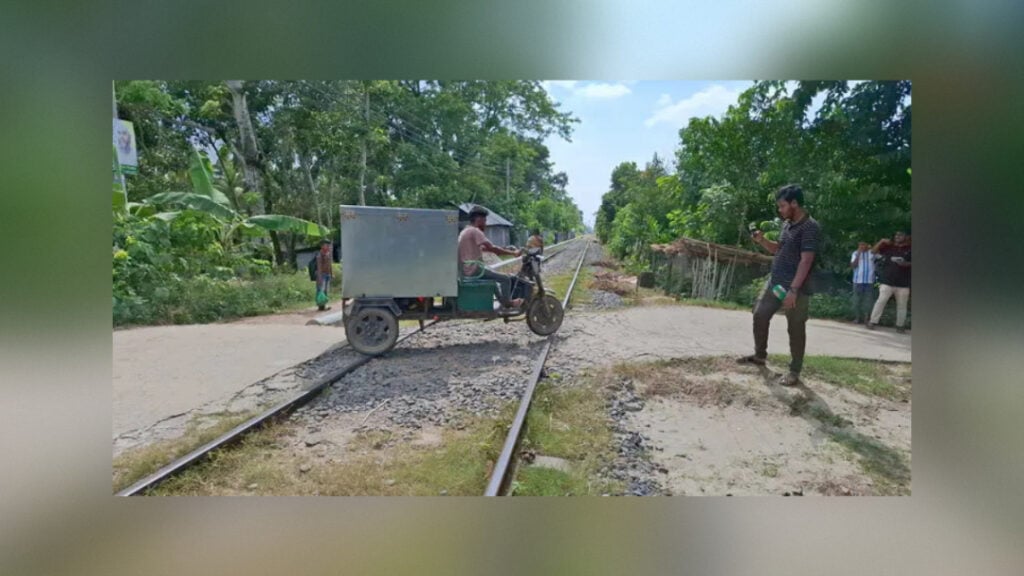
At least 101 level crossings along railway routes in Rajbari remain without adequate safety arrangements, raising concerns over the risk of train accidents in the district. Of the 154 level crossings identified across the Rajbari railway area, more than 100 reportedly have neither gatekeepers nor barriers to regulate movement when trains pass.
The safety concerns come amid a high number of deaths. According to information from relevant sources, 68 people died in Rajbari between January and August this year in various railway-related incidents, including deaths caused by being struck or run over by trains.
Local residents have called for unauthorised crossings to be closed permanently and for proper safety measures to be introduced at authorised but unprotected crossings.
The railway area stretches from Goalanda Ghat to Machpara in Pangsha and from Bhanga Junction in Faridpur to Gobra in Gopalganj. Across these routes, there are 154 level crossings, of which 67 are authorised and 87 were created without approval. Many of the unauthorised crossings emerged over time to facilitate local movement across railway tracks.
Railway officials said only around 51 to 54 of the 154 crossings have both barriers and gatekeepers. The remaining crossings are effectively unprotected. This leaves pedestrians and vehicle users dependent largely on their own judgement when crossing the tracks.
The problem becomes particularly serious when people attempt to cross while a train is approaching. Officials said some unauthorised crossings have been closed on several occasions, but local people later reopened them. Legal action has also been taken in connection with the issue.
Rajbari’s railway network is used by trains travelling to several destinations, including Dhaka, Khulna, Rajshahi, Gopalganj, Faridpur, Goalanda Ghat and Poradaha. The Sundarban, Benapole, Madhumati and Tungipara Express trains, along with various commuter services, operate through the area.
With regular train movement and numerous informal crossing points, the absence of controlled access at many locations has become a significant safety concern.
Kalikapur railway bridge poses another hazard
The Kalikapur railway bridge in Kalukhali upazila has also been identified by local residents as a dangerous location. The risk is particularly severe for people who travel on the roofs of trains, an illegal practice that railway officials have repeatedly sought to prevent.
Local residents claim that several people have died at the location this year.
Railway officials said the bridge, constructed during the British period, is approximately 14 feet 6 inches high. There are plans to increase its height in the future. Until such work is carried out, however, people travelling on train roofs remain exposed to a serious risk when trains pass beneath the structure.
Local businessman Mohammad Farabi said the Kalikapur bridge is particularly low on the route from Rajbari towards Pangsha. The small clearance between the top of a train and the bridge structure means that anyone travelling on the roof could be exposed to a potentially fatal accident.
He stressed the need to ensure that no passenger is on the roof before a train leaves the station.
Another local resident, Saikat Shatadal, also described the bridge as dangerous. He said the growing movement of trains makes stronger safety measures increasingly necessary. He called for adequate staffing at unprotected level crossings and permanent closure of unauthorised crossing points.
Lack of awareness also contributes to accidents
Railway Assistant Loco Master S M Sajjad Hossain said train schedules and routes generally do not change without specific reasons. As a result, many local residents are expected to have some awareness of when trains normally pass through particular areas.
Despite this, people sometimes attempt to cross railway tracks while distracted or without paying sufficient attention. Some even try to cross in front of an approaching train, effectively racing against it.
In such circumstances, even a driver making every possible effort may not be able to prevent a collision. A train requires considerable distance to slow down and stop, making sudden attempts to cross the track particularly dangerous.
Rajbari Railway Station Master Tanmoy Kumar Dutta said travelling on the roof of a train is a punishable offence. Security personnel at stations take measures to prevent passengers from climbing onto train roofs. Announcements are also made before trains arrive, warning passengers against travelling on the roof.
Rajbari Railway Assistant Executive Engineer Md Habibur Rahman said there are 154 level crossings in the area, with more than 100 lacking gatekeepers or barriers. He confirmed that 87 crossings had been created without authorisation.
According to him, railway authorities regularly close such crossings, but local residents sometimes reopen them afterwards. Legal measures have also been taken over the issue.
Habibur Rahman added that level crossings are not responsible for every railway accident in the area. People also suffer accidents at different points along the railway because of carelessness or a lack of awareness. He said plans are also being considered regarding safety at the Kalikapur railway bridge.
Local residents believe that reducing deaths on Rajbari’s railway network will require action on several fronts. Unauthorised crossings need to be closed, while authorised crossings without adequate protection should be equipped with barriers and staffed by trained personnel.
At the same time, simply closing informal crossings may not provide a lasting solution if people have no safe alternative route. Providing safer crossing arrangements where necessary, combined with stronger monitoring and public awareness campaigns, could help reduce the pressure on unsafe points.
Greater vigilance is also needed to prevent passengers from travelling on train roofs, particularly on routes where low bridges or other structures create additional hazards. Railway safety ultimately depends on both infrastructure and public behaviour, and the continuing death toll in Rajbari highlights the need to address both.