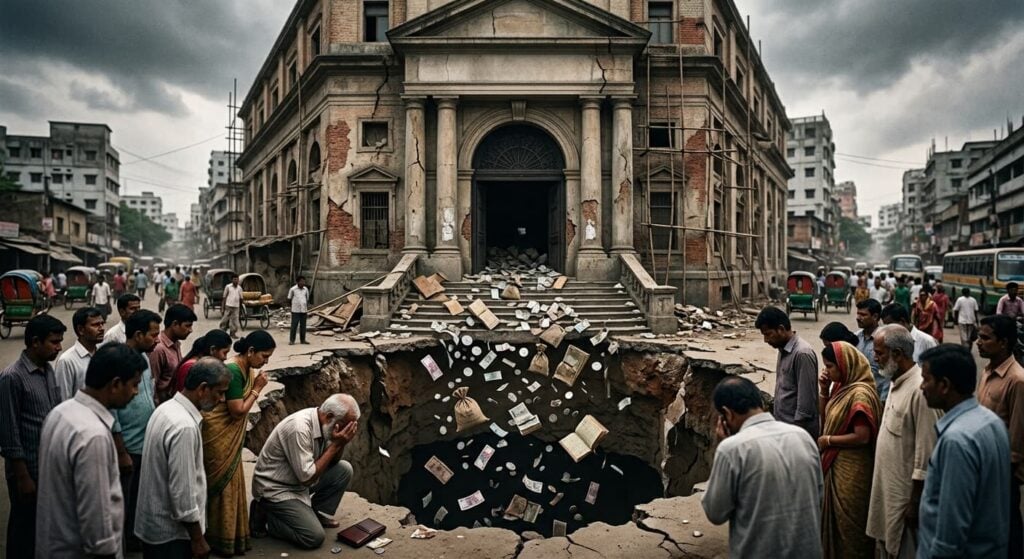
Bangladesh’s banking sector is facing mounting financial pressure, with the combined capital shortfall of 21 banks reaching nearly Tk2.94 lakh crore in March 2026, according to Bangladesh Bank data.
The figure was around Tk2.74 lakh crore at the end of December 2025, meaning the deficit increased by roughly Tk20,000 crore in just three months. The deterioration has occurred alongside a sharp rise in non-performing loans and the resulting increase in provisioning requirements.
When banks with capital surpluses are taken into account, the overall net capital shortfall across the country’s 61 banks stood at Tk2.39 lakh crore in March. This was about Tk22,000 crore higher than the Tk2.17 lakh crore recorded in December.
Bankers and economists have attributed the worsening position largely to the continued rise in defaulted loans. They say persistent capital deficiencies indicate that a significant part of the banking sector remains financially weak.
Syed Mahbubur Rahman, managing director and chief executive officer of Mutual Trust Bank, said the rise in defaulted loans directly increases pressure on banks’ capital. Banks must maintain provisions against loans that may not be recovered, which reduces profits. Continued losses can then further widen the capital deficit.
Provision shortfall adds to pressure
The banking sector’s provision position has also deteriorated. Bangladesh Bank data show that the provision shortfall stood at Tk2,05,665 crore in March, compared with Tk1,98,260 crore at the end of December 2025. By June, the shortfall had risen further to Tk2,22,357 crore.
Provisioning is intended to ensure that banks have funds available to absorb potential losses from loans that may not be recovered. For regular or performing loans, banks generally need to maintain provisions of around 1% to 2%. For classified loans, however, the requirement can rise to as much as 100%, depending on the classification.
The mechanism is designed to protect depositors and strengthen banks’ ability to withstand financial shocks. Yet when defaulted loans rise sharply, banks have to allocate increasingly large amounts towards provisions. That reduces the resources available as profit and puts additional pressure on capital.
Total defaulted loans stood at Tk5,88,704 crore in March 2026, equivalent to 32.26% of total outstanding loans.
Bankers and economists say the deterioration in the banking sector’s capital position has developed over several years. Aggressive lending, weak supervision and loan approvals influenced by political considerations have been cited among the factors contributing to the accumulation of problem loans.
The government is also allocating substantial resources to support weaker banks. Finance Minister Amir Khosru Mahmud Chowdhury recently told Parliament that the government was spending around Tk40,000 crore in the current financial year to recapitalise weak banks as part of broader efforts to restore discipline and stability to the financial sector.
Capital weakness poses wider risks
The effects of inadequate capital can extend beyond the banks directly affected. Zahid Hussain, former lead economist at the World Bank’s Dhaka office, said capital shortfalls could have two major consequences for the banking sector.
The first is a loss of depositor confidence. Adequate capital provides banks with a buffer against losses and helps protect depositors’ interests. When capital becomes negative or significantly inadequate, concerns about a bank’s ability to withstand financial shocks can increase.
The second concern relates to foreign financing. Financially stronger banks could also face pressure if overseas lenders and creditors become more cautious about extending credit to institutions in Bangladesh because of concerns about the broader banking sector.
Zahid said a capital shortfall affecting one or two banks could potentially be managed. However, when 20 or 21 of the country’s 61 banks remain in deficit for a prolonged period, it points to a broader weakness across the sector.
CRAR moves further into negative territory
Another indicator of the sector’s financial health is the capital-to-risk-weighted assets ratio, or CRAR. Bangladesh Bank data show that the banking sector’s CRAR fell to negative 3.17% at the end of March, from negative 2.64% in December.
International regulatory standards require banks to maintain a minimum CRAR of 12.5%. The gap between that requirement and Bangladesh’s sector-wide position underlines the severity of the capital pressure.
Bangladesh Bank’s Financial Stability Report 2025 showed that Pakistan’s banking sector had a CRAR of nearly 21% at the end of 2025, while Sri Lanka’s exceeded 19%. Indian banks had an average CRAR of 17.20%.
Md Touhidul Alam Khan, managing director and chief executive officer of NRBC Bank, said failure to maintain the required regulatory capital, particularly CRAR, could create serious regulatory, financial and operational consequences.
These consequences could include restrictions on dividend payments and incentive bonuses, weaker credit ratings, declining depositor confidence, greater solvency and funding risks, and higher business costs, particularly in trade finance. Higher provisioning requirements could also put further pressure on profitability.
Touhidul said inadequate capital could restrict a bank’s lending capacity and reduce its ability to absorb losses.
First Security Islami Bank has largest deficit
First Security Islami Bank recorded the largest capital deficit among the country’s banks in March 2026, at Tk66,264.80 crore.
Bangladesh Krishi Bank ranked second, with a deficit of Tk31,687.17 crore, while Social Islami Bank reported a shortfall of Tk30,936.67 crore.
Among other major institutions with large deficits, Union Bank had a capital shortfall of Tk30,594.56 crore, while Exim Bank’s deficit stood at Tk30,302.23 crore. Janata Bank reported a shortfall of Tk18,354.90 crore and Global Islami Bank Tk16,297.61 crore.
National Bank’s deficit stood at Tk11,984.98 crore, followed by AB Bank at Tk8,487.59 crore and Agrani Bank at Tk8,234.92 crore.
The figures point to a banking sector under considerable financial strain, with high defaulted loans, large provision requirements and inadequate capital reinforcing one another. Recapitalisation may provide temporary support to weaker institutions, but the longer-term health of the sector will depend on improving loan recovery, strengthening supervision and preventing the build-up of new problem loans.