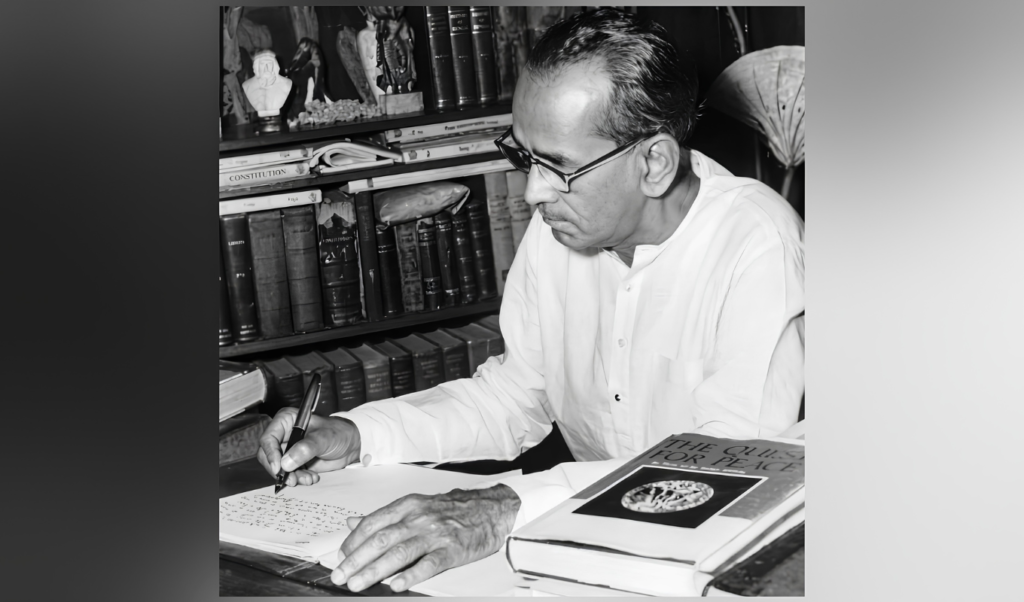
Tarasankar Bandyopadhyay shines as a luminary in the realm of Bengali literature. With extraordinary narrative power, he brought to life the red soil of Birbhum, the heartbeat of rural Bengal, the joys, sorrows, love, struggles, dreams, and social transformations of its people. His literary oeuvre remains an authentic testament to an era undergoing profound transition.
He was far more than a distinguished novelist and short-story writer; he was a socially conscious intellectual actively engaged in the political discourse of his time.
Early Life and Political Engagement
Born on 23 July 1898 into a zemindari family in Labhpur village, Birbhum district, West Bengal, Tarasankar lost his father at an early age. His childhood and adolescence were spent under the affectionate care of his mother and widowed aunt.
After passing his Entrance examination from the local Jadablal High School in 1916, he enrolled in the IA program at St. Xavier’s College, Calcutta. However, India was then caught in the fervour of the anti-colonial freedom movement. Drawn to Mahatma Gandhi’s Non-Cooperation Movement, young Tarasankar actively joined the political struggle. His political activities led to a one-year house arrest in 1921, effectively bringing his formal academic career to an abrupt end.
Undeterred, he aligned himself deeply with the Indian National Congress, participating actively in the Civil Disobedience Movement, which resulted in a year-long imprisonment in 1930. While politics marked an important chapter in his early adulthood, literature ultimately became his lifelong vocation.
After spending some time in his native village following his release from prison, he settled permanently in Calcutta in 1940 to dedicate himself entirely to literary pursuits. Over the years, his varied professional life included managing a coal business in Calcutta and working in Kanpur, all while maintaining an unshakeable connection to the grassroots. He was elected President of the local Union Board and later served as an elected member of the West Bengal Legislative Council for eight years. In 1970, he was elected President of the Bangiya Sahitya Parishad.
Literary Emergence and Vision
Although he initially experimented with poetry, Tarasankar forged his true identity as a prose writer. His debut short story, Raskali, appeared in the renowned literary magazine Kallol. Subsequently, his works were regularly featured in leading periodicals of the era, including Kalikalam, Bangasree, Shanibarer Chithi, Prabasi, and Parichay.
The greatest strength of Tarasankar’s literary vision lay in his deep empathy and keen observation of human life. He did not observe society from a distant ivory tower; he immersed himself in the inner worlds of his subjects, capturing their laughter, tears, ambitions, resentments, failures, loves, rebellions, and inherent dignity.
The soil and people of the Birbhum-Burdwan region formed the primary tapestry of his fiction. The complex multi-tiered rural society, the freedom movement, war, famine, economic inequality, the decay of feudalism, the rise of the new mercantile class, and the expansion of industry and commerce—all found powerful artistic expression in his works.
Having been born into a landlord family, Tarasankar witnessed the gradual decline of the zemindari system firsthand. He observed the fracturing of traditional rural structures and the emergence of new socio-economic forces. The dual tension between rural decay and urban-industrial expansion became a recurring motif across his novels.
The Artist of Human Dignity
Tarasankar’s literature offers more than a chronicle of social history; it is a profound exploration of the human psyche. He portrayed the complexities, instincts, internal conflicts, passions, greed, self-respect, and rebelliousness of human nature with remarkable compassion.
A defining hallmark of his writing was his ability to discover extraordinary human grandeur within ordinary, marginalized lives. Snake charmers, scroll painters, florists, lathi-wielders, night watchmen, boatmen, and marginalized communities—traditionally overlooked by society—were accorded profound dignity in his narratives. His characters are never mere literary tropes; they embody living history, social reality, and universal human truths.
Following Sarat Chandra Chattopadhyay, Tarasankar Bandyopadhyay emerged as one of the most widely read and celebrated authors in Bengali literature. His works function simultaneously as historical records, social mirrors, and artistic reflections of the human soul.
Notable Works
Tarasankar authored nearly two hundred books during his prolific career. Among his most celebrated novels and literary works are:
-
Chaitali Ghurni
-
Dhatridevta
-
Kalindi
-
Ganadevata
-
Panchagram
-
Kobi
-
Hansuli Banker Upakatha
-
Arogya Niketan
-
Jalsaghar
He also achieved exceptional mastery in the short story format. Masterpieces such as Raskali, Bedeni, and Dak-Harkara hold a permanent place in Bengali literature. A comprehensive collection of his short stories was published in three volumes by Sahitya Samsad.
Furthermore, several of his iconic works—including Dui Purush, Kalindi, Arogya Niketan, Jalsaghar, Hansuli Banker Upakatha, and Ganadevata—were adapted into landmark films, extending his narrative legacy from the printed page to the visual arts.
Accolades and Recognition
In recognition of his immense contribution to literature, Tarasankar was honoured with numerous prestigious awards, including:
-
Sarat Smriti Puraskar, Calcutta University (1947)
-
Jagattarini Gold Medal (1956)
-
Rabindra Puraskar
-
Sahitya Akademi Award
-
Jnanpith Award
The Government of India also conferred upon him the national honours of Padma Shri and Padma Bhushan.
While awards brought national prestige, Tarasankar’s greatest achievement remained his enduring place in the hearts of his readers. Through the medium of words, he immortalised the red-dust roads of Birbhum, the pulse of rural life, underlying social conflicts, and the unyielding human struggle for survival. He carved out a distinct geography, ethos, and philosophy within Bengali literature.
Enduring Legacy
Tarasankar Bandyopadhyay passed away on 14 September 1971.
Yet, a true artist never truly dies. People depart, eras shift, and societies evolve, but genuine artistic creations endure deep within collective memory and consciousness. Tarasankar Bandyopadhyay remains far more than a departed classic novelist; he is an indelible chapter of Bengali literary heritage and an eternal narrator of the soil and its people.