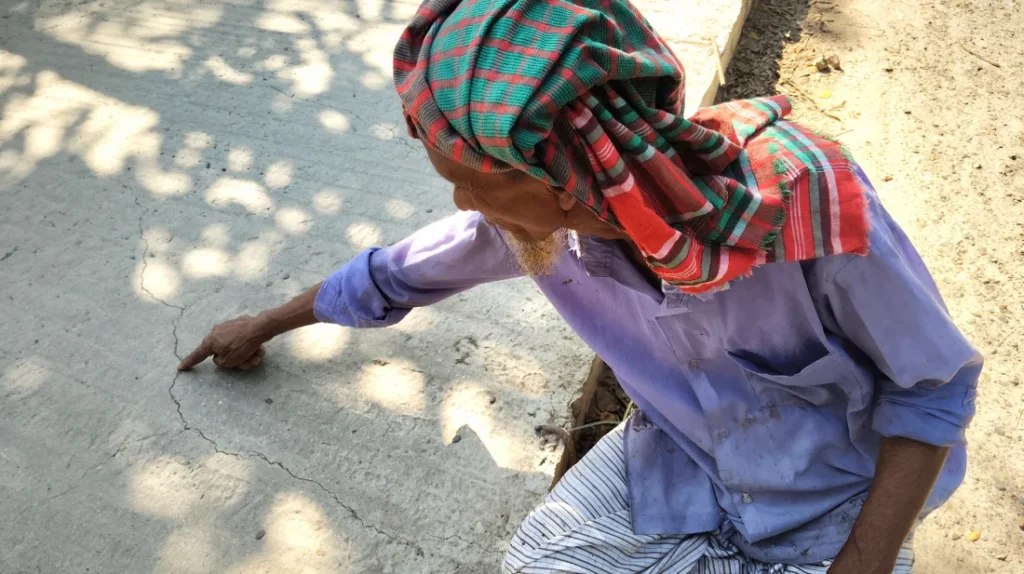
A key infrastructure project intended to bring relief to thousands of commuters in Rajshahi has instead sparked public outrage. Cracks have begun appearing along newly laid reinforced concrete sections of the Baya-Kashim Bazar-Tanore highway just weeks after pouring, raising urgent concerns over construction standards and oversight.
The stretch, spanning over nine kilometres across Poba and Tanore upazilas, is undergoing a major overhaul under the “Baya-Kashim Bazar-Tanore Road Rehabilitation (Widening and Strengthening)” project. Executed by the Local Government Engineering Department (LGED), the scheme carries a contract value of nearly Taka 14 crore. Work officially commenced on 9 May, with a scheduled completion deadline set for 12 March 2027.
A site visit on Thursday, 17 September, revealed visible fissures along an estimated half-kilometre stretch of concrete casting in the Baksara-Naodapara area. Sections of the road surface have already subsided under weight, prompting an immediate halt to concrete work in the affected zone while operations continue elsewhere along the route.
Local residents and community leaders have voiced deep skepticism regarding the integrity of the works. Former ward councillor Nazmul Huda Molla observed that ground compaction was severely neglected after initial excavation. He noted that failure to operate heavy rollers properly caused one side of the road to sink and the other to fracture, adding that the concrete mix appeared overly diluted with sand rather than proper aggregate. Other villagers reported that casting was executed directly over uncleaned ground without proper vibration equipment to settle the material, predicting the surface will fail within a year.
Addressing the structural failures, contractor Mohammad Yunus Ali of the firm M/S Jewel Electronics attributed the damage to unstable subsoil and premature traffic load. He explained that newly cast concrete requires at least 28 days of restricted traffic to cure properly. However, due to the corridor’s high traffic volume, heavy vehicles continued using the route uninterrupted. He claimed he had formally raised concerns regarding the poor bearing capacity of the soil prior to construction, but his warnings were unheeded.
Poba Upazila Engineer Mohammad Ali defended the materials used, shifting responsibility onto the underlying “organic soil” of the region. This type of earth loses its structural bearing capacity rapidly upon absorbing moisture, causing the surface above to collapse under load. Heavy rainfall and unmanaged transit traffic exacerbated the structural breakdown.
In response to the early failure, the engineering office has applied for an immediate redesign of the project structure. The proposed modifications involve adding a three-inch plain cement concrete base topped with a 12-inch reinforced concrete surface containing double-layered rebar mats and corner reinforcement bars. LGED project directors have already conducted field inspections to evaluate the revised design requirements.