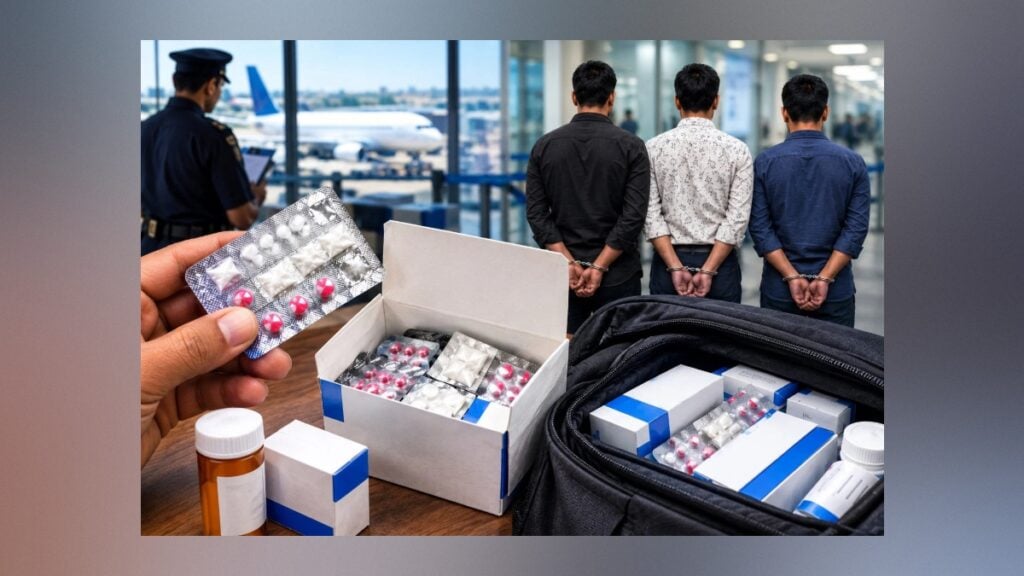
Ordinary Bangladeshi expatriate workers travelling to Saudi Arabia were allegedly being used, without their knowledge, to carry consignments of yaba concealed inside medicine packets. The travellers were reportedly told they were carrying medicines, while the actual contents allegedly included the illegal drug. Once the consignments reached Saudi Arabia, members of an alleged trafficking network were expected to collect them.
Two separate incidents in Shahrashti, Chandpur, have brought the alleged network to the attention of law enforcement authorities. A total of 520 yaba tablets were recovered in the two cases.
Information gathered from police, case documents and audio conversations has pointed to three Shahrashti residents — Arif Hossain, Mahmudul Hasan and Mohin Uddin — as alleged key figures in the network. Arif is currently in Bangladesh, while Mahmudul and Mohin are reportedly in Saudi Arabia.
According to the information obtained during the investigation, members of the group allegedly identified people from their area who were preparing to travel to Saudi Arabia. They would then approach them as acquaintances and ask them to carry small packages of medicines, often explaining that medicines were expensive in Saudi Arabia.
The packages were allegedly prepared by removing medicines from their original packaging and replacing them with yaba tablets. The packets were then sealed in a manner designed to make the contents difficult to detect from the outside.
Those involved in transporting the consignments were allegedly promised about Tk 20,000. However, several travellers reportedly did not receive any payment because they believed they were simply carrying medicines and were unaware of the alleged drugs hidden inside.
160 yaba tablets found in medicine package
Sujon Mia, from Tamta Chhoyal Bari in Shahrashti, travelled to Saudi Arabia on 27 August. Five days before his departure, Mahmudul Hasan, also known as Hasan, contacted him through Facebook Messenger and asked whether he was travelling to Saudi Arabia.
After Sujon confirmed that he was, Mahmudul allegedly asked him to carry some medicines. He reportedly told Suজন that medicines were expensive in Saudi Arabia and asked him to take a package weighing about half a kilogram.
According to police and the case statement, 160 yaba tablets had been concealed inside packets labelled as Phoenix-20 and gastric medicines. The package was allegedly being taken to Sujon by Abdur Razzaq, also known as Anik, and Arif.
Acting on confidential information, police from Shahrashti Police Station conducted an operation on a road west of Munsi Gazi Patowari Bari. Anik was arrested with the yaba, while police said Arif fled during the operation.
A case was filed at Shahrashti Police Station on 25 August by Sub-Inspector Mahbubul Alam. Anik was named as an accused, along with several unidentified individuals.
According to the police station, Anik told investigators during preliminary questioning that the yaba had been concealed in the medicine packets for shipment abroad. He allegedly said that he and his associates were taking the package to Suজন.
Shahrashti Police Station Officer-in-Charge Mir Mahbubur Rahman said Anik had been arrested with 160 yaba tablets and sent to court. He said investigators were examining the alleged involvement of Arif and Mahmudul and had sought Anik’s remand to identify other members of the network.
Earlier attempt involved 360 tablets
An earlier incident involved an alleged attempt to send another 360 yaba tablets to a Saudi-bound expatriate. The package was intercepted on 1 August at Bholdighi Bazar in Shahrashti after local traders became suspicious.
According to the allegations, Runa Akter, the wife of expatriate Arif Hossain, handed a package to Enayet Hossain, director of Hakkani Traders. The package was reportedly intended to reach Rashed, a Saudi-bound resident of Malra village.
Enayet became suspicious after noticing the package’s weight and size. Rather than opening it alone, he called other local traders. The package was then opened in front of them while the process was recorded on video.
Inside were 12 packets labelled as Phoenix-20 and Rabeprazole Sodium. After the medicines had been removed, 30 yaba tablets had allegedly been placed inside each packet, bringing the total to 360.
Police later arrived at the scene and seized the tablets. A man named Belal Hossain was subsequently arrested. Police said Runa went into hiding after the incident.
Enayet said he had suspected something was unusual about the package and therefore called people nearby before opening it. The yaba had allegedly been concealed beneath the medicine packaging in such a way that it was not apparent from the outside.
Rashed, who was supposed to receive the package, said Arif had telephoned him and asked him to carry several medicines. Arif’s wife later took the package to Rashed’s home. He said he had asked her to leave it at a shop in the market rather than at his house.
Rashed said he would not have known that he was allegedly being used to transport yaba had the package not been intercepted. He also raised concerns about the consequences he could have faced had the package been discovered in his possession at the airport.
Alleged network extends to Saudi Arabia
Investigators have reportedly found indications that the alleged operation involved activities both in Bangladesh and Saudi Arabia.
People travelling to Saudi Arabia were allegedly identified in advance and approached through personal contacts or local acquaintances. The request to carry medicines was reportedly presented as a favour, with the explanation that certain medicines cost more in Saudi Arabia.
Once a traveller agreed, associates in Bangladesh allegedly prepared the packages. The original medicines were reportedly removed from their packaging and replaced with yaba before the packets were resealed.
Several expatriates have told investigators that, after the travellers reached Saudi Arabia, one of Arif, Mahmudul or Mohin would allegedly collect the consignments.
Arif is currently in Bangladesh but has previously lived in Saudi Arabia. There are allegations that he had also collected drug consignments from expatriates while he was there. Mahmudul and Mohin are reportedly still in Saudi Arabia and have faced similar allegations.
The alleged roles of the network’s members appear to have extended beyond arranging transportation. According to the information gathered, members allegedly searched for Saudi-bound travellers, arranged for packages to be prepared and delivered in Bangladesh, and received consignments after they reached Saudi Arabia.
Audio recordings raise further allegations
A Saudi-based expatriate, speaking on condition of anonymity, said Mohin contacted him after he returned to Bangladesh in 2024. Mohin allegedly asked him to take some medicines when he travelled back to Saudi Arabia.
The expatriate said he did not take the medicines because he was in a hurry. He later learned of allegations that Saudi-bound people from the area were being used to transport yaba under the guise of carrying medicines.
In an audio recording obtained during the inquiry, Mahmudul’s wife, Nusrat, can allegedly be heard saying that her husband had asked her to inform him if she found anyone travelling to Saudi Arabia. In the same account, Mohin allegedly offered Tk 20,000 for sending a consignment.
Nusrat can also reportedly be heard saying that she had asked her husband to stop such activities. According to the recording, however, a consignment was subsequently sent to Sujon through Anik, who was arrested on the way.
She also reportedly said that many of the people used to transport such consignments were unaware of whether the packages contained medicines or yaba. The issue is particularly serious for expatriate workers who often travel abroad after borrowing money or taking on debt, as a drug-related arrest could have consequences for both the individual and their family.
Several expatriates, speaking without revealing their names, alleged that the network had been using Saudi-bound passengers for some time. They also alleged that members of the group were involved in attempts to bring gold back into Bangladesh and had links to drug trading and other offences in Saudi Arabia. These remain allegations and are subject to investigation.
In another audio conversation, Mahmudul can allegedly be heard saying that he had sold ‘maal’, a term used for yaba, for around six years. He later denied involvement in the recent consignments. He also denied knowing Anik. Although he acknowledged sending Suজন messages through Messenger, he claimed the communication was not related to yaba.
In the same audio, Mohin can allegedly be heard threatening an expatriate over discussions about him with another woman. The context and authenticity of the recording are matters for investigators to establish.
Airport authorities pledge vigilance
Rakib Hasan, an official of the Airport Armed Police Battalion, said specialised teams were working to prevent drug trafficking, human trafficking and other crimes linked to airports.
He also said 4,364 yaba tablets had recently been recovered from a passenger.
‘We remain alert against drugs at all times. If specific information is received about drug trafficking abroad, action will certainly be taken,’ he said.
The cases highlight the risks faced by overseas-bound passengers who accept medicine packets or other items from acquaintances without knowing what they contain. A traveller who unknowingly carries an illegal substance can still face serious legal consequences if the material is discovered during airport screening or after arrival.
Authorities are now investigating the alleged network, including the identities and roles of other people who may have helped prepare or transport the packages. The police investigation will also determine whether the allegations against the named individuals can be substantiated.
Officials from the Ministry of Civil Aviation and Tourism were contacted several times for comment on the matter, but no response was received.