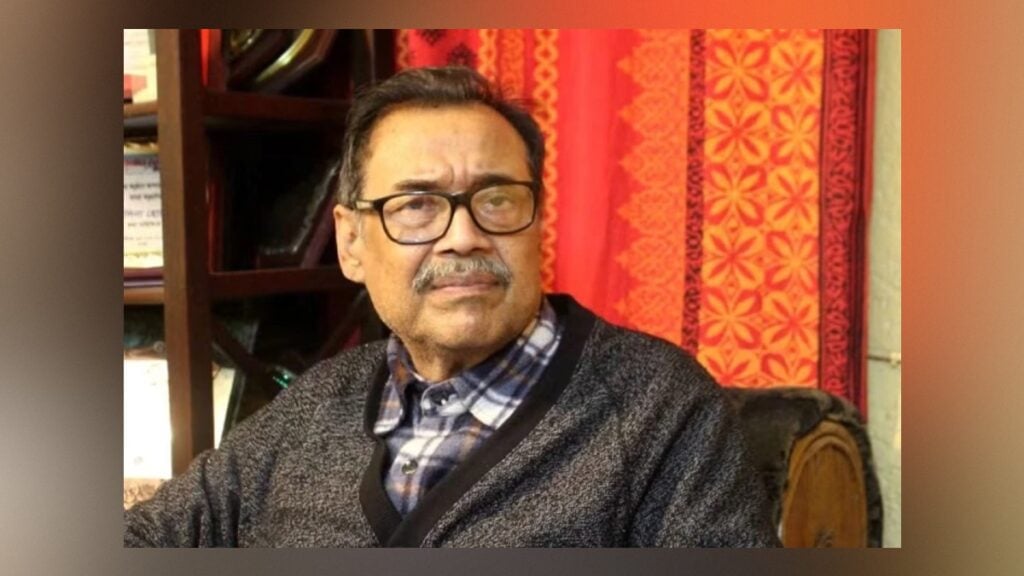
He was the husband of renowned novelist, Ekushey Padak-winning writer and former Bangla Academy president Selina Hossain. His death marks the passing of a figure whose life was closely associated with the student movement, the country’s struggle for independence, public service and educational development.
Anwar Hossain Khan played a significant role at different stages of Bangladesh’s history. His contribution was particularly notable in organising the Liberation War in the southern region, where he helped mobilise freedom fighters and coordinate activities during the 1971 independence struggle.
His first funeral prayer (namaz-e-janaza) was held on Thursday (12 November) morning at the mosque grounds of Shishu Palli in Shyamoli, Dhaka. A second funeral prayer was scheduled to take place later in the afternoon at his family home in Douatala Union, Bamna Upazila, in Barguna district.
Following the prayers, he was due to be buried beside the Liberation War memorial pillar, Chiro Unnoto Shir, situated in front of Halta Douatala Wazed Ali Khan Degree College and Secondary School. The location holds particular significance given his longstanding contribution to the educational development of his home area.
From student politics to the Liberation War
Anwar Hossain Khan began his political and organisational journey through student activism during the period when Bangladesh was still East Pakistan. He was actively involved in movements demanding students’ rights and participated in the wider political struggles against the then Pakistani authorities.
During his time at the University of Dhaka, he served as vice-president of Iqbal Hall, now known as Shaheed Sergeant Zahurul Haque Hall. His involvement in student politics helped shape his organisational experience, which later became particularly important during the country’s struggle for independence.
When the Liberation War began in 1971, he joined the independence movement and became actively involved in organising resistance in southern Bangladesh. He played an important role in mobilising freedom fighters and coordinating organisational activities in the region.
His activities were particularly significant around the headquarters of the Bukabunia sub-sector under Sector 9 of the Liberation War. The sector was one of the operational divisions through which the freedom fighters conducted their campaign against Pakistani forces.
The organisation of local resistance groups, coordination among fighters and the management of wartime activities were essential elements of the independence struggle. Anwar Hossain Khan’s contribution to these efforts established his place among the organisers who worked behind the scenes to advance the liberation movement.
A career in public and cultural institutions
Following independence, Anwar Hossain Khan continued to serve the country through various professional responsibilities. He worked as a director of Bangla Academy, one of Bangladesh’s leading institutions dedicated to the promotion of the Bengali language, literature and cultural heritage.
He also served as general manager of Biman Bangladesh Airlines, the country’s national flag carrier. His professional career therefore extended beyond the cultural sector into the country’s aviation industry.
Before his death, he was serving as managing director of the Faria Lara Foundation. Alongside his professional responsibilities, he remained actively involved in initiatives aimed at improving education and social conditions in his home district.
Lasting contribution to education in Barguna
One of the most significant aspects of Anwar Hossain Khan’s life was his involvement in educational development in Bamna Upazila, Barguna.
He played a leading role in establishing Halta Douatala Wazed Ali Khan Degree College, an institution that has contributed to expanding access to higher education in the area. He was also involved in establishing several primary schools in the locality.
His contribution extended to the development of existing educational institutions. He played an important role in upgrading Halta Douatala Cooperative Junior School into a secondary school, helping create wider educational opportunities for students from the surrounding communities.
In rural areas, access to educational institutions can have a lasting impact on the prospects of younger generations. His involvement in establishing and expanding schools and colleges reflected his commitment to improving opportunities for students in his home region.
His work in education and social development earned him recognition among local residents, particularly those who benefited from the institutions and initiatives he helped establish.
Husband of celebrated novelist Selina Hossain
Anwar Hossain Khan was married to Selina Hossain, one of the most prominent figures in contemporary Bengali literature. Her literary career spans several decades, during which she has explored Bangladesh’s history, society, political struggles and human experiences through fiction.
Among her best-known novels are Hangor Nodi Grenade, Japon Jibon and Gayatri Sandhya. Her novel Hangor Nodi Grenade, in particular, is widely recognised for its portrayal of the Liberation War and the sacrifices made by ordinary people during the country’s struggle for independence.
In recognition of her contribution to Bengali literature, Selina Hossain received the Bangla Academy Literary Award in 1980 and the Ekushey Padak in 2009. She also served as president of Bangla Academy, further strengthening her association with the country’s literary and cultural institutions.
Tributes expected from colleagues and local communities
Anwar Hossain Khan’s death has cast a shadow of mourning among fellow freedom fighters, former student leaders, students and residents of his home area.
His life reflected several dimensions of public service: participation in student movements, organisational involvement in the Liberation War, professional responsibilities in national institutions and sustained efforts to expand educational opportunities in rural communities.
While his role in the independence struggle remains an important part of his legacy, his contribution to education and social development in Bamna is also likely to be remembered by generations of local residents.
His passing brings to an end a life closely connected with Bangladesh’s political history and post-independence development.