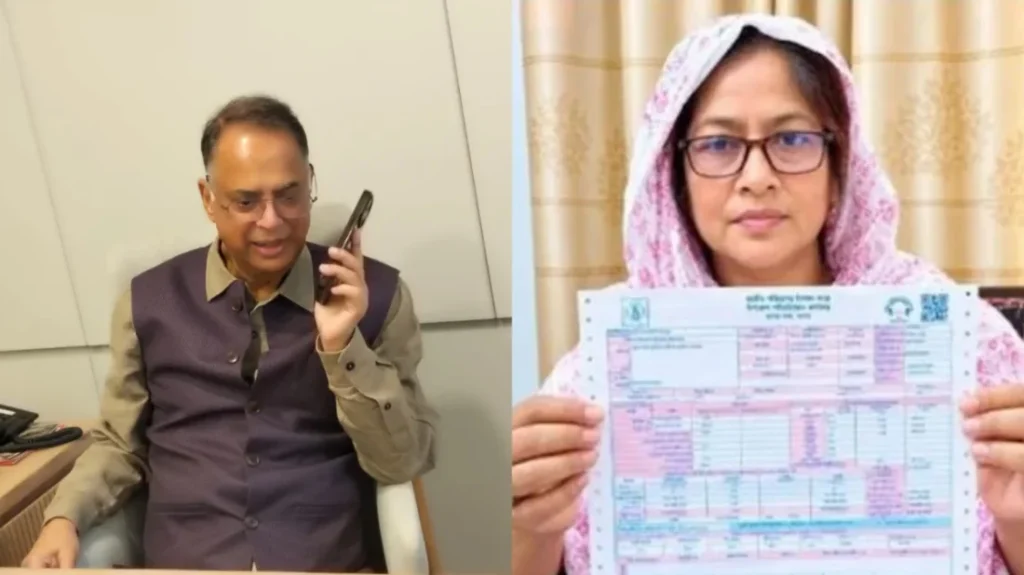
A retired schoolmaster’s family in Magura has been left stunned after receiving a residential electricity bill exceeding ৳506.83 crore for consuming merely 235 units of power in a single month. The extraordinary blunder triggered immediate government action on Wednesday, leading to the summary suspension of the Magura Palli Bidyut General Manager and a personal phone call of apology from the Minister for Power, Energy and Mineral Resources, Iqbal Hasan Mahmud Tuku.
The Ministry of Power, Energy and Mineral Resources confirmed the disciplinary measures and minister’s intervention following widespread outrage.
The phantom bill was issued under the name of Aleya Khatun, wife of retired schoolteacher Shahidul Islam, residing in Kechuadubi village under the Maghi Union of Magura Sadar Upazila. Issued on 10 September with a payment deadline set for 29 September, the document categorised the household under the standard LT-A residential tariff.
Official meter records indicate that on 8 August, the meter reading stood at 160 units, advancing to 395 units by 8 September. The actual household consumption over the month was exactly 235 units, which should have incurred a legitimate charge of ৳1,963, rising to ৳2,056 if paid past the due date.
Instead, the automated statement presented a staggering primary demand charge of ৳482.69 crore alongside normal usage fees. To compound the absurdity, a Value Added Tax (VAT) assessment of ৳24.13 crore and a standard ৳10 meter rent were added to the total, pushing the final payable amount to ৳506,83,11,593. The notice further warned that failure to settle the sum within the deadline would incur a late penalty fee, elevating the total payable amount to an astronomical ৳530,96,59,764.
Expressing her distress over the bureaucratic negligence, Aleya Khatun voiced deep frustration over the ordeal. She described the invoice as not merely a ghost bill, but a bizarre invention that exposed sheer carelessness within the power distribution agency, causing severe mental strain to her household.
The episode highlights long-standing concerns regarding billing irregularities, system inaccuracies, and lack of oversight in rural electrification networks, where administrative oversights often impose unnecessary distress upon ordinary subscribers.