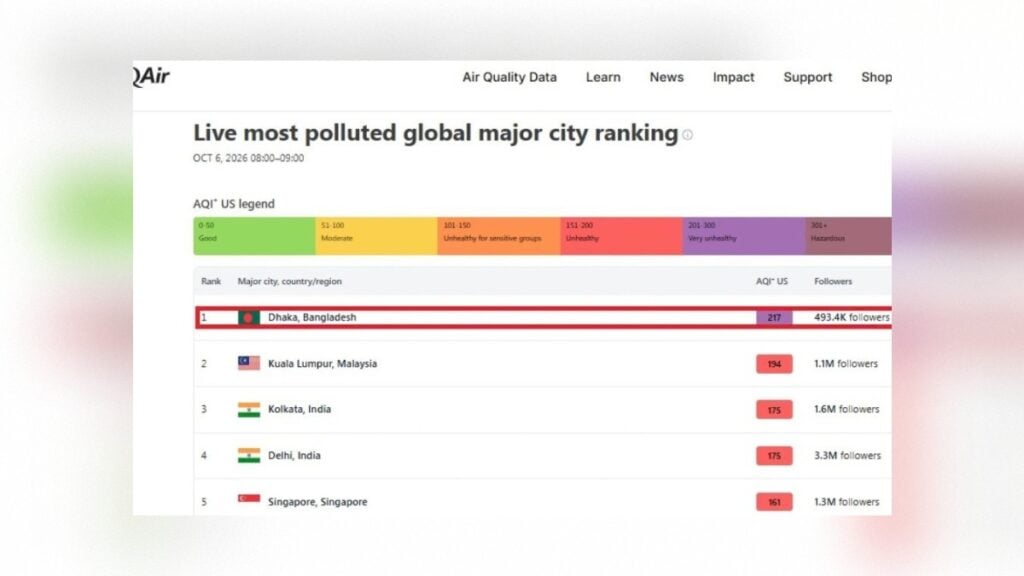
Dhaka has emerged as the world’s most polluted major city in terms of air quality, with the capital recording an Air Quality Index (AQI) score of 217 on Tuesday (6 October). The reading places the city in the ‘very unhealthy’ category, highlighting continuing concerns over the quality of air breathed by millions of residents.
The information was reported by IQAir, the Switzerland-based air quality monitoring organisation, through its global air pollution ranking. The index compares air quality across cities and provides an indication of the potential health risks associated with current pollution levels.
With an AQI score of 217, Dhaka ranked first among the cities included in the global ranking on Tuesday. Kuala Lumpur in Malaysia followed in second place with a score of 194. India’s Kolkata ranked third with 175, while Delhi also recorded 175 and was placed fourth. Singapore occupied fifth position with an AQI score of 161.
Under IQAir’s classification system, an AQI reading between zero and 50 represents ‘good’ air quality. A score from 51 to 100 is considered ‘moderate’ or acceptable. The range from 101 to 150 is classified as ‘unhealthy for sensitive groups’, while 151 to 200 is considered ‘unhealthy’. Readings between 201 and 300 fall into the ‘very unhealthy’ category, while any score above 300 is classified as ‘hazardous’.
Dhaka’s reading of 217 therefore represents a significant level of pollution. Such conditions can be particularly concerning for people who are more vulnerable to polluted air, including children, older people and individuals with respiratory or cardiovascular conditions.
Bangladesh’s AQI assessment takes several major pollutants into consideration. These include particulate matter, particularly PM10 and PM2.5, as well as nitrogen dioxide (NO₂), carbon monoxide (CO), sulphur dioxide (SO₂) and ozone (O₃). Fine particulate matter such as PM2.5 is especially concerning because its small size allows it to penetrate deep into the respiratory system.
Air pollution in Dhaka is driven by a combination of sources. A report published in March 2019 by the Department of Environment and the World Bank identified brick kilns, vehicle emissions and dust from construction sites as three major sources of pollution in the capital.
The city’s rapid urban activity means construction work, road traffic and dust remain persistent features of everyday life. Emissions from vehicles add to the concentration of pollutants in the atmosphere, while dust from construction sites and roads can further deteriorate air quality, particularly when it becomes airborne.
The health consequences of polluted air can be severe. According to the World Health Organization (WHO), exposure to air pollution is associated with a range of serious illnesses, including stroke, heart disease, chronic obstructive pulmonary disease (COPD), lung cancer and acute respiratory infections.
The WHO estimates that air pollution contributes to around seven million deaths worldwide each year. The scale of the health burden has made air quality a major public health issue in many densely populated cities.
For Dhaka, the latest ranking underlines a longstanding environmental challenge. Tackling the problem requires attention to the different sources of pollution, from vehicle emissions and construction dust to emissions associated with brick production. The city’s position at the top of the latest global ranking once again puts the quality of its air under scrutiny and highlights the need for sustained efforts to reduce pollution.